
HR software starts paying back in stages: admin time saved shows up in the first weeks, while retention, hiring speed and review quality take quarters to measure. The honest answer for a 20-100 person company is that the first measurable ROI arrives within the first quarter, and the full case takes 12 months to prove. The number depends on what you track and how fast you finish setup.
- Expect first measurable ROI from HR software in the first quarter, mostly from admin hours saved.
- Retention, time-to-hire and review quality gains take two to four quarters to show up in data.
- Slow setup is the biggest ROI killer: ROI clock starts at adoption, not at signature.
- HRSpace's modular per-employee pricing lets you start with one pain point and expand once it pays back.
Why this matters in 2026
Most HR software purchases get judged at the first renewal. If you cannot name a number by then, the tool gets cut or tolerated. Deciding in advance what you will measure and when is the difference between a defensible line item in 2026 and a subscription nobody can justify.
This page gives you the timeline by type of return, what delays it, and how to set a baseline before you buy. No vendor has a universal payback figure, so none is stated here. Your own pre-purchase baseline is the only number that counts.
How long does it take to see ROI from HR software?
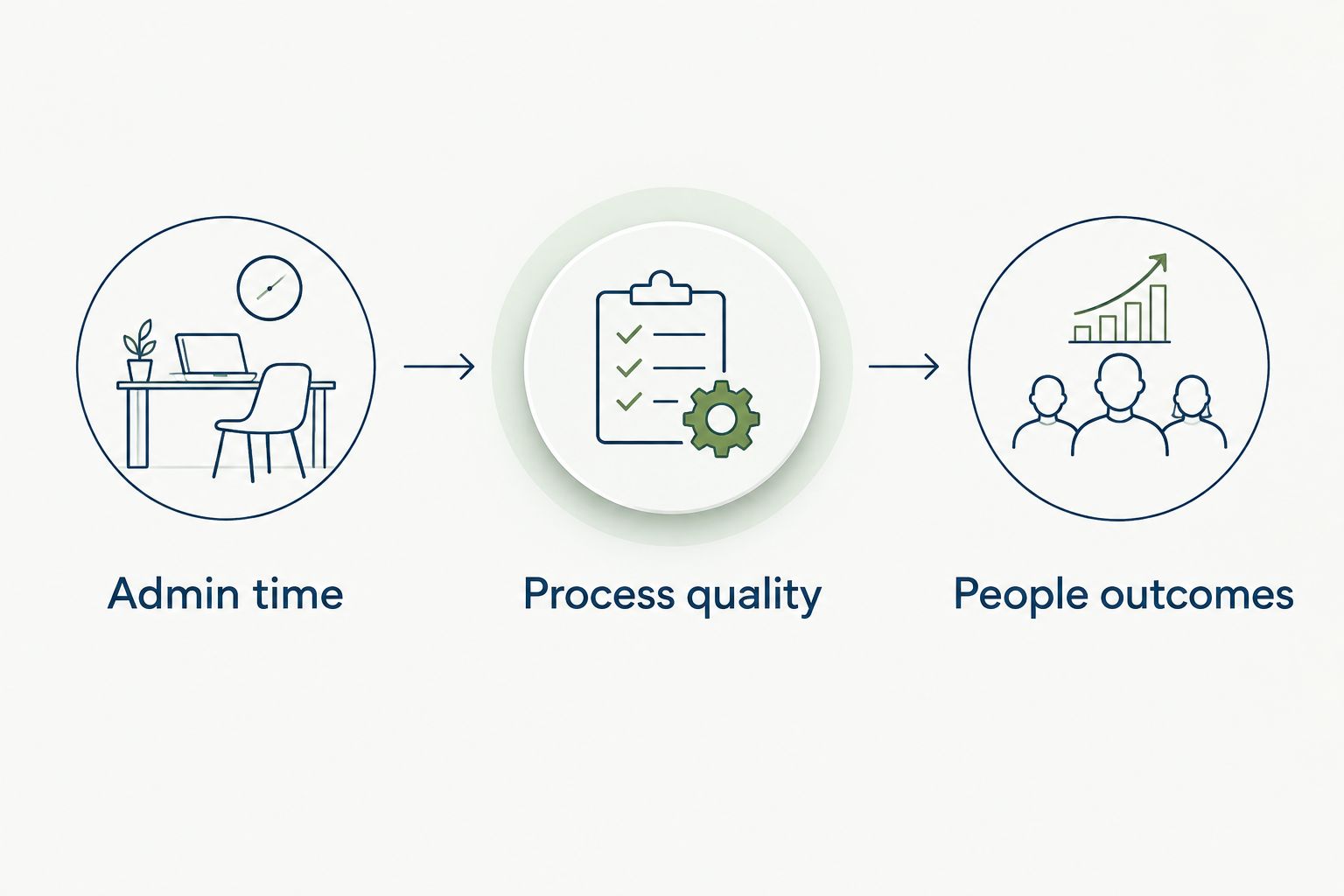
ROI shows up in three waves. Each wave has its own clock, and the clock starts when employees and managers actually use the tool, not when you sign.
| Return type | When it appears | What to measure |
|---|---|---|
| Admin time saved | First weeks after go-live | Hours per week on onboarding paperwork, time-off tracking, status questions |
| Process quality | First one to two quarters | Onboarding completion rate, review completion rate, ticket resolution against targets |
| People outcomes | Two to four quarters and beyond | Retention, time-to-hire, engagement, internal mobility |
The first wave is the fastest because it replaces work that already exists: spreadsheets, email chains, chat requests. The third wave is the biggest but the slowest, and it is the hardest to attribute to software alone. Treat it as upside, not as the basis of your business case.
Wave 1: admin time saved (first weeks)
This is where the quickest return sits. Time-off requests, onboarding paperwork and "quick questions" in chat all cost HR hours every week, and all can be moved into structured workflows.
- Time-off tracking: requests route to managers for approval instead of landing in your inbox. See time-off tracking software options.
- Onboarding paperwork: a checklist replaces the manual chase. See whether HR software can automate onboarding paperwork.
- Employee questions: a self-service portal or service desk turns chat pings into tracked requests with routing rules and SLA targets.
To measure it: log how many hours your team spends on these tasks for two weeks before go-live, then repeat at week four and week eight. The difference, multiplied by your loaded hourly cost, is your first ROI figure.
Wave 2: process quality (one to two quarters)
Once the tool runs on real data, you can see things you could not see in spreadsheets: which onboarding steps stall, which managers skip reviews, which tickets breach their targets.
This wave is about completion and consistency:
- Onboarding tasks finished before day one versus after.
- Review cycles closed on schedule.
- Requests resolved inside the SLA target you set.
These are leading indicators. They do not equal dollars on their own, but they predict the outcomes in wave three. A full cycle (one review round, one hiring push, one onboarding cohort) has to complete before you can compare it to the old way.
Wave 3: people outcomes (two to four quarters and beyond)
Retention, time-to-hire and engagement move slowly and depend on more than software. Be direct with your leadership about that.
- Hiring speed: read whether AI recruitment software can reduce time to hire before you attribute any gain to it.
- Retention: recognition and structured reviews can help, but the effect needs several cycles to show. See whether recognition software improves retention.
Verdict: do not promise wave-three results in your first-year business case. Promise wave one, track wave two, and report wave three as it arrives.
What delays ROI
Why payback timing varies from company to company:
- Setup time. Every week between signature and real usage is a week of cost with no return. Read how long HR software takes to implement and compare vendors on ease of setup.
- Data migration. Messy spreadsheets slow go-live. Plan for it using this guide to migrating from spreadsheets to HR software.
- Scope. Buying modules you do not use inflates cost without adding return.
- Manager adoption. If managers ignore approvals and reviews, the admin load stays with HR.
- No baseline. Without a before-number, any after-number is an opinion.
- Pricing model. Cost per employee scales with headcount, so check the math against your size. See per-employee versus flat-rate pricing.
How to set up an ROI measurement in 2026
- Pick two or three pain points, not ten. Time-off admin, onboarding and employee questions are common starting points.
- Record a baseline for two weeks: hours spent, request counts, completion rates.
- Set a go-live date and a 30, 90 and 180-day review.
- Convert hours to cost using your own loaded hourly rate.
- Compare against the subscription cost for the same period.
Why modular pricing shortens payback
HRSpace is a cloud HR platform priced per employee and sold in modules: onboarding, time-off, performance reviews, goals, recognition, AI recruitment and an internal service desk. For ROI, the point is simple. You can switch on the module that fixes your biggest time drain first, show a result, then add the next one. You are not paying up front for a suite you will use a fraction of.
HRSpace does not publish a guaranteed payback period here, and none should be taken from a vendor page. Run your own baseline instead. For a wider view of the category, see the roundup of best HR software for small business, or start at HRSpace.
Start with one module
Pick the HR task that costs you the most hours and fix that first.
Does faster setup mean faster ROI?
Yes. ROI starts when people use the tool. A platform that is live in days starts returning admin time in days, while a long rollout pushes every wave back by the same amount.
Is ROI different for small teams?
Small teams see wave one faster because a single HR person feels every hour saved. They have less data for wave three, so retention and hiring effects are noisier. Judge small-team ROI on hours saved first.
Which module pays back first?
The one replacing your biggest manual task. For many teams that is time-off tracking, onboarding paperwork or employee request handling, because those repeat every week.
FAQ
How long does it take to see ROI from HR software?
Expect first measurable ROI within the first quarter, mostly from admin hours saved. Retention and hiring gains take two to four quarters to show in your data.
What is the fastest ROI from HR software?
Admin time saved is the fastest. Automating time-off requests, onboarding paperwork and employee questions removes recurring manual work within weeks of go-live.
When does HR software ROI start counting?
ROI starts at adoption, not at signature. Every week between purchase and real use adds cost without return, so implementation speed directly affects payback.
How do I calculate HR software ROI?
Measure hours spent on HR tasks before go-live, measure again after, multiply the difference by your loaded hourly cost, and compare it to the subscription cost for the same period.
Does HR software reduce employee turnover?
It can contribute through better reviews and recognition, but turnover moves slowly and has many causes. Do not base a first-year business case on it.
Is cheaper HR software faster to pay back?
Not automatically. A lower price helps, but a tool that takes months to set up or that managers avoid pays back slower than a pricier one people use immediately.
Can a small business get ROI from HR software?
Yes. Small teams often feel admin savings faster because each saved hour comes from a very small HR team. Start with one module and measure it.
One last thing
Write your baseline down before the demo, not after. The most common reason HR software looks like it failed to pay back is that nobody recorded what the old process cost. Two weeks of hour-logging now gives you the only ROI proof your finance lead will accept at renewal.