
Yes—employee recognition software can support retention when it helps managers acknowledge meaningful work consistently and fairly. It does not fix poor management, unsustainable workloads or stalled careers, and increased recognition activity alone does not prove that fewer employees are leaving.
- Can employee recognition software improve retention? Yes, when recognition supports better management rather than replacing it.
- HRSpace combines employee recognition with broader HR processes; retention impact still requires measurement.
- Track recognition coverage, employee feedback and voluntary departures—not just messages sent.
- Fix workload, management and growth problems alongside your recognition program.
Can employee recognition software improve retention?
Recognition software is a support tool, not a retention guarantee. Its useful contribution is making appreciation a repeatable management practice rather than something that depends entirely on memory or visibility.
For a growing company, the buying question is not whether recognition sounds positive. It is whether the software helps you change a specific practice: acknowledging overlooked contributions, giving useful feedback or making recognition more consistent across teams.
Start with the process before the product. The employee recognition software guide provides a relevant starting point for evaluating the category, but your retention decision needs evidence from your own employees.
| Approach | Best for | Useful contribution | Limitation |
|---|---|---|---|
| Informal manager recognition | Teams establishing basic appreciation habits | Keeps acknowledgment close to the work | Depends on each manager remembering to do it |
| Dedicated recognition software | Teams needing a repeatable recognition process | Gives recognition a defined place in everyday work | Adds another process employees must adopt |
| Recognition within an HR platform | Teams assessing recognition alongside employee lifecycle processes | Keeps recognition within the broader HR software scope | Broader scope does not establish a retention benefit |
These approaches are not substitutes for good management. Choose the one that addresses your actual process gap, and assess whether employees experience the recognition as useful.
Why this matters
For companies with 20–100 employees, retention decisions involve people you know, not just a dashboard. A departure can expose a management problem, a workload problem or a mismatch between the job employees expected and the job they have.
Recognition belongs in that diagnosis. It should not dominate it. If employees say their contributions go unnoticed, a better acknowledgment process addresses that complaint; if they say the workload is unmanageable, recognition does not resolve the workload.
For your 2026 retention plan, separate the problem from the proposed tool. Write down what employees need to experience differently before you evaluate features. Otherwise, you risk measuring a successful software rollout instead of a better employee experience.
What recognition software can actually change
Recognition software gives you a place to build a deliberate practice around appreciation. The value depends on how managers and employees use that place, not merely on its existence.
A useful acknowledgment names the contribution and explains why it mattered. Thanking someone for documenting a difficult handoff tells them what you value; generic praise leaves that unclear.
Make contributions specific
Ask managers to connect recognition to observable work. Describe the problem someone solved, the colleague they supported or the responsibility they handled well.
This is a management standard, not a software feature requirement. A platform can hold the acknowledgment, but the person writing it remains responsible for making it meaningful.
Include work that is easy to overlook
Review whether recognition includes the work that keeps the company running: preparation, documentation, support and reliable follow-through. Do not limit appreciation to visible launches or public-facing wins.
Use employee feedback to identify omissions. A recognition program that celebrates only the most visible work does not address employees who already feel overlooked.
Keep appreciation separate from evaluation
Recognition and performance reviews serve different purposes. Appreciation acknowledges a contribution; a review examines responsibilities, results, development needs and expectations.
Keep both useful. Do not turn every acknowledgment into a rating, and do not use a stream of positive messages as a substitute for a difficult performance conversation.
Why retention impact varies
A recognition program's role in retention depends on the problem it addresses and the way you run it. Review these factors before treating recognition software as a retention initiative:
- The underlying complaint. Check whether employees identify missing appreciation, or whether they describe pay, workload, management or career concerns instead.
- Manager practice. Require specific acknowledgment tied to real contributions. Software cannot supply a manager's understanding of someone's work.
- Fairness. Ask whose work receives attention and whose work remains invisible. Evaluate the experience, not just the volume of recognition.
- Employee preference. Ask whether employees want public acknowledgment, private thanks or a different approach. Do not assume everyone wants the same treatment.
- Follow-through. Pair appreciation with action on concerns employees raise. Thanking someone for handling repeated overload is not a workload solution.
- Measurement. Separate adoption, employee experience and departures. Each answers a different question about whether the program is working.
These are evaluation criteria, not promises of improvement. Your 2026 decision should rest on whether the program addresses a real employee concern and whether the evidence supports continuing it.
How to test whether recognition supports retention
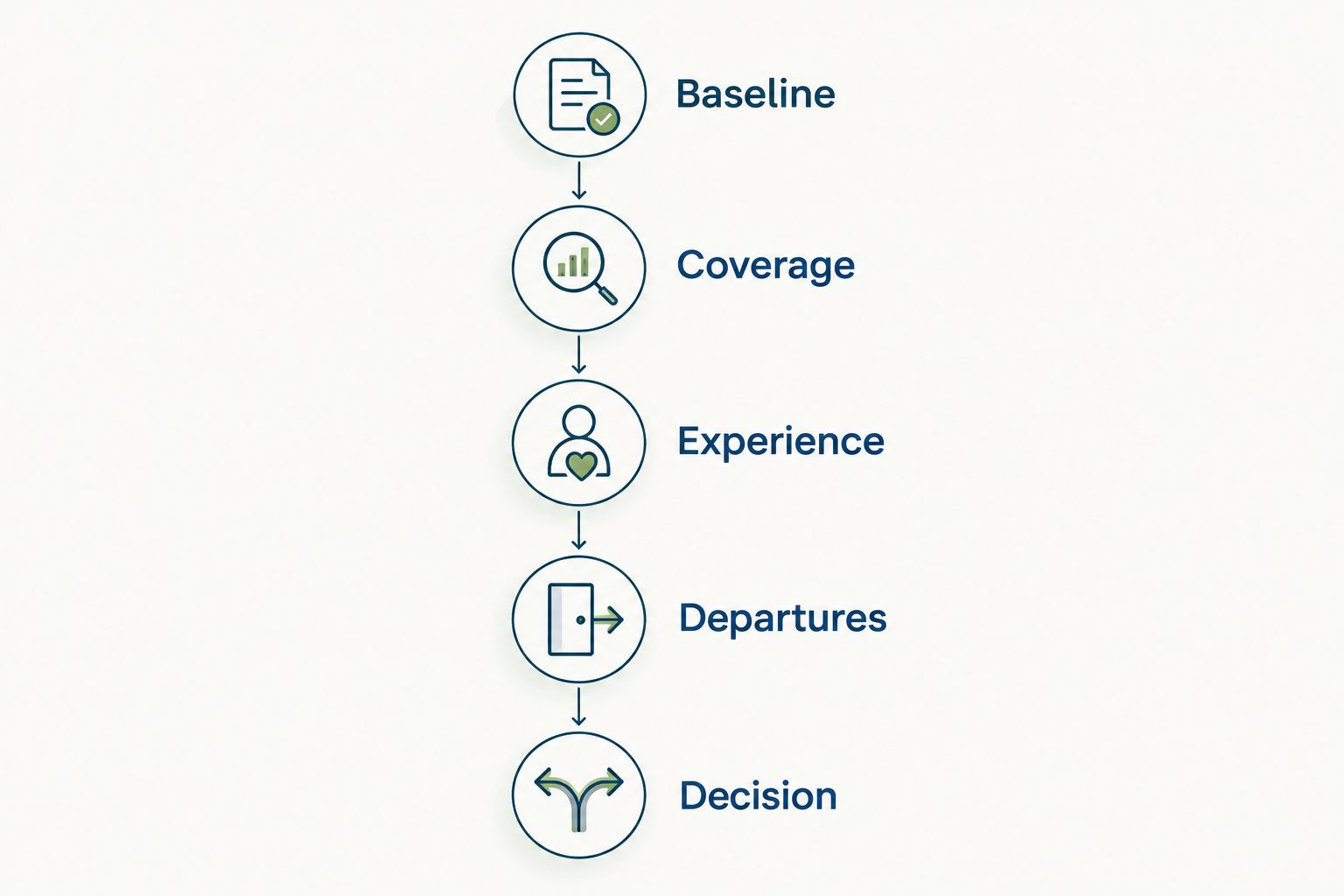
Measure the process, the employee experience and departures separately. Combining them into a single success claim hides the difference between using software and improving retention.
Use the following sequence to make your evaluation clear enough that another leader can inspect the evidence and reach the same conclusion.
1. Baseline
Document your current recognition practice before changing it. Ask employees whether their contributions are acknowledged, whether that acknowledgment feels fair and whether they receive useful feedback from their manager.
Record how you define voluntary departures and which employees belong in the comparison. Keep those definitions stable. Changing the definition halfway through makes the results harder to interpret.
Include the context of the period you are measuring. Hiring, team changes and other HR initiatives belong in the record because recognition is not happening in isolation.
2. Coverage
Check whether the process reaches the intended employees. A busy recognition channel tells you that messages exist; it does not tell you whether acknowledgment reaches across roles and teams.
If your chosen software provides suitable reporting, use it. Otherwise, review the process without assuming that a vendor includes recipient-level analytics or retention reporting.
Treat repeated omissions as a question for managers, not an automatic finding of unfairness. Investigate the work and the employee experience before deciding what needs to change.
3. Experience
Ask employees whether recognition feels specific, sincere and relevant. Use the same core questions before and after the process change so the comparison remains understandable.
Read the comments alongside the responses. An employee can appreciate a thank-you while still reporting that their manager ignores workload concerns. Those answers are not contradictory.
Check whether employees feel pressured to participate. A program should make acknowledgment easier, not turn appreciation into another obligation with little connection to their work.
4. Departures
Track voluntary departures using the definition you established at the start. Review exit feedback and other employee feedback together rather than assuming that every departure reflects the same problem.
Do not treat a quieter period as proof of causation. Changes in leadership, compensation, staffing or job responsibilities can complicate the comparison.
For smaller teams, examine the reasons behind individual departures as well as the overall pattern. Keep personal information appropriately restricted, and report only what decision-makers need to understand the findings.
5. Decision
Decide whether the program addresses the original problem. Better participation supports an adoption finding; better employee feedback supports an experience finding. Neither automatically establishes a retention result.
For your 2026 review, report those findings separately. Continue, change or stop the program based on what you can demonstrate—not on the outcome you hoped to see.
What should you ask during a software demo?
Ask the vendor to demonstrate the recognition process your employees would actually use. A feature list is not enough to judge whether the workflow fits your team.
Give the vendor a realistic scenario: a manager wants to acknowledge a contribution, an employee prefers private appreciation, and HR wants to review whether the process reaches the whole team. Ask which parts the product supports and which require manual work.
Check the following before making your 2026 shortlist:
- Employee effort: What does someone need to do to give or receive recognition?
- Manager effort: How does the process fit into existing feedback habits?
- Visibility: Who can see an acknowledgment, and what choices exist?
- Reporting: Which adoption or coverage questions can the product actually answer?
- Administration: Who owns setup, changes and ongoing support?
- Scope: Which capabilities are included in the modules you are considering?
Do not assume that recognition software includes rewards, automated triggers, payroll connections or retention analytics. Ask for a demonstration of every capability your decision depends on.
For a team of 20 employees, assess who will maintain the process alongside their existing responsibilities. For a team of 100 employees, inspect how you will review participation across managers and teams. These are operating questions, not promised performance thresholds.
Where HRSpace fits
HRSpace is best for growing HR and People Operations teams evaluating recognition within a modular HR platform. HRSpace includes employee recognition alongside onboarding, time-off, performance reviews, goals, recruitment, workflow automation and an internal service desk.
The relevant advantage is scope: you can evaluate recognition as part of the employee lifecycle rather than as an isolated purchase. The platform uses modular, per-employee pricing; confirm the module scope and terms that apply to your requirements.
The limitation is equally important. Platform breadth is not proof that recognition reduces departures. Evaluate the recognition workflow directly, and do not assume that separate modules automatically exchange data or trigger actions without confirming those capabilities.
If recruiting or HR workflows are also part of your project, assess them separately. Keep the recognition decision focused on acknowledgment, employee experience and the management practices you intend to change.
Can recognition replace a retention strategy?
No—recognition is one management practice, not a complete retention strategy. Employees still need clear expectations, workable responsibilities and a credible response when they raise concerns.
Use recognition to acknowledge contributions. Use management conversations and operational decisions to address the conditions surrounding those contributions. A thank-you and a workload adjustment do different jobs.
How long should you measure the results?
Use an ongoing measurement period rather than treating launch activity as a retention result. Choose checkpoints that fit your existing HR review schedule, and keep definitions consistent between them.
If you already use 90-day reviews, include a recognition-experience check at that checkpoint. That is an opportunity to collect feedback, not a claim that retention impact appears within 90 days.
What if recognition increases but employees still leave?
Increased recognition and continued departures can coexist. Review whether appreciation improved while the reasons employees leave remained unresolved.
Do not respond by simply asking for more recognition messages. Return to employee and exit feedback, identify the unresolved concerns, and assign actions to the people who can address them.
FAQ
Can employee recognition software improve retention?
Employee recognition software can support retention when it strengthens meaningful, fair acknowledgment. Software adoption or increased message volume alone does not prove that fewer employees are leaving.
Is recognition software enough to stop employees leaving?
No, recognition software is not a complete retention strategy. It does not resolve workload, compensation, management or career concerns by itself.
What's the best way to measure a recognition program?
Measure recognition coverage, employee experience and voluntary departures separately. Keep definitions consistent and consider other workplace changes before attributing a retention result to recognition.
Should employee recognition always be public?
No, recognition should respect employee preferences. Ask employees how they want contributions acknowledged and verify which visibility choices your chosen software supports.
Is recognition software useful for a small company?
Recognition software is useful when it addresses a defined process gap, such as inconsistent acknowledgment. A small company should establish the management practice before deciding whether software is necessary.
Does HRSpace include employee recognition?
Yes, HRSpace includes employee recognition within its modular cloud HR platform. Evaluate the recognition workflow and module scope against your team's requirements rather than assuming a retention outcome.
What should an employee recognition plan include in 2026?
A 2026 employee recognition plan should define meaningful acknowledgment, employee preferences, ownership and measurement. It should also explain how managers will act on concerns that appreciation alone cannot resolve.
One last thing
A rise in recognition messages is evidence of activity, not evidence of retention. Before approving the program, write the sentence you expect to use when reporting its results.
If that sentence claims reduced turnover, define the evidence needed to support it. If your evidence only shows that employees feel better acknowledged, report that result accurately. A narrower, defensible finding is more useful than a larger claim you cannot prove.