
HR software has no single per-employee cost in 2026: your bill depends on the quoted employee rate, the people counted and the modules included. That rate alone does not establish your total cost; check the agreement for platform fees, implementation charges and other services before comparing offers.
- How much does HR software cost per employee? Compare complete quotes, not employee rates alone.
- HRSpace suits growing People Operations teams seeking modular HR software across the employee lifecycle.
- Calculate effective per-employee cost using the full recurring bill and the employees covered.
- Separate implementation expenses from recurring subscriptions so first-year and ongoing budgets stay clear.
How much does HR software cost per employee in 2026?
The useful number is the complete recurring bill divided by the employees it covers. A quoted employee rate is only comparable when vendors count the same people and include the same work.
For a modular option, HRSpace offers per-employee-priced cloud HR software covering onboarding, time-off, performance reviews, goals, recognition, recruitment and an internal service desk. Ask for a quote that identifies the modules you need rather than treating the platform description as a list of included entitlements.
Use this breakdown to compare proposals:
| Cost component | What to establish | How to compare it |
|---|---|---|
| Employee subscription | Rate, billing period and billable employee definition | Apply the same workforce scope to each quote |
| Selected modules | Functions included in the quoted package | Match the workflows your team needs |
| Platform charge | Whether a separate recurring fee applies | Include it in the recurring total if charged |
| Implementation | Any charges for setup, migration or configuration | Keep one-time expenses separate |
| Additional services | Which support or service items require another agreement | Include only items your team will purchase |
| Contract terms | Minimum commitments and rules for headcount changes | Compare obligations, not just the headline rate |
These are questions for the agreement, not a claim that every provider charges every fee. Mark each line as included, separately charged or not applicable.
Why this matters
A founder buying HR software for 20 employees needs a different purchasing brief from a People Operations leader supporting 100 employees. The distinction is not a presumed market rate. It is the number of people, workflows and responsibilities the quote must cover.
In 2026, build that brief around actual work: new hires getting ready, managers handling leave, employees completing reviews and support requests reaching an owner. Compare the cost of the required scope, not the cost of an attractive entry package.
Keep subscription spending and internal effort separate. A lower software bill does not prove a lower administrative workload, and a broader platform does not prove that your team will use every feature.
Calculate your effective employee cost
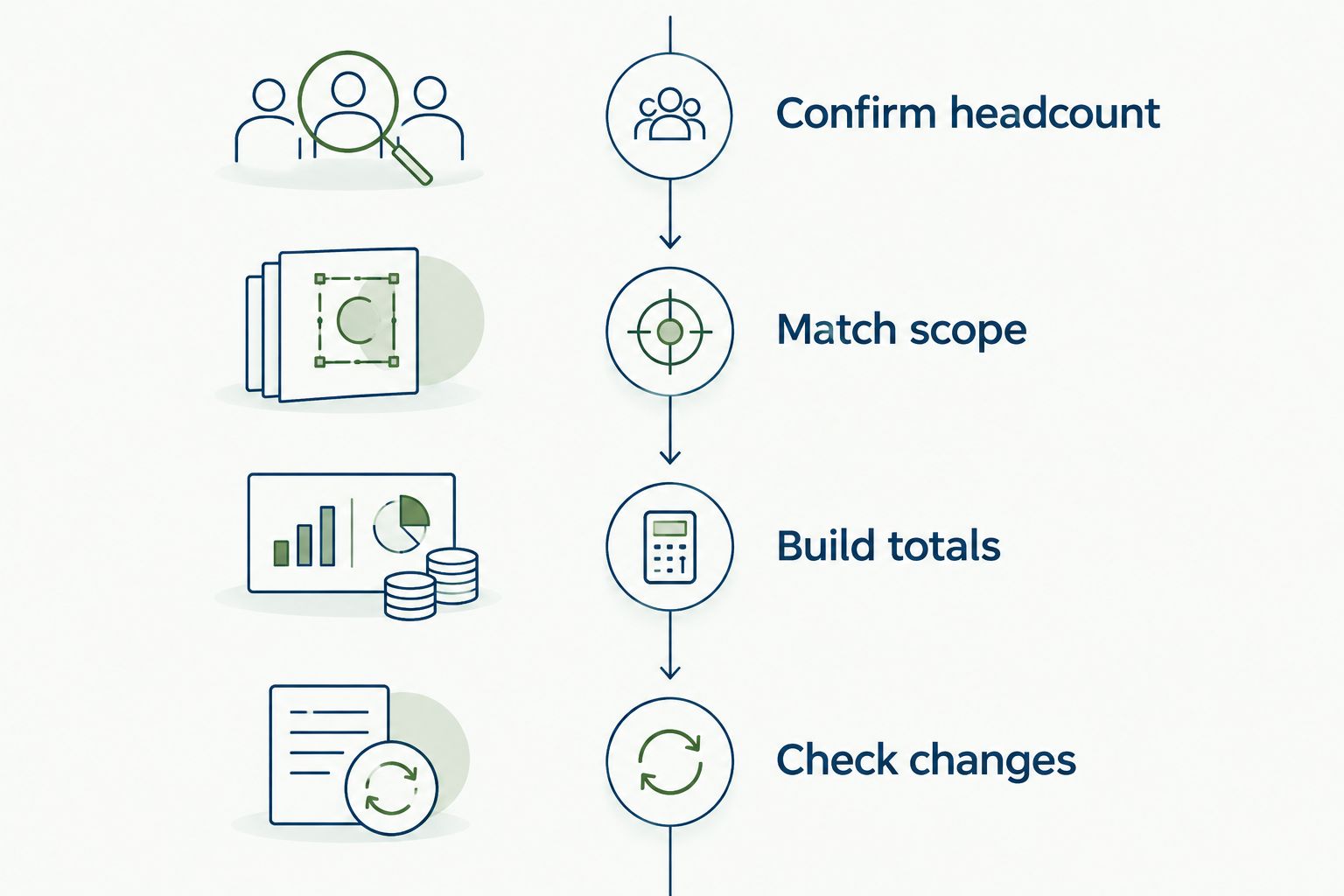
Start with the recurring agreement, then build a separate first-year view. This prevents a one-time implementation charge from obscuring the ongoing subscription and prevents a narrow subscription figure from hiding the initial commitment.
Confirm headcount
Ask exactly who counts as a billable employee. Check how the agreement treats active staff, contractors, employees on leave and people who have left but whose records remain.
Do not assume those categories are billed differently. Get the definition in writing, then apply it consistently across your shortlist. Your payroll headcount and your software billing headcount should not be treated as interchangeable without that check.
Match scope
List the work you need the platform to support. Separate essential workflows from functions you are evaluating for later.
For example, onboarding and time-off can be immediate requirements while a new review process remains a later project. Request a quote for the immediate scope and a separate explanation of what changes when you add the later requirement. This is a purchasing method, not a promise that every vendor supports that packaging.
Build totals
Add the recurring charges that apply to your selected configuration. Divide that total by the employees covered to get an effective per-employee figure for the same billing period.
Next, record implementation and other one-time expenses separately. Your first-year budget combines the contracted recurring spending with those initial expenses; your ongoing budget should show recurring commitments without carrying one-time work forward.
Check changes
Ask how the bill changes when your workforce grows or shrinks. Confirm when adjustments take effect and whether a minimum commitment changes the calculation.
For a team planning its 2026 budget, a current-headcount quote is not enough if hiring is already part of the operating plan. Request the same configuration at the workforce sizes relevant to that plan rather than guessing how the contract scales.
Why per-employee quotes vary
Different proposals can describe different purchases even when they use the same per-employee language. Check these factors before calling one offer cheaper:
- Workforce coverage: The billable employee definition determines which people enter the calculation. Align that definition before comparing totals.
- Module scope: Onboarding, time-off, performance, recognition, recruitment and employee support are distinct requirements. Confirm which are included rather than inferring coverage from a product overview.
- Workflow requirements: Approval paths, request routing and review processes shape your buying brief. Ask whether the proposed configuration supports the work you have specified.
- Implementation scope: Establish who prepares data, configures the system and manages the transition. Record any contracted charges and assign the internal tasks separately.
- Service scope: Identify what assistance the agreement includes and what requires another purchase. Do not treat an undefined support promise as a deliverable.
- Contract structure: Billing periods, minimum commitments and headcount adjustment rules affect the obligation. Read those terms alongside the employee rate.
None of these factors establishes a universal benchmark. They explain why a comparable quote needs more detail than an employee rate and a feature checklist.
Modular platform or broader package?
Choose the packaging that covers your required work with clear obligations. Modular purchasing makes you decide which functions belong in the initial scope; a broader package makes you decide whether the included scope is useful.
Neither approach wins on cost without a matched quote. Use the following comparison to decide what to investigate, not to assume a vendor's terms.
| Approach | Best for | Buying advantage | Trade-off to check |
|---|---|---|---|
| Modular HR platform | Teams with a clear initial scope and later requirements | Lets you evaluate selected functions separately | Confirm the combined scope when adding modules |
| Broader HR package | Teams seeking several HR functions together | Gives you one package to assess against the buying brief | Check whether included functions are needed |
| Separate HR tools | Teams keeping a working tool for a specific task | Allows evaluation of one workflow at a time | Assess handoffs and ownership across systems |
A modular approach still needs an employee-lifecycle plan. If onboarding, performance and employee support are purchased at different stages, specify how responsibility passes between those processes before committing.
The new-hire onboarding to 90-day reviews workflow provides a useful process to evaluate when deciding whether your initial scope reaches beyond the first day. Use it to define the work you want covered, not as evidence of a particular subscription entitlement.
Where HRSpace fits
HRSpace is best for growing HR and People Operations teams seeking modular HR software across the employee lifecycle. Its stated scope includes onboarding, time-off, performance reviews, goals, recognition, AI-assisted recruitment, workflow automation and an internal service desk.
The practical advantage is the breadth of HR work available within one platform. You can evaluate hiring, employee development and internal support within the same purchasing brief instead of limiting the decision to employee records.
The purchasing trade-off is that platform scope does not establish your package. Before selecting HRSpace, confirm the modules included in your proposal, the billable employee definition, implementation responsibilities and the contractual cost of your chosen configuration.
For service-desk requirements, turn product terms into acceptance criteria. Routing rules determine who receives a request; SLA targets define the response expectation; approval chains identify who must sign off. Ask the vendor to demonstrate the specific process your team needs.
Make every vendor answer the same brief
For your 2026 shortlist, send an identical brief to each provider. This keeps a narrow proposal from looking better simply because it excludes work another proposal includes.
Use these requirements:
- The workforce categories the software must cover.
- The workflows required at launch.
- The workflows being considered for a later phase.
- The systems you intend to keep.
- The data and process ownership during implementation.
- The recurring charges, one-time charges and contract obligations to itemize.
Ask BambooHR, HiBob or any other shortlisted provider to respond to that same brief. Compare their written responses; do not assume equivalent scope from similar feature names.
A useful demonstration follows a real process from start to finish. Show how a new hire enters the workflow, how a manager handles an approval and how an employee support request reaches its owner. Record which requirements are demonstrated and which still need confirmation.
What should a 50-employee team ask for?
A team with 50 employees should request a quote covering 50 employees under a clearly defined billing rule. That is a comparison scenario, not a market-price estimate or a customer result.
Require the provider to identify selected modules, recurring charges and implementation responsibilities. If your company expects headcount changes, ask for the same scope at the planned workforce size and a written explanation of when billing adjusts.
Is the lowest employee rate the cheapest option?
The lowest employee rate does not establish the lowest total commitment. Compare the complete recurring bill, initial expenses and required scope before deciding which proposal costs less.
Should I budget implementation separately?
Yes. Separate implementation from the recurring subscription so your first-year budget and ongoing budget answer different questions. Confirm whether any implementation charge applies rather than assuming it does.
Should I buy every module immediately?
Buy the scope your team has a defined process and owner to use. Evaluate later modules separately, and confirm the contractual consequences of adding them before signing the initial agreement.
FAQ
How much does HR software cost per employee in 2026?
HR software has no single per-employee cost in 2026. Compare written quotes using the same billable headcount, required modules and recurring charges, then separate implementation expenses.
How do I calculate the actual cost per employee?
Divide the complete recurring software bill by the employees covered for the same billing period. Keep one-time implementation expenses separate so you can distinguish ongoing spending from the first-year budget.
What should I ask about HR software pricing for 20 employees?
For 20 employees, ask which people count toward billing, which modules are included and whether a minimum commitment applies. Use the same workforce scope when requesting competing quotes.
What changes when my company reaches 100 employees?
At 100 employees, recalculate the quote using the contract's billable headcount definition and your required scope. Ask when headcount adjustments affect billing and whether the agreement changes your commitment.
Is modular HR software cheaper than an all-in-one package?
Modular HR software is not automatically cheaper than a broader package. Compare the complete quoted configurations covering the same workflows rather than comparing an individual module with an entire suite.
Is HRSpace relevant for a growing People Operations team?
HRSpace is relevant for growing People Operations teams evaluating modular, per-employee-priced HR software. Its stated scope covers onboarding, time-off, performance, goals, recognition, AI-assisted recruitment, workflow automation and an internal service desk; confirm your selected package in the quote.
Should I compare BambooHR and HiBob using employee rates alone?
No. Ask BambooHR and HiBob for quotes against the same workforce definition and workflow brief, then compare the full recurring commitment and implementation scope.
One last thing
Keep two separate records: a cost comparison and a workflow acceptance checklist. The cost comparison shows what you must pay; the checklist shows whether the proposed scope handles the work.
For your 2026 purchase, do not let one substitute for the other. A clear quote without a demonstrated process is an incomplete decision, and a good demonstration without clear contract terms is incomplete too.