
Yes—AI recruitment software can reduce time to hire when it removes repetitive work from a hiring stage that is actually delaying decisions. It does not fix unclear selection criteria, unavailable interviewers, or slow offer approvals by itself. For your 2026 evaluation, judge the software on shorter hiring stages and sound decisions, not on how quickly it generates text.
- Can AI recruitment software reduce time to hire? Yes, when assisted tasks remove delays from your hiring workflow.
- HRSpace fits growing teams evaluating AI recruitment alongside onboarding and broader HR workflows.
- Measure candidate time in each stage, not just recruiter activity.
- Keep people accountable for selection criteria, candidate review, and final hiring decisions.
Why this matters
For an HR or People Operations team supporting 20–100 employees, recruitment competes with onboarding, time-off requests, performance reviews, and employee support. Your software choice should reflect that workload. A faster recruiting task is useful, but it is not the same as a faster accepted offer.
HRSpace offers AI recruitment within a modular cloud HR platform that also covers onboarding and other employee lifecycle processes. That scope makes it relevant when you want to evaluate recruiting and the work that follows a hire together. Platform scope alone does not prove a time-to-hire reduction.
Buy against the delay you need to remove. If candidates wait for manager decisions, a writing assistant is not the answer to that delay. Start with the stalled stage, then assess whether the proposed feature changes it.
Can AI recruitment software reduce time to hire?
Yes, but distinguish three things: completing a task faster, moving a candidate through a stage faster, and reaching an accepted offer faster. Only the last directly answers the hiring-speed question. The first two are useful evidence when they explain the final result.
For your 2026 assessment, use a consistent measurement convention: candidate entry into your hiring process through accepted offer. Record the job-opening date separately if you also measure time to fill. Mixing those starting points makes comparisons misleading.
Follow this sequence before selecting software:
- Define the clock. Choose the event that starts your time-to-hire measurement and the event that ends it. Apply the same definition before and after a change.
- Locate the wait. Record when candidates enter and leave each stage. Separate active review work from time spent waiting for a response or decision.
- Name the task. Identify the specific activity the proposed software would assist. Ask the vendor to demonstrate that activity with a representative hiring scenario.
- Keep a decision owner. Assign a person to review assisted output and make the next hiring decision. An output without an owner is another unfinished task.
- Check the result. Compare equivalent roles and record other process changes. Faster hiring alongside new interview rules does not isolate the software's contribution.
This method prevents a common evaluation error: accepting a demonstration of fast output as proof of fast hiring. A demonstration shows what a feature does. Your hiring records show whether the process improves.
AI assistance versus workflow automation
AI assistance and workflow automation solve different problems. AI assistance helps produce or interpret information; workflow automation moves work according to defined rules. Treat the table below as an evaluation framework, not a claim that every recruitment product includes every capability.
| Approach | Best for | What to evaluate | Advantage | Limitation |
|---|---|---|---|---|
| Manual recruitment | Establishing a clear baseline | Existing review steps and decision ownership | Makes your current process visible | Repetitive work remains manual |
| AI-assisted recruitment | Assisting repeatable information work | Output accuracy, review effort, and relevance to the role | Can shorten the task it assists | Requires human review; faster output does not guarantee faster decisions |
| Workflow automation | Moving work between responsible people | Triggers, ownership, exceptions, and completion evidence | Makes a defined handoff repeatable | Does not repair an unclear rule or an unassigned decision |
Choose an approach by the work involved, not the label attached to it. If your problem is repetitive preparation, assess assistance. If your problem is an unresolved handoff, assess the workflow and its owner.
Keep both questions in a product demonstration. Ask what information the system helps prepare, then ask what happens next. A convincing answer identifies the next person, the next decision, and how you know the work is complete.
Find the delay before choosing the feature
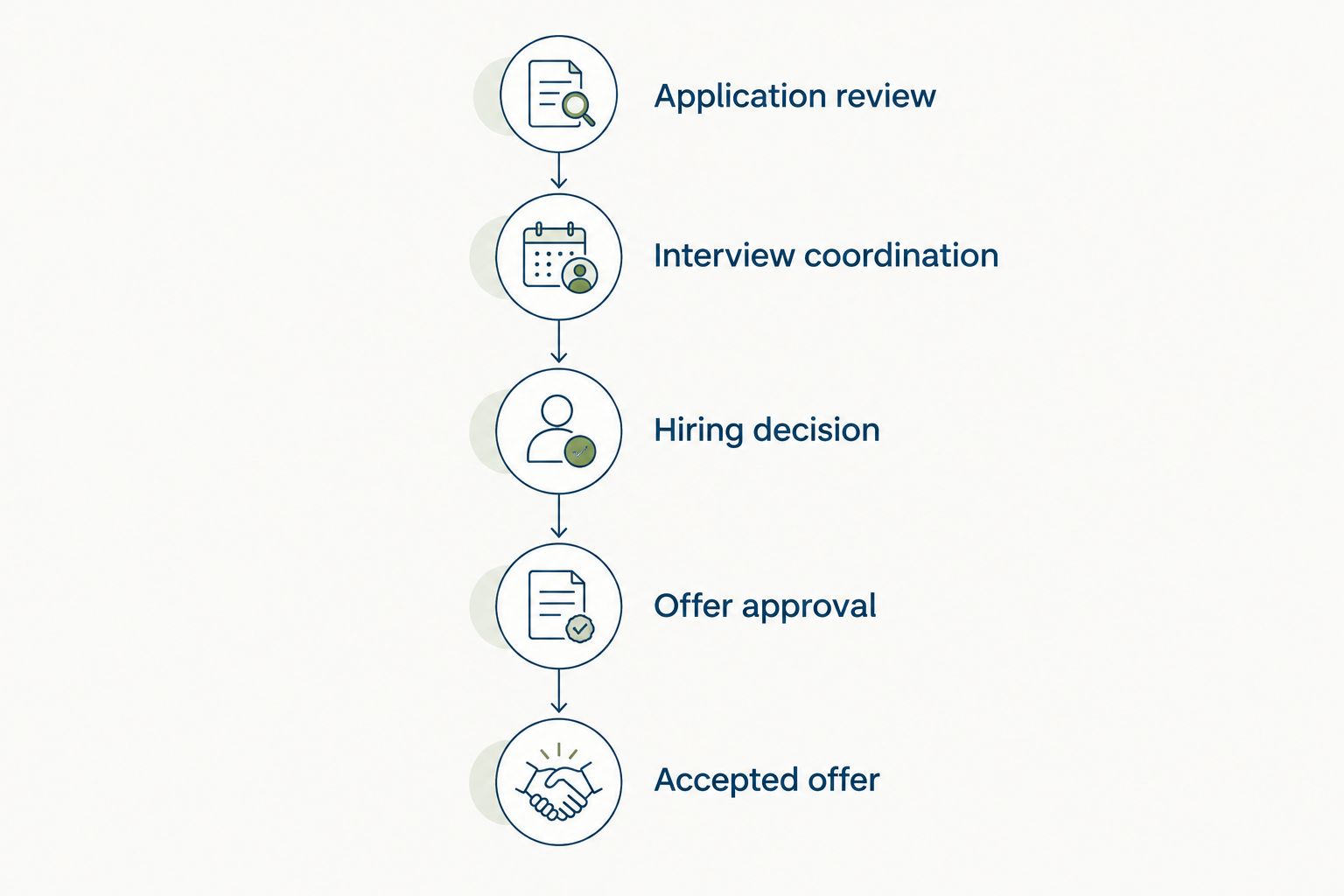
Separate your hiring process into observable stages. You do not need an elaborate reporting project to begin; you need consistent events and a record of where candidates stop progressing. Use the same stage names throughout your 2026 evaluation.
- Application review: Identify who checks applications against the agreed role criteria.
- Interview coordination: Identify who arranges the next conversation and confirms participation.
- Hiring decision: Identify who gathers feedback and authorizes the outcome.
- Offer approval: Identify who approves the offer before it reaches the candidate.
- Accepted offer: Record acceptance as the endpoint of your time-to-hire measurement.
These are process checkpoints, not assumptions about product functionality. Ask vendors to show the parts they support and explain what remains outside their system. Do not translate a broad feature name into a capability you have not seen.
A useful demonstration follows a candidate through the relevant stage, including an exception. Ask what happens when information is incomplete, a reviewer disagrees, or the assigned person does not act. The exception reveals whether the process has a real owner or merely produces more output.
What determines the time saved?
The value of recruitment assistance depends on where it fits into your work. Evaluate these factors together rather than treating the presence of an AI feature as evidence of a hiring-speed improvement.
- Recruitment scope: Specify which recruiting task you want assistance with. Broad product coverage does not establish support for that particular task.
- Workflow ownership: Define who acts on the output. A completed preparation task still needs a clear next step.
- Review requirements: Include checking and correcting assisted output when assessing the effort involved. Generation time is only part of the task.
- Setup effort: Assess the configuration and process work needed before the feature becomes useful. Ask for a demonstration of setup rather than accepting a general speed claim.
- Onboarding handoff: Decide what must happen after acceptance. Keep that work connected operationally, but outside your time-to-hire calculation.
These factors turn a vague promise into testable questions. What work disappears? What work remains? Who is accountable when the output is wrong or the next step stalls?
A shorter task is valuable only if its benefit survives review and reaches the hiring process. Keep that distinction visible in your evaluation notes. It gives your founder or operations lead a clearer decision than a list of feature names.
Measure speed without lowering the hiring bar
Track elapsed hiring time alongside the work required to reach a decision. Keep your role criteria stable during the comparison, and record changes in interview structure or approval rules. Otherwise, you cannot distinguish a software effect from a process change.
Use a small, readable measurement sheet:
| Measure | What it tells you | What it does not prove |
|---|---|---|
| Candidate entry to accepted offer | End-to-end elapsed hiring time | That software alone caused the change |
| Time in each stage | Where candidates wait | Why that wait occurred |
| Preparation and review effort | Work needed to produce usable output | That candidates progressed sooner |
| Corrections to assisted output | Whether review catches errors | That unflagged output is accurate |
| Completed decision records | Whether reviewers documented the outcome | That the selection criteria were appropriate |
Use equivalent roles where possible. A specialist search and a recurring role are not interchangeable benchmarks. Record the differences instead of presenting a single blended result as proof.
For a 2026 pilot, agree on success criteria before enabling the feature. State which stage should improve, what reviewers must check, and what would justify stopping the pilot. Keep the decision grounded in your process rather than a vendor's general claim.
Where HRSpace fits
HRSpace is best suited to growing HR and People Operations teams evaluating AI recruitment alongside broader employee lifecycle software. Its stated platform scope includes onboarding, time-off, performance reviews, goals, recognition, workflow automation, and an internal service desk. Modular, per-employee pricing is part of its commercial model; request the current terms for your selected scope.
The advantage is the breadth of work you can assess within one platform. The limitation is equally important: that description does not establish a measured reduction in time to hire, a specific recruiting capability, or an automatic connection between modules. Ask for evidence tied to your hiring process.
If you support 20 employees, frame the demonstration around the work your current team owns. If you support 100 employees, include the actual reviewers and handoffs involved in your process. Employee count sets context; it is not proof of a particular recruiting need.
Use the AI recruitment to first-day onboarding workflow to frame the transition after acceptance. Evaluate that transition separately from recruiting speed so neither result hides the other.
Evaluate your recruiting workflow
Assess AI recruitment, onboarding, and HR workflows against the stages your team needs to improve.
Will AI recruitment fix slow hiring approvals?
AI recruitment software does not resolve a slow approval simply by producing information faster. The approval still needs a named owner, clear criteria, and a decision. Evaluate any proposed approval capability separately rather than assuming it follows from the AI label.
Ask the hiring manager what is missing at the moment of approval. If the answer is usable information, assistance has a task to address. If the answer is authority or availability, change that part of the process first.
Does faster recruiting mean better hiring?
No—time to hire measures speed, not the quality of the selection decision. Keep job-related criteria and human review in place while reducing repetitive work. Do not approve a process change solely because it moves candidates through stages faster.
Read a shortened stage alongside its decision record. You should still be able to explain why a candidate progressed, what evidence the reviewer considered, and who made the decision. Speed is a useful outcome, not a substitute for accountability.
Should onboarding count toward time to hire?
No—under the measurement convention used here, time to hire ends at accepted offer. Track onboarding separately so preparation for the first day does not distort recruiting comparisons. A connected employee lifecycle still needs distinct measures for distinct outcomes.
Your 2026 scorecard should therefore separate hiring speed from onboarding readiness. That keeps an improvement after acceptance from being reported as a reduction in recruiting time.
FAQ
Can AI recruitment software reduce time to hire for a small team?
Yes, when it shortens a task that is delaying candidate progress. Identify the stalled stage first, then measure whether assistance changes its elapsed time after human review.
What should I measure before buying AI recruitment software?
Measure candidate entry to accepted offer and elapsed time in each hiring stage. Record preparation and review effort separately so faster output does not become a false claim of faster hiring.
Is AI recruitment the same as hiring workflow automation?
No. AI assistance helps produce or interpret information, while workflow automation moves work according to defined rules; evaluate the capabilities your proposed product actually supports.
Will AI recruitment software replace hiring managers?
Your hiring process should retain human responsibility for selection criteria, review, and final decisions. Evaluate assistance as support for that process, not as permission to remove decision accountability.
Is HRSpace relevant if I also need onboarding software?
Yes—HRSpace's stated platform scope includes both AI recruitment and onboarding. Ask for a demonstration of your specific handoff rather than assuming the modules automatically connect.
How do I check a claim that recruitment software saves time?
Ask which task or hiring stage the claim measures and how the comparison was made. Verify the result against equivalent roles and include the effort needed to review and correct assisted output.
Should I include the employee's first day in time to hire?
No, not under the candidate-entry-to-accepted-offer convention used here. Track first-day readiness separately and keep the same endpoints throughout your comparison.
One last thing
Do not start your evaluation with the fastest-looking feature. Start with the longest unresolved wait. Ask your team to identify the candidate stage that has no clear next action, then assign an owner before introducing assistance.
That gives the software a defined job. It also gives you a fair way to judge the result: less waiting, usable output, and a hiring decision your team can explain.