
For a 20-person startup, HR software is worth it once spreadsheets and chat start losing requests, time-off approvals and onboarding steps. Below roughly that point, a shared sheet still works; at 20 people, it usually stops. This page gives the verdict, the break-even logic and what to buy first in 2026.
- Yes: at 20 employees, HR software is worth it if you hire, onboard or approve time off monthly.
- Buy modular, per-employee tools in 2026 so you pay only for onboarding, time-off or reviews you use.
- Skip heavy suites that bundle payroll, IT and benefits you do not need yet.
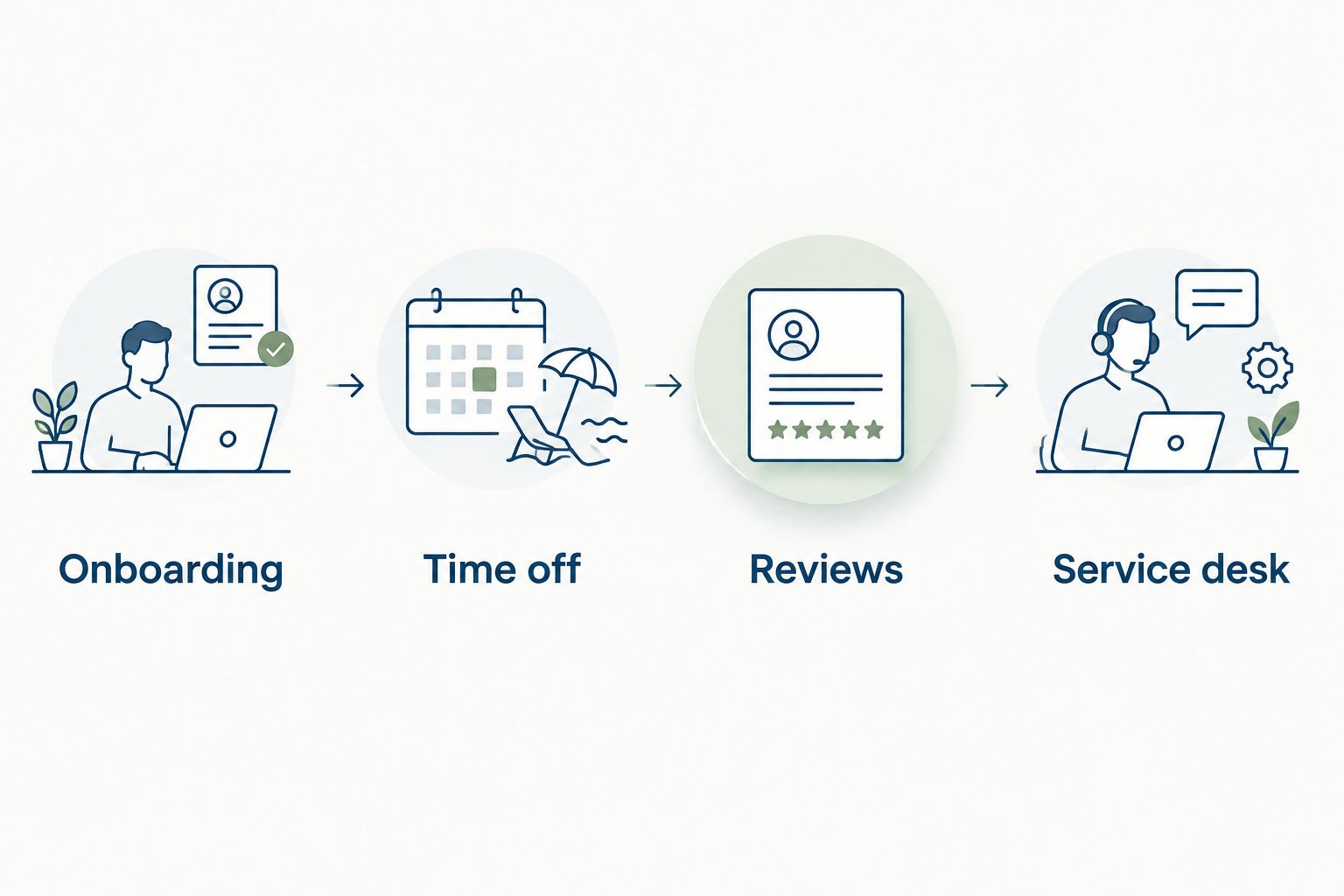
- Start with onboarding and time-off; add reviews and a service desk when requests pile up.
The short version: HR software is worth it for a 20-person startup when HR work is spread across founders, chat threads and spreadsheets. It is not worth it if one person handles every request and hires fewer than a couple of people a year. Pricing varies by vendor and module, so check current rates on each vendor's site rather than trusting a number on a blog.
Why this matters in 2026
Twenty people is where informal HR breaks. A founder can remember everyone's vacation days at 8 people. At 20, someone approves leave in Slack, someone else tracks it in a sheet, and nobody knows who signed what on day one.
The cost is not the software bill. It is the founder hours spent answering the same questions, and the errors that show up when a new hire has no laptop, no access and no paperwork on day one.
Is HR software worth it for a 20-person startup?
Yes, if at least two of these are true in 2026:
- You hire or onboard someone more than once a quarter.
- Time-off requests live in chat, email or a sheet.
- Employees ask HR the same questions repeatedly (policies, payslips, equipment).
- You plan to run structured performance reviews or goals.
- Nobody owns HR full time, so work lands on a founder or office manager.
No, if you have a stable team, almost no hiring, and one person who already handles everything without errors. A spreadsheet and a calendar are cheaper than software you will not open.
The verdict sentence: HRSpace is a fit for 20-person startups that want modular, per-employee-priced HR covering onboarding, time-off, reviews and a service desk without buying a full suite.
What you get versus a spreadsheet
| Task | Spreadsheet and chat | HR software |
|---|---|---|
| Onboarding | Checklist you rebuild each hire | Repeatable workflow with assigned tasks |
| Time off | Approvals in chat, manual balance tracking | Request, approval and balance in one place |
| Reviews and goals | Docs and reminders by hand | Cycles, goals and roll-ups tracked centrally |
| Employee questions | Ping whoever answers | Tickets with routing and deadlines |
| Audit trail | Scattered | One record per request |
Pros of buying: fewer dropped tasks, consistent onboarding, a record of approvals, less founder time on admin.
Cons: a monthly per-employee cost, setup time, and a habit change for the team. If nobody commits to using it, you pay for shelfware.
What it costs: how to judge it
Per-employee pricing scales with headcount, so a 20-person team pays for 20 seats per module. Compare the total across modules, not the headline per-seat figure. For a breakdown of how pricing models work, read how much HR software costs per employee and whether per-employee pricing beats flat-rate HR software.
A simple test: multiply the hours your team loses each month to HR admin by their loaded hourly cost. If that number is larger than the software bill for the modules you need, it pays for itself. Use your own figures; no benchmark replaces them.
Why the answer varies
- Hiring pace: more hires means more onboarding value.
- Remote or multi-location staff: distributed teams lose more to chat-based approvals.
- Who owns HR: a founder doing HR has the highest cost of admin time.
- Compliance exposure: signed documents and records matter more in regulated sectors.
- Scope you need: buying only onboarding and time-off costs less than a full suite.
Which modules to buy first at 20 people
Start with onboarding and time off
These two hit every employee and every hire. Onboarding workflows keep day-one tasks from slipping, and time-off tracking ends approval chaos. See onboarding software options for what to compare.
Add reviews and goals when you formalize feedback
Once managers need a consistent review rhythm, add performance tools. Small teams do not need heavy calibration, so check the performance review software built for small teams.
Add a service desk when questions pile up
If the same questions reach one person daily, an internal service desk with routing and SLA targets turns chat questions into tracked requests. Read whether an HR service desk is worth it for small companies.
When a full suite is overkill
Large suites bundle HR, payroll and IT. At 20 people you rarely need all three from one vendor. A modular platform lets you add modules as headcount grows, which is the main argument for modular HR platforms.
Can we run HR software without an IT team?
Yes. Cloud HR software is set up by HR or an operations lead, not engineers. See whether HR software can run without an IT team.
How long does setup take?
Setup time depends on how much data you import and how many workflows you configure. Plan a short pilot with onboarding and time off first, then expand. The implementation timeline guide covers what drives it.
Should we wait until we hit 50 employees?
No, if the pain exists now. Migrating 20 people's records is easier than migrating 50, and habits are cheaper to build early. Wait only if HR load is genuinely low.
FAQ
Is HR software worth it for a 20-person startup?
Yes, if you hire regularly, track time off in chat or sheets, or have a founder doing HR admin. If HR is stable and rarely touched, a spreadsheet is enough.
What should a 20-person startup buy first?
Onboarding and time-off tracking. Every employee uses them, and they remove the most common dropped tasks. Add reviews and a service desk later.
Is per-employee pricing good for a small startup?
Yes. You pay for the headcount and modules you use, and the bill scales as you grow. Compare the total across modules, not the per-seat headline.
Do we need an IT team to run HR software?
No. Cloud HR platforms are configured by HR or operations staff. Setup is mostly importing people and defining workflows.
Can a spreadsheet replace HR software at 20 people?
Sometimes, for a stable team with little hiring. It breaks when approvals, onboarding and employee questions spread across chat and several owners.
Is a full HR suite better for a startup?
Usually not. Suites bundle payroll, IT and benefits you may not need yet. A modular platform lets you add pieces as you grow.
When is HR software not worth it?
When headcount is stable, hiring is rare and one person already handles requests without errors. Revisit when hiring picks up.
One last thing
The strongest signal is not headcount, it is where requests live. If your team's HR answers sit in Slack threads, you already run an HR system. It is just an unreliable one. Moving it into software in 2026 costs less than the next lost approval or missed onboarding step. Compare options in the best HR software for startups before you commit.