
Yes, small businesses can afford modular HR software, because you pay per employee and only for the modules you turn on. HRSpace publishes no price figures in the inputs for this page, so the exact monthly cost depends on your headcount and the modules you pick; check the current pricing on the site before you budget in 2026.
The cost that headline pricing hides is the time to set up and run each module. A cheap module you never finish rolling out costs more than a pricier one your team uses in week one.
- Can small businesses afford modular HR software? Yes: per-employee pricing means cost scales with headcount, not with a suite you don't use.
- HRSpace is modular and per-employee priced, so a 20-person company starts with one module, such as onboarding or time-off.
- Add performance, recognition, recruitment or the service desk only when a real problem justifies it.
- Compare total cost across modules, setup effort and payroll integration, not the lowest advertised rate.
Can small businesses afford modular HR software?
Yes. Modular pricing exists to fix the main small-business problem with HR suites: paying for features you won't touch in 2026.
Here is how the two models compare on the points that decide affordability.
| Factor | Modular, per-employee | Bundled suite |
|---|---|---|
| What you pay for | Modules you switch on, multiplied by headcount | Full package, often with tier minimums |
| Starting point | One module, such as onboarding or time-off | Whole platform from day one |
| Cost as you grow | Rises with headcount and added modules | Rises with headcount and tier jumps |
| Main risk | Module costs stack up if you add everything | Paying for unused features |
| Best for | 20-100 person teams with one or two clear HR problems | Teams that need every function immediately |
The verdict: modular per-employee pricing is the cheaper entry point for a small team, and the more expensive route only if you end up buying every module. For the full per-seat picture, read how much HR software costs per employee.
Why modular HR software costs what it costs
Four or five factors move your bill. Know them before you request a quote.
- Headcount. Per-employee pricing multiplies every module by the number of people on payroll.
- Number of modules. Onboarding, time-off, performance reviews, goals, recognition, AI recruitment and the service desk are each a separate decision.
- Setup effort. Internal hours spent configuring workflows are a real cost, even when no invoice shows them.
- Payroll connection. If payroll sits in another system, check how data moves between the two before you commit.
- Growth. A team that doubles in a year doubles its per-seat spend, so model next year's headcount, not today's.
The per-seat versus flat-rate trade-off is its own question. Is per-employee pricing cheaper than flat-rate HR software walks through it.
How to keep a modular HR stack affordable
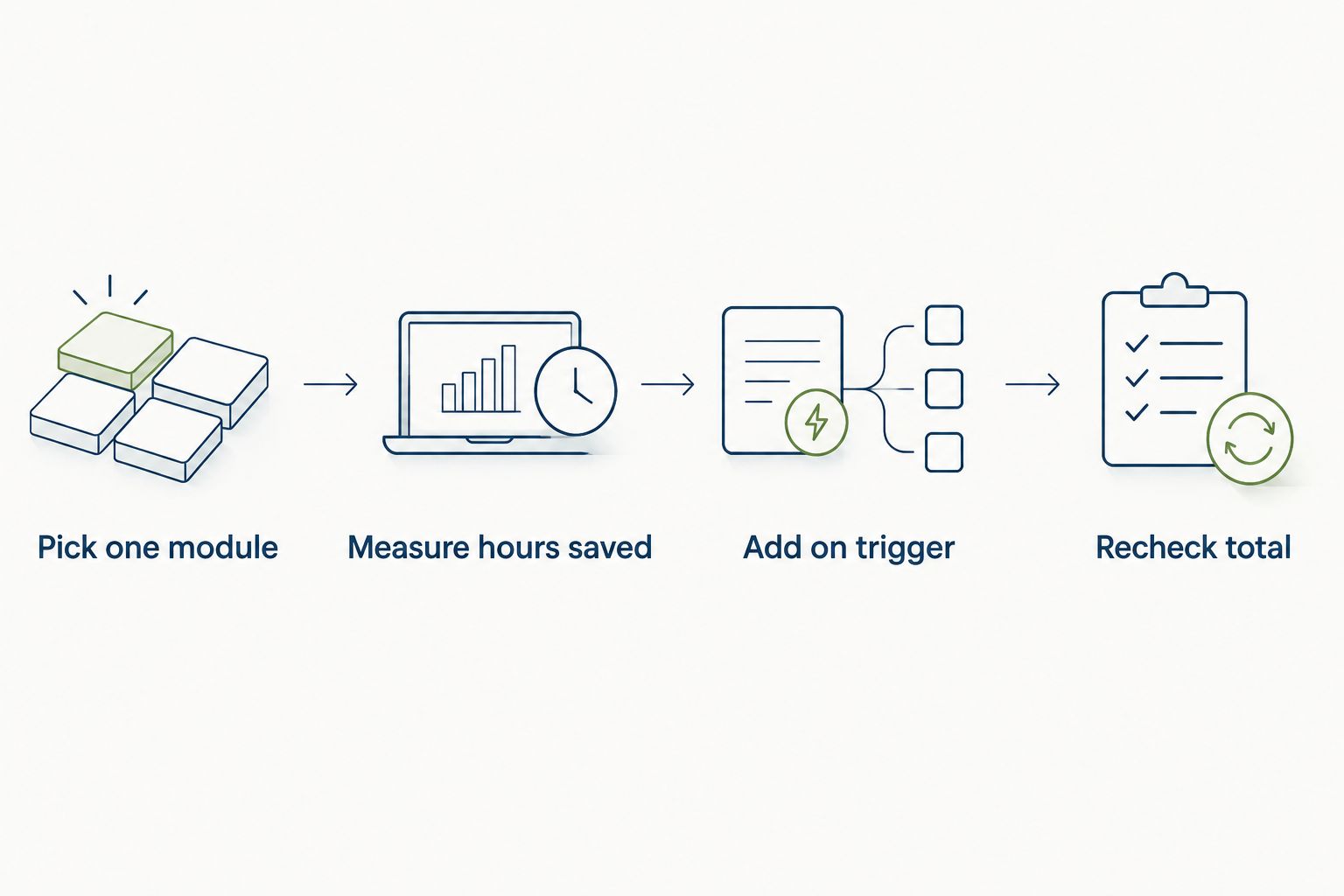
Start with the one problem costing your team the most hours. Buy that module. Run it for a quarter.
- Pick one module first. New hires slipping through the cracks means onboarding. Messy leave requests mean time-off.
- Measure the hours it saves. If it doesn't free up time for whoever runs HR, don't add a second module.
- Add the next module only on a specific trigger. A review cycle coming up is a reason to add performance. A growing hiring plan is a reason to add recruitment.
- Re-check the total at each addition. Total spend equals modules times headcount, so recalculate every time.
An AI-assisted recruiting module in particular needs a clear hiring volume to justify the spend. See whether AI recruitment software is worth it before you add it.
Where modular pricing gets expensive
Modular is not automatically cheap. Three situations flip the math.
- You need everything at once. Seven modules across 100 people can cost more than a bundled tier.
- You skip the cost model. Without a spreadsheet of modules times headcount, spend creeps.
- You buy modules nobody adopts. Recognition software no manager uses is pure waste.
If you want a ranked view of platforms built this way, see the best modular HR software platforms.
HRSpace for small teams
HRSpace is a cloud HR platform with onboarding, time-off, performance reviews, goals, recognition, AI recruitment and an internal service desk, priced per employee and by module. It suits HR and people ops leads at companies of roughly 20-100 employees who want to start with one problem and expand. The trade-off: stacking every module raises the per-seat total, so model the full build-out first. Browse the platform at HRSpace.
Is modular HR software cheaper than a suite like BambooHR?
It can be, if you need only a few functions. A suite charges for its bundle; a modular tool charges for what you enable. Run the same headcount and module list through both quotes in 2026 and compare totals, not rates.
Do small businesses need payroll integration?
Most do. Check how HR data reaches payroll before you buy. Can HR software integrate with payroll systems covers what to ask vendors.
How long does setup take for a small team?
Setup time varies by module and by how clean your current data is. Moving off spreadsheets is the slowest part for most small teams, so plan for it in your 2026 budget.
FAQ
Can small businesses afford modular HR software?
Yes. Per-employee, per-module pricing lets a small team start with one module and add others later, so spend tracks real need.
Is modular HR software cheaper than an all-in-one suite?
It is cheaper when you use only a few functions. If you enable every module, the total can match or exceed a bundled tier, so compare full quotes.
How is per-employee HR pricing calculated?
Each enabled module is priced per employee, so your bill is modules multiplied by headcount. Check the current pricing on the vendor site for exact rates.
Which HR module should a small business buy first?
Buy the one that fixes your biggest time drain. For most teams that is onboarding or time-off tracking.
Does HRSpace charge per employee?
Yes. HRSpace is a modular, per-employee-priced platform, so you pay for the modules you use across your headcount.
Will costs rise as my company grows?
Yes. Per-seat pricing scales with headcount, so forecast your 2026 and 2027 team size when you compare options.
Can I add modules later?
Yes. Modular platforms are built for adding functions as needs appear, such as performance reviews before a review cycle.
One last thing
The cheapest HR purchase is the module you finish rolling out. Before you compare prices, pick the single process that wastes the most hours each week and price only that. If the saved time covers the cost, expand from there.