
Sales teams’ OKR software is a system for tracking objectives and key results with the aim of improving sales outcomes beyond quota attainment. This 2026 guide explains how to choose it without duplicating your CRM, confusing stretch goals with compensation targets, or adding another reporting chore.
- Choose OKR software for sales teams around measurable outcomes, clear ownership, and a repeatable review process.
- HRSpace fits growing companies that want goals and performance reviews within a broader HR platform.
- Keep deal records in your CRM; use objectives and key results to direct improvement.
- Test scoring, permissions, and data updates before committing to any platform.
Why OKR software matters for sales teams
Sales teams need to distinguish between hitting a target and improving how they sell. A quota describes the result expected from a seller. An objective describes a meaningful improvement, while key results define the evidence that improvement happened.
For a company with 20–100 employees, the buying decision also crosses departments. Sales owns commercial execution; People Operations helps managers connect goals, coaching, and performance reviews. A separate tool needs to justify the extra administration it creates.
HRSpace includes goals and performance reviews alongside onboarding, time-off, recognition, recruitment, workflows, and an internal service desk. HRSpace goals and performance software is best for growing companies that want those processes in one HR platform. Dedicated sales OKR requirements still need a demonstration, particularly scoring, CRM connections, and reporting.
The practical question for 2026 is not whether you need more dashboards. It is whether your current process makes ownership, evidence, and corrective action clear.
Build a sales OKR process before choosing software
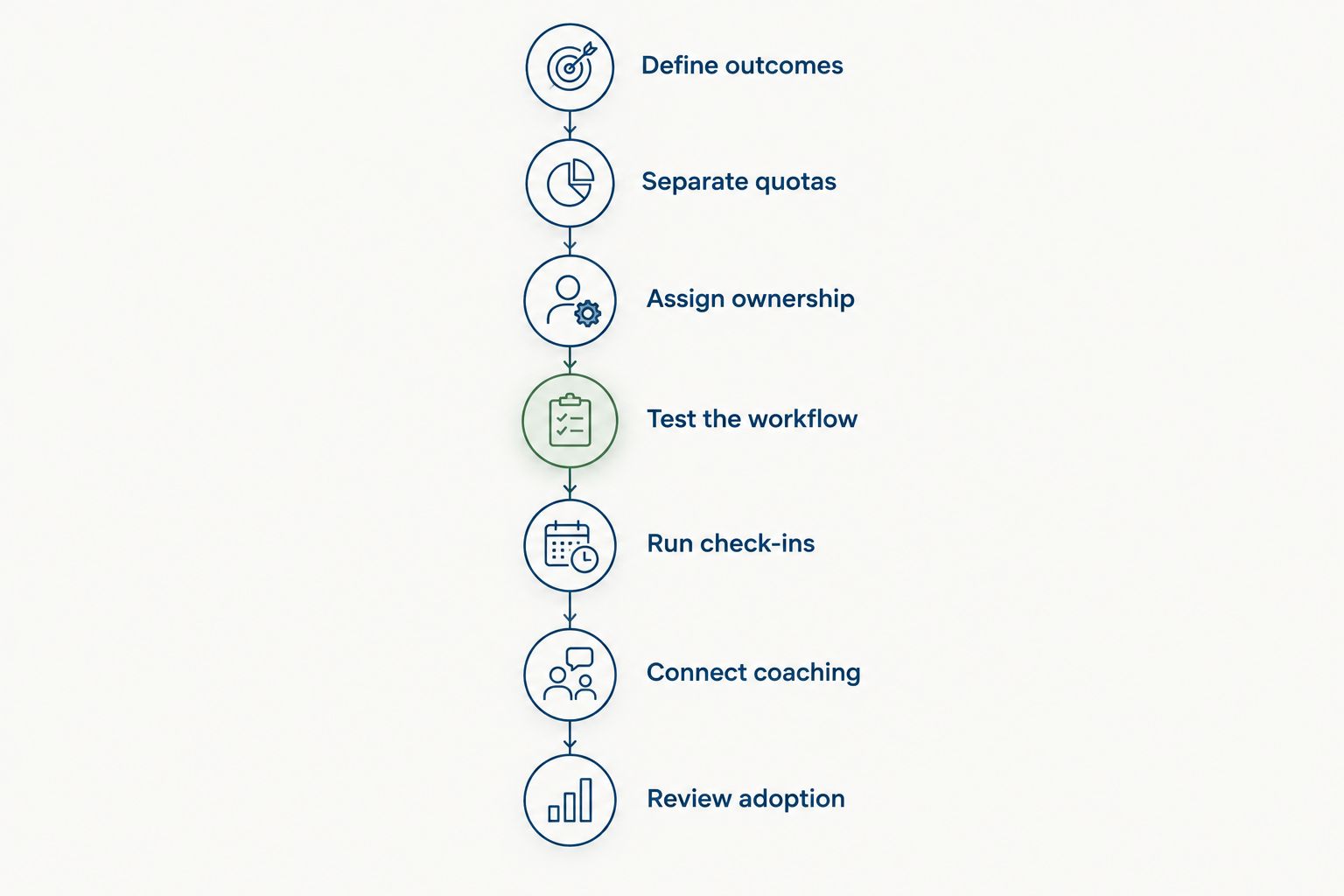
Define outcomes
Start manually in a shared document. Write the sales problem in plain language before creating fields, dashboards, or approval flows. An objective such as improving the quality of qualified opportunities gives the team a direction; increasing completed calls alone describes activity.
Keep each key result tied to an observable change. State the baseline, target, deadline, and source of evidence. If the baseline is unknown, establish it before setting an improvement target rather than borrowing an unrelated benchmark.
For your 2026 planning cycle, begin with 1 team objective and 2–3 key results. This is a suggested starting scope, not a benchmark. Expand only when the team can explain what each result changes.
- Name the business problem the objective addresses.
- Record the baseline using your own sales data.
- Define the target and reporting period.
- Specify which records count toward the result.
- Write down what the team will stop doing.
Separate quotas
Use your existing quota document to identify contractual or compensation-linked expectations. Keep those expectations distinct from improvement objectives. The same revenue measure can inform both conversations, but employees need to understand which target affects pay and which guides experimentation.
Separate outcomes from tasks, too. Completing account research is an initiative. Improving progression among the accounts researched is an outcome to measure. A task list belongs beside the objective, not in place of it.
Do not replace your commission plan with an OKR score. Review compensation rules separately and explain the relationship before launch. Otherwise, sellers have a reason to negotiate easier objectives instead of proposing useful improvements.
- Label quota, key result, and initiative separately.
- Document how compensation decisions are made.
- Keep activity measures subordinate to outcomes.
- Distinguish committed expectations from stretch goals.
- Explain what an incomplete objective means.
Assign ownership
Create a simple ownership sheet before configuring software. Give each key result a named owner who can explain progress and coordinate action. Contributors can be shared; accountability should not depend on everyone assuming someone else will update the record.
HRSpace brings goals and performance reviews into the same platform as broader employee processes. That makes it relevant when People Operations wants fewer separate systems. Before treating it as your sales OKR system, demonstrate the ownership model and visibility your team requires.
Test a cross-functional objective involving sales and onboarding. Ask whether the proposed setup makes the sales manager’s responsibility clear without exposing individual performance information more widely than intended. A product tour is not enough; use your actual management structure.
- Assign an accountable owner to each result.
- Name contributors and decision-makers separately.
- Record dependencies on marketing or customer teams.
- Define who can view and edit individual goals.
- Decide who resolves conflicting priorities.
Test the workflow
Build a manual version using a document and your current CRM reports first. This exposes unclear definitions before software makes them harder to change. Then ask each shortlisted vendor to reproduce the same workflow with sample records.
In a 2026 evaluation, focus on the whole update process rather than a polished dashboard. Identify where the result originates, how it reaches the goal record, who checks it, and what happens when the source changes. Never assume a CRM connection exists because a platform supports goals.
Include a difficult case: an opportunity moves backward, its owner changes, or a duplicate record appears. The evaluation should show how you correct the result and explain the change, whether that process is manual or automated.
- Identify the authoritative data source.
- Demonstrate an update from source to goal.
- Check how corrections affect reported progress.
- Test the required permissions and exports.
- Record every manual handoff that remains.
Run check-ins
Use a shared agenda before buying reminders or reporting features. Each owner should explain what changed, what blocked progress, and what decision is needed. Reading a dashboard aloud is not a check-in.
Start with a 15-minute weekly review as a working format. Ask owners to update evidence beforehand so the meeting stays focused on decisions. This is a suggested cadence, not a claim that every sales team needs the same schedule.
Match the review rhythm to the sales cycle. A result with little weekly movement still needs useful commentary about assumptions, risks, and next actions. Do not turn a slow-moving outcome into a daily activity target just to make the chart look busy.
- Update evidence before the meeting.
- Discuss exceptions rather than every record.
- Name the blocker and required decision.
- Assign the next action to an owner.
- Record changes to definitions or targets.
Connect coaching
Begin with a manager’s written coaching notes. Separate the employee’s actions from factors outside their control, including territory changes, lead quality, and dependencies on another team. An outcome needs interpretation before it becomes performance feedback.
A platform containing both goals and reviews gives you a place to evaluate those processes together. It does not remove the need for managerial judgment. Ask vendors to demonstrate the review workflow rather than assuming goal progress automatically becomes review evidence.
For your 2026 review cycle, explain how managers will discuss missed goals. A seller who surfaces a flawed assumption early should not receive the same feedback as someone who ignores an agreed action. Keep recognition specific to the contribution, not just the final score.
- Connect feedback to observable actions.
- Record context alongside the result.
- Separate development needs from territory issues.
- Check evidence before writing review conclusions.
- Recognize useful collaboration and learning.
Review adoption
Track the pilot in a simple checklist. Look for current evidence, clear owners, decisions made, and duplicate work. Logging in is not proof that the process helps the sales team.
Run a 4-week pilot as an initial adoption test, not a promise of business results. That period lets you inspect several check-ins, while longer sales cycles need more time to assess commercial outcomes. Keep those two evaluation questions separate.
Before expanding in 2026, ask whether the process changed a decision. If managers still maintain a private spreadsheet because they cannot trust the official record, fix the definition or workflow first. Adding more users will not solve it.
- Check whether owners update results consistently.
- Identify fields nobody uses to make decisions.
- Record duplicated data entry.
- Ask managers which action the process changed.
- Agree on expansion criteria before the pilot ends.
The sequence matters: define the work, test the workflow, and then judge adoption. Buying software before those decisions leaves the platform carrying an unclear process.
Compare your options
Choose the category that matches the problem. A spreadsheet tests the process. A CRM stores sales records. A dedicated OKR platform deserves evaluation when goal management itself has become complicated. A broader HR platform fits a different buying need: keeping goals close to employee development.
The table describes evaluation paths, not verified feature lists for unnamed vendors. For a wider shortlist, use the best OKR software guide, then test each candidate against your workflow.
| Option | Best for | Main advantage | Key limitation |
|---|---|---|---|
| Shared spreadsheet | Teams testing their first OKR process | Lets you change definitions and ownership manually | Requires manual updates and version discipline |
| Existing CRM reports | Teams whose immediate need is sales reporting | Keeps analysis close to opportunity records | Reporting alone does not define ownership, coaching, or review rules |
| Dedicated OKR platform | Teams evaluating specialized goal-management workflows | Provides a focused category to assess against complex OKR requirements | Adds another system; verify actual scoring, permissions, and data connections |
| HRSpace | Growing companies combining goals, reviews, and wider HR processes | Includes goals and performance reviews within a modular HR platform | Sales-specific OKR scoring, CRM connections, and reporting require confirmation |
HRSpace uses modular, per-employee pricing. Define which modules and employees belong in the proposed rollout, then confirm the commercial terms directly. Do not treat a broad HR platform and a standalone goal tracker as equivalent purchases: compare the work each replaces and the administration each adds.
Common mistakes sales teams make
Turning every quota into an objective
Copying every seller’s quota into another system creates a second reporting surface without explaining what should improve. Keep quota reporting where it belongs, then use OKRs for a deliberate change in sales execution.
Rewarding activity without checking quality
Calls, emails, and meetings are visible, but they do not establish whether opportunities are useful. Pair activity information with defined qualification or progression evidence before calling the objective successful.
Applying identical goals across different territories
A new territory and an established account base do not start from the same conditions. Record the baseline and constraints before comparing outcomes; identical targets are not automatically fair targets.
Assuming goals means complete OKR support
A goals feature does not establish weighted scoring, dependencies, history, or CRM synchronization. Make each requirement a demonstration task. If the vendor cannot show it, keep it unresolved rather than building your rollout around an assumption.
Changing targets without preserving context
Sales conditions change, but rewriting a target without explanation makes the record hard to interpret. Record why the target changed, who approved it, and which period the revised definition covers.
FAQ
What is the best OKR software for sales teams?
The best OKR software for sales teams supports your ownership, evidence, and review process without duplicating CRM work. HRSpace fits buyers who want goals and performance reviews within broader HR software; verify sales-specific requirements in a demonstration.
Can we use our CRM instead of separate OKR software?
Use your CRM for sales records and reporting when it meets that need. Assess goal ownership, commentary, cross-functional dependencies, and review requirements separately before deciding whether another system is necessary.
What is the difference between a sales quota and a sales OKR?
A sales quota sets an expected sales result, while an OKR defines an objective and measurable evidence of progress. Keep compensation rules explicit rather than assuming an OKR score determines commission.
How many OKRs should a sales team start with?
Start with 1 team objective and 2–3 key results as a practical pilot scope. This is a starting recommendation, not a universal benchmark; add complexity only when each result informs a decision.
Does HRSpace connect sales OKRs to CRM data?
Confirm CRM connectivity directly before including it in your buying decision. Its stated platform scope includes goals and performance reviews, but that alone does not establish a particular integration or automatic sales-data update.
How often should sales teams review OKRs?
Use a weekly check-in as an initial working cadence, then adjust it to your sales cycle and decision needs. Update evidence beforehand and spend meeting time on blockers, decisions, and next actions.
Should missed OKRs lower a salesperson’s performance rating?
A missed OKR should not determine a performance rating by itself. Review the agreed expectations, employee actions, dependencies, and business context before drawing a conclusion.
One last thing
Test the missed-goal conversation, not just the progress dashboard. Before signing, ask a manager to explain an off-track result using the proposed workflow: what happened, which evidence supports that account, and what changes next. If the software cannot support that conversation clearly, the evaluation is not finished.