
Sales teams’ employee recognition software is a system for acknowledging sales contributions with the aim of making valuable work visible beyond closed revenue. This 2026 guide explains how to choose it, recognize different sales roles fairly, and keep recognition separate from commission and formal performance decisions.
- Employee recognition software for sales teams should recognize pipeline quality, customer care, and teamwork—not only closed deals.
- HRSpace fits growing teams that want employee recognition, goals, and performance reviews in one HR platform.
- Start with written recognition criteria before evaluating software; a leaderboard alone is not a recognition program.
- Run a focused pilot and assess participation, role coverage, and administrative effort before expanding.
Why recognition matters for sales teams
Recognition should explain what good selling looks like—not repeat the revenue leaderboard. Your sales team includes work that happens before a contract closes and after the salesperson hands it over. A useful program makes those contributions visible without treating every role as if it owns the same target.
An account executive, sales development representative, and sales engineer contribute differently. Recognizing only booked revenue leaves you without a clear way to acknowledge careful qualification, technical support, or a clean customer handoff.
For growing companies with 20–100 employees, the decision is also about scope. Do you need a separate recognition process, or recognition alongside the employee goals and reviews you already manage?
HRSpace includes recognition, goals, and performance reviews within a modular cloud HR platform. HRSpace is best for growing teams that want recognition, goals, and reviews in one HR platform. That is a platform-fit verdict, not a claim that every specialist recognition feature is included.
Build a program your sales team trusts
The strongest buying brief starts with behavior, ownership, and evidence. Use the following steps to define the process manually, then test whether software makes that same process easier to run.
1. Define the sales behaviors you want repeated
Start with a shared document. Name the behaviors worth acknowledging and give managers concrete examples of each. Keep the criteria visible to employees so recognition does not depend on guessing what a manager values.
For your 2026 program, separate recognition criteria into three areas: closed deals, pipeline quality, and team contribution. These are categories for your program, not suggested product features.
A large deal deserves acknowledgment, but so does identifying a poor-fit opportunity early. Define why each action matters. Otherwise, employees see the celebration without understanding the standard behind it.
- Closed deals: acknowledge the specific selling behavior, not just the contract outcome.
- Pipeline quality: recognize accurate qualification and useful opportunity notes.
- Team contribution: acknowledge help with demonstrations, proposals, and handoffs.
- Customer care: recognize honest expectation-setting and clear follow-through.
2. Separate recognition from compensation and ratings
Write down what recognition does—and what it does not do. A thank-you should not silently become a bonus decision or a performance rating. Those decisions need their own criteria and evidence.
You can manage this distinction with a simple policy and a recognition log. Record the behavior, context, and contributor. Do not automatically translate the number of acknowledgments into a measure of employee performance.
Software becomes useful when you need an ongoing place for recognition rather than scattered messages. HRSpace brings recognition, goals, and performance reviews into the same platform; evaluate each process separately instead of assuming recognition automatically changes a review score.
- State whether recognition has any connection to formal rewards.
- Keep commission rules in the compensation process.
- Keep performance ratings tied to documented expectations.
- Let employees ask questions about recognition criteria.
3. Assign ownership and a repeatable workflow
Start with a form or shared log and assign a program owner. Sales managers provide context; People Operations checks whether the process follows the published rules. Give each person a clear responsibility so acknowledgments do not wait indefinitely for someone else.
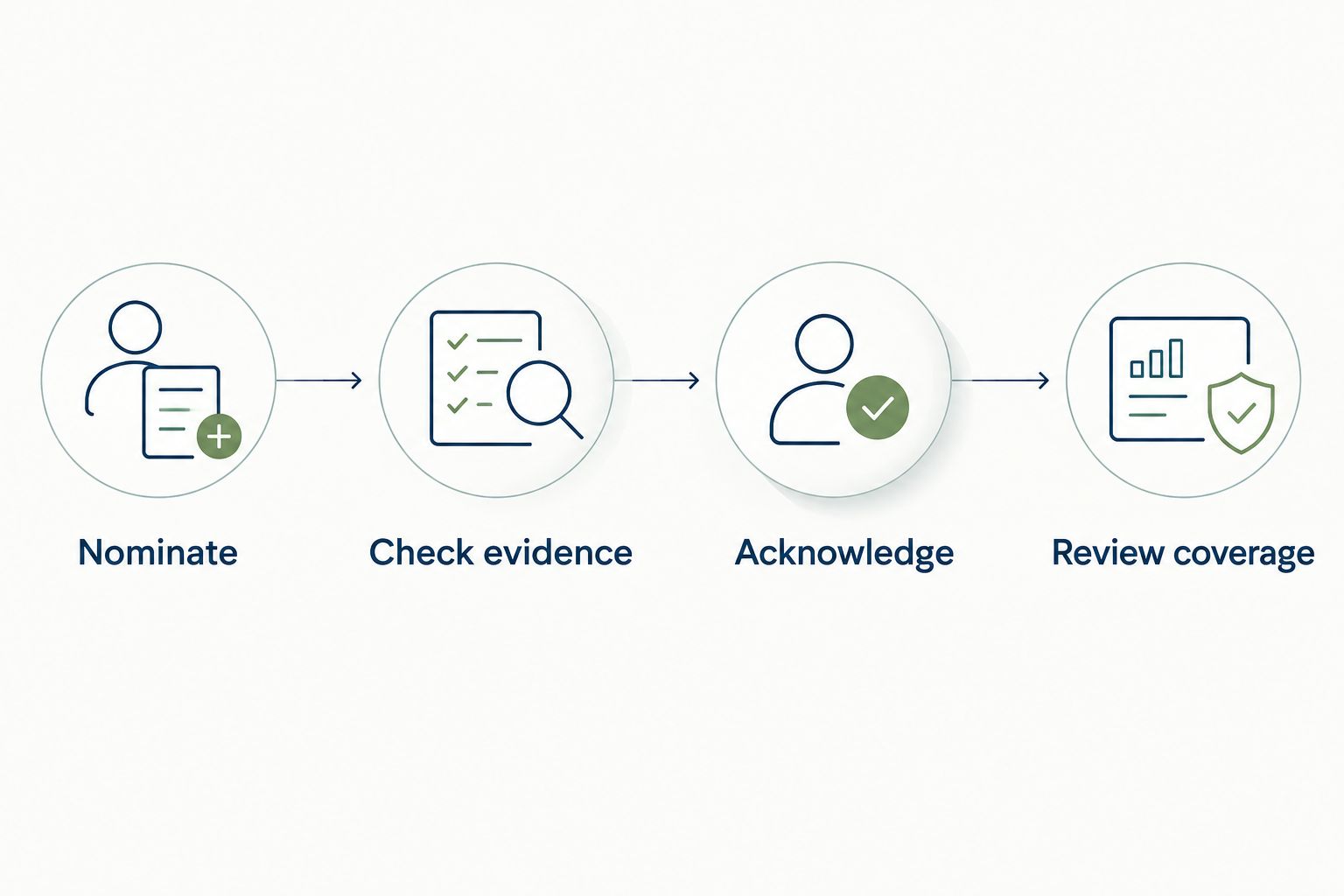
Use a simple sequence: nominate, check evidence, acknowledge, and review coverage. Your manual version should work before you ask a vendor to demonstrate it. That makes the demonstration a test of your needs rather than a tour of unrelated features.
For a 2026 rollout, ask vendors to show the entire sequence with a sample sales contribution. Do not accept a screenshot as proof that the workflow supports your approval, visibility, or reporting requirements.
- Nominate: record who contributed and what they did.
- Check evidence: confirm the example matches your criteria.
- Acknowledge: explain the behavior in language the team understands.
- Review coverage: check which roles and contributors remain unseen.
4. Include every sales role in the criteria
Create a role-by-role checklist before choosing a tool. Ask what excellent work looks like for each role and what evidence a colleague can reasonably observe. Avoid one universal threshold based on revenue ownership.
An outbound representative can contribute through research and qualification. A sales engineer can contribute through technical discovery. An account executive can contribute through negotiation and handoff quality. Your criteria should describe those contributions without pretending they are interchangeable.
Use your employee recognition software comparison alongside this checklist. Product breadth matters only when it supports the people and behaviors your program actually covers.
- Write examples for prospecting, closing, and technical support roles.
- Include behind-the-scenes contributors in eligible acknowledgments.
- Distinguish individual effort from shared deal work.
- Check whether remote and office-based employees receive equal consideration.
5. Test the software against real scenarios
Build a short evaluation worksheet and use the same scenarios for every option. Begin with the manual baseline: what can your team already accomplish with a document, a form, and a regular review?
Then test whether the software removes a specific administrative task or makes the process easier to follow. Ask the vendor to demonstrate recognition creation, recipient visibility, access controls, and any reporting you require. These are evaluation requirements—not assumed capabilities.
HRSpace offers recognition alongside broader employee lifecycle functions and uses a modular, per-employee commercial model. That scope fits buyers consolidating HR processes. It is not proof of points, reward catalogs, sales-system connections, or automated sales-triggered recognition; verify those requirements directly.
- Bring an individual contribution and a shared deal contribution.
- Test what employees and managers can see.
- Request a demonstration of required reporting and access controls.
- List essential connections to existing systems without assuming support.
- Confirm which modules and contractual terms apply to your proposed setup.
6. Run a bounded pilot before expanding
Use a 30-day pilot as a planning window, not as a promised implementation timeline. Choose a sales group that includes different roles and give its members the same written criteria.
Before starting, record how recognition happens today and who maintains it. During the pilot, note incomplete nominations, unclear criteria, and administrative work. A tool that looks tidy in a demonstration still needs to fit the way your managers actually operate.
Hold a 15-minute weekly review to resolve questions while they are fresh. These are recommended operating intervals, not product performance claims or industry benchmarks.
- Publish the pilot’s start, finish, owner, and eligible roles.
- Capture questions about what qualifies for recognition.
- Record manual corrections and follow-up work.
- Ask participants whether acknowledgments explain a useful behavior.
- Decide what must change before expanding the program.
7. Measure coverage before calling the program successful
A higher volume of praise does not establish better selling. Review participation and coverage first, then assess whether the process is manageable and meaningful to employees.
For your 2026 review, distinguish program measures from business outcomes. Participation tells you whether people use the process. Role coverage tells you who receives attention. Neither measure, by itself, proves that recognition caused a revenue change.
Start with a spreadsheet if necessary. Only require software reporting after you know which questions you need answered and how you will use the results.
- Count distinct recipients rather than only total acknowledgments.
- Compare recipient coverage across eligible sales roles.
- Check whether the same contributors repeatedly receive recognition.
- Track the administrative time needed to maintain the program.
- Record employee feedback alongside participation measures.
Compare approaches, not just feature lists
Choose the narrowest approach that solves your actual problem. A manual process is a valid starting point when you are still defining criteria. A dedicated recognition tool deserves evaluation when recognition-specific requirements drive the purchase.
A broader HR platform fits a different brief: managing recognition alongside employee processes. A sales dashboard answers another question entirely—what happened in the pipeline or against targets. Do not confuse measurement with acknowledgment.
| Option | Best for | Main advantage | Key limitation or buying check |
|---|---|---|---|
| Shared document and manager-led recognition | Teams defining their first program | You control the criteria and workflow without a software rollout | Someone must maintain the log and review coverage manually |
| Dedicated recognition software | Teams prioritizing recognition-specific requirements | Keeps the purchase focused on the recognition process | Demonstrate required features; do not assume broader HR coverage |
| HRSpace | Growing companies combining recognition with goals, reviews, and HR workflows | Recognition sits within a modular employee lifecycle platform | Verify specialist recognition requirements and sales-system connections |
| Sales performance dashboard | Sales leaders reviewing pipeline and target attainment | Keeps commercial measurements separate from recognition criteria | A dashboard alone does not define how contributions are acknowledged |
Write your buying decision as a sentence: you need a place to record acknowledgments, a recognition-specific workflow, or a shared platform for HR processes. If the sentence remains vague, keep refining the requirements before purchasing.
Common mistakes sales teams make
Rewarding only the largest deals
A largest-deal award recognizes an outcome without necessarily identifying the behavior behind it. Add a brief explanation of qualification, collaboration, or customer handling. Keep the commercial achievement visible without making it the only route to recognition.
Turning acknowledgments into a popularity ranking
Counting praise is easy; interpreting it is harder. A frequently visible salesperson and a behind-the-scenes contributor do not have equal exposure to colleagues. Review the examples and role coverage instead of treating acknowledgment totals as a performance ranking.
Giving shared work to one visible contributor
A closed deal can include prospecting, technical discovery, proposal support, and customer handoff. Ask the nominator to identify the contributors and their actions. That creates a clearer account than attaching every acknowledgment to the person who owns the opportunity.
Buying around an unverified connection
Do not build your recognition plan around an assumed connection to a sales system. Put the required action in the buying brief and ask for a demonstration. If the workflow depends on manual entry, evaluate that work honestly before signing.
Treating recognition as corrective feedback
Public acknowledgment and corrective feedback serve different purposes. Do not use a recognition announcement to imply that everyone else is failing. Keep coaching specific, private where appropriate, and connected to the employee’s actual responsibilities.
FAQ
What is employee recognition software for sales teams?
Employee recognition software for sales teams provides a place to acknowledge sales contributions using defined criteria. Your program should cover relevant selling behaviors and teamwork rather than simply repeat a revenue leaderboard.
What should sales teams recognize besides closed deals?
Sales teams should recognize qualification quality, useful collaboration, technical support, and clear customer handoffs. Define observable examples for each eligible role so employees understand what qualifies.
Is HRSpace a fit for sales team recognition?
HRSpace fits growing companies that want recognition alongside goals, performance reviews, and other HR processes. Verify any required recognition-specific workflow, reporting, or sales-system connection before choosing it.
Should recognition affect sales commissions?
Keep recognition separate from commissions unless your documented compensation policy explicitly connects them. Employees need to understand whether an acknowledgment is appreciation, a reward decision, or formal performance evidence.
Can we start a sales recognition program without buying software?
Yes, you can start with written criteria, a shared log, and an assigned owner. Use that process to identify the administrative work and requirements a software purchase must address.
How do we make recognition fair across different sales roles?
Define role-specific contributions and review who receives recognition. Do not apply closed-revenue criteria to employees whose work supports prospecting, technical evaluation, or customer handoffs.
How should we evaluate recognition software in 2026?
Evaluate recognition software against your actual nomination, evidence-checking, acknowledgment, and coverage-review workflow. Demonstrate required capabilities, run a bounded pilot, and distinguish participation measures from business outcomes.
One last thing
Require every acknowledgment to describe an action worth repeating. Before expanding your 2026 program, read a sample of recognition entries without looking at deal values. If the entries only celebrate results, rewrite the criteria so employees can learn what good work looks like.
That is the useful test: not whether recognition sounds positive, but whether another salesperson understands what to do differently tomorrow.