
Best dedicated OKR choice: Perdoo. Best for HR-connected goals: HRSpace. Best for weekly check-ins: Weekdone. For your 2026 shortlist, also consider Lattice for performance conversations and Asana for connecting goals to project work; choose around the management process you need, not the longest feature list.
- Perdoo is the best OKR software shortlist starting point for a dedicated objectives-and-key-results process.
- HRSpace is best for growing teams that want goals alongside performance reviews and broader HR workflows.
- Weekdone suits weekly check-ins; Lattice suits performance conversations; Asana suits project-connected goals.
- Test ownership, measurable results, updates and reporting before choosing an OKR platform.
Why this matters
An objective describes what you want to achieve. A key result defines the measurable outcome that shows whether you achieved it. Software helps you keep those commitments visible, but a task list with an OKR label still measures activity rather than results.
For companies with 20–100 employees, the buying decision starts with ownership. Does People Operations need goals beside reviews, do department leaders need a dedicated planning system, or do project teams need a clearer connection between delivery and outcomes?
Buy for the person responsible for keeping goals current. A specialist platform adds little if managers still collect every update through chat. An HR platform is not automatically a dedicated OKR system just because it includes goals.
What makes the best OKR software?
Use these criteria to assess your 2026 shortlist before comparing dashboards:
- Clear ownership: Every objective and key result needs an accountable person. Shared visibility should not mean shared ambiguity.
- Measurable results: You should be able to distinguish an outcome from a completed task and explain how progress is calculated.
- Useful alignment: Managers need to understand how team goals contribute to company priorities without creating unnecessary dependencies.
- Repeatable updates: The update process should fit an existing management routine rather than create another reporting exercise.
- Decision-ready reporting: Leaders need to spot stalled results and discuss corrective action, not simply admire completion charts.
- Fit with existing work: Decide whether goals belong primarily in HR reviews, weekly check-ins, strategic planning or project execution.
Treat permissions, exports and implementation requirements as buying checks, too. Ask vendors to demonstrate them using your actual roles and reporting needs rather than accepting a generic tour.
Best OKR software at a glance
The order below starts with the HR-connected option for this guide's audience, then separates the dedicated and adjacent alternatives by use case. It is not a claim that every platform offers the same depth of OKR functionality.
| Software | Best for | Standout focus | Key limitation to evaluate |
|---|---|---|---|
| HRSpace | Goals within a broader HR platform | Goals, performance reviews and employee lifecycle modules | Confirm dedicated OKR alignment, scoring and reporting requirements |
| Perdoo | A dedicated OKR management process | Objectives, key results and KPI tracking | Requires ownership of a distinct goal-management process |
| Weekdone | Weekly team check-ins | OKRs alongside weekly planning and updates | Weekly reporting needs consistent manager participation |
| Lattice | Goals within performance management | Goals alongside feedback and performance reviews | Performance workflows can add scope beyond an OKR-only brief |
| Asana | Goals connected to project execution | Connecting goals with supporting projects and work | Project completion must not substitute for outcome measurement |
1. HRSpace: best for HR-connected goals
HRSpace brings goals and performance reviews into a modular cloud HR platform that also covers onboarding, time-off, recognition, recruitment and an internal service desk. That scope fits a People Operations leader who wants goal conversations to sit within the employee lifecycle rather than in a separate management tool.
The reason to shortlist it is consolidation, not an assumption about specialist OKR depth. Modular per-employee pricing gives you a purchasing model to evaluate against the HR functions you need; it does not establish which modules or goal features belong in your proposal.
HRSpace pros:
- Goals and performance reviews are part of the platform's stated scope.
- Broader modules address employee processes beyond goal tracking.
- Modular purchasing supports a discussion about the functions your team actually needs.
HRSpace cons:
- Goals functionality alone does not establish dedicated OKR scoring or alignment capabilities.
- A goals-only buyer must assess whether broader HR scope is useful.
Best for: People Operations teams choosing an HR platform with goals, rather than replacing a specialist strategy-management system.
In the demo, follow a goal through an update and a performance conversation. Separately test any requirement for nested objectives, shared key results or executive reporting.
Verdict: Buy for HR-connected goals after validating your OKR requirements.
2. Perdoo: best for a dedicated OKR process
Perdoo focuses on objectives, key results and KPIs. That makes it a direct shortlist candidate when your main problem is managing organizational priorities rather than adding another HR module.
The useful distinction is between change and ongoing health. An OKR can describe an improvement you want to achieve, while a KPI tracks a measure you need to maintain. Keep that distinction visible when you assess how the system presents performance.
Perdoo pros:
- Its product focus directly matches OKR management.
- KPI tracking supports conversations about ongoing business performance.
- A dedicated environment keeps the buying brief centered on goals rather than employee administration.
Perdoo cons:
- A separate goal-management environment creates another place employees must keep current.
- Dedicated software still requires leaders to resolve competing priorities and unclear ownership.
Best for: Founders and department leaders who want a distinct company-wide OKR process.
Ask the vendor to model a company objective and the team results supporting it. Then change one result and inspect what a leader sees. The evaluation should reveal the relationship between goals, not just how attractive the overview looks.
Verdict: Buy when dedicated OKR management is the primary requirement.
3. Weekdone: best for weekly check-ins
Weekdone combines OKRs with weekly planning and reporting. Its fit is clearest when your team needs a regular update habit as much as a place to record objectives.
That cadence is the reason to consider it. If managers already discuss progress each week, evaluate whether the software makes those conversations more specific instead of asking employees to submit the same update twice.
Weekdone pros:
- Weekly planning and reporting sit alongside OKRs.
- The product's focus suits recurring team progress conversations.
- A check-in-centered approach gives managers a clear routine to evaluate.
Weekdone cons:
- Weekly reporting becomes administrative work if managers do not use the updates.
- Recording accomplishments does not automatically demonstrate progress against a measurable outcome.
Best for: Team leaders building a consistent weekly planning and OKR review habit.
Test the employee experience first. Ask someone to update a result, explain a blocker and prepare for a manager conversation. If those actions duplicate your existing meeting notes, decide which process you will retire before introducing the tool.
Verdict: Buy when weekly check-ins are central to your operating routine.
4. Lattice: best for goals within performance conversations
Lattice combines goals with performance-management functions such as reviews and feedback. It belongs on your shortlist when managers need goals in the same context as employee development and performance discussions.
Be explicit about how you will use those goals. Stretch objectives and individual evaluation serve different purposes; employees need to understand whether an ambitious target is a learning commitment, an assessment criterion or both.
Lattice pros:
- Goals sit within a performance-management product context.
- Reviews and feedback support a broader manager–employee conversation.
- Its scope fits buyers evaluating goals and performance processes together.
Lattice cons:
- A performance-management brief is broader than a standalone OKR requirement.
- Connecting goals with reviews requires a clear policy on how goal outcomes affect assessment.
Best for: People teams prioritizing goals, feedback and performance conversations in one purchasing decision.
During evaluation, ask a manager to explain an employee's goal progress without reducing the discussion to a completion percentage. Also check how your intended review process handles changed priorities and goals that are no longer relevant.
Verdict: Buy when performance management is the main reason to change software.
5. Asana: best for goals connected to project work
Asana is a work-management platform with goals functionality that connects organizational objectives to supporting work. It fits a different question from an HR suite: how does the work your teams are delivering contribute to the outcome you want?
The distinction matters. Finishing a launch plan is an activity; improving the result that launch was meant to produce is an outcome. Your evaluation should keep those measures separate.
Asana pros:
- Goals can sit alongside the projects supporting them.
- Work management gives delivery teams context for their contribution.
- Existing Asana users can evaluate goals within a familiar work environment.
Asana cons:
- Completed projects are not proof that a business outcome improved.
- A work-management platform does not replace broader HR administration.
Best for: Operations and project leaders whose main challenge is connecting execution to objectives.
Bring a real project and its intended outcome to the demo. Ask the vendor to show both progress on the work and progress on the result. Treat those as separate acceptance checks, even when the interface presents them together.
Verdict: Buy for project-connected goals; skip it as an HR-system replacement.
How these recommendations are ranked
This 2026 ranking uses product scope and management use case, not an invented test score. The criteria are ownership, measurable results, alignment, updates, reporting and fit with existing work.
Dedicated OKR tools earn their place when organizational goal management is the primary job. HR and performance platforms belong when goals need employee context. Work-management tools belong when execution is the missing connection.
That is why the recommendations do not share a single winner. The right default depends on which process you are buying the software to improve.
Run a demo around your own goals
Use a 30-minute demo to test a real management conversation. Prepare an objective your company actually cares about, a measurable result and the person responsible for updating it; avoid a vendor's polished sample organization.
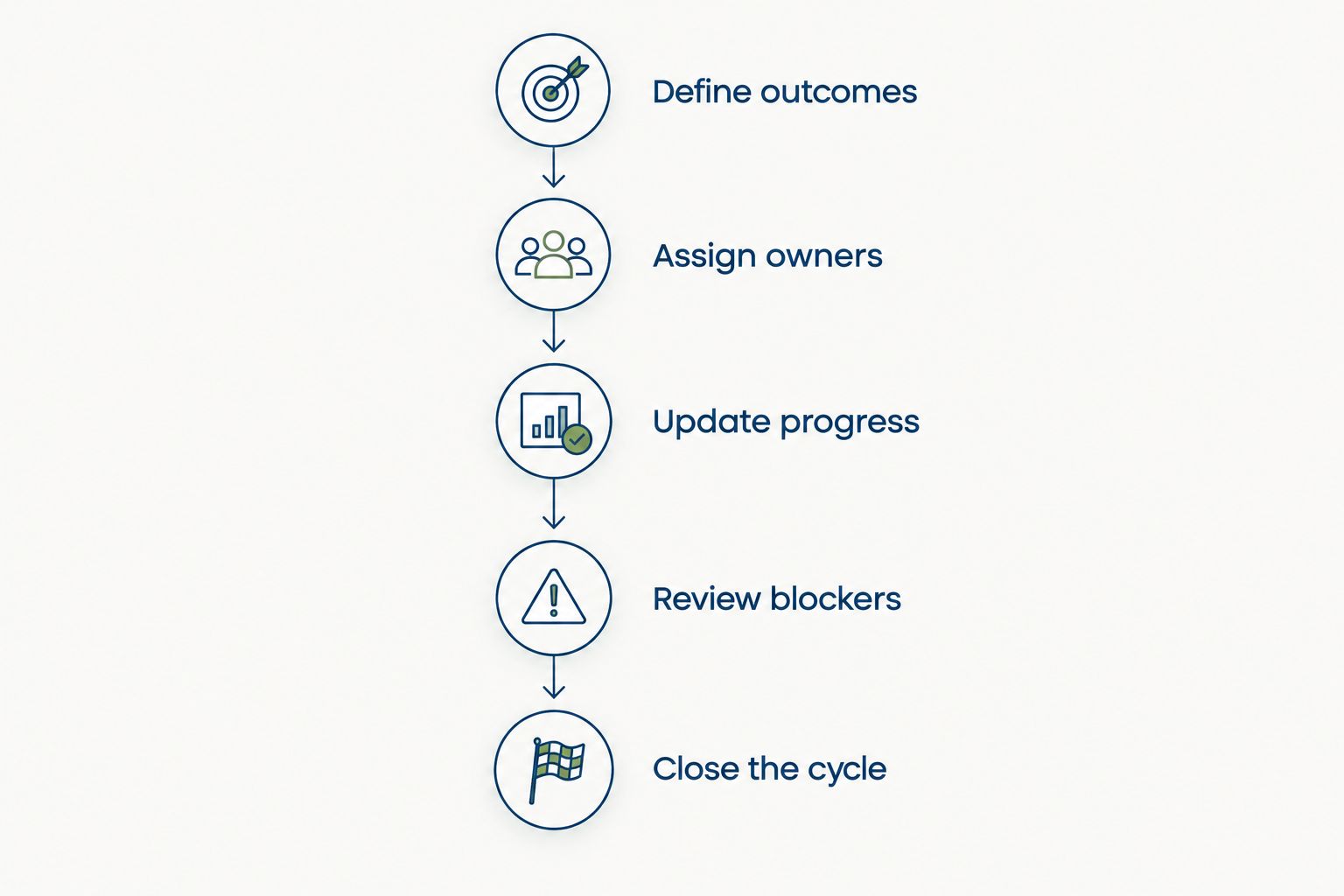
Follow this sequence during your 2026 evaluation:
- Define outcomes: Enter the objective and explain what success means. Reject wording that only describes a task.
- Assign owners: Name the person accountable for the result. Clarify who can update it and who needs visibility.
- Update progress: Change the measurement and add context. Check whether a manager can understand what happened.
- Review blockers: Record a problem and discuss the next decision. Look beyond a status color.
- Close the cycle: Review the outcome and capture what should change in the next planning period.
After the demo, run a 2-week pilot with a small group of managers and contributors. This is a proposed evaluation window, not a vendor implementation promise; its purpose is to expose confusing updates and duplicated work before a wider rollout.
Write down the buying conditions before the pilot starts. Include required permissions, reporting views, exports, module scope and responsibility for administration. Ask for a setup plan tied to your requirements rather than accepting an unsupported promise about implementation speed.
Which OKR software should you choose?
Choose HRSpace for HR-connected goals when you also need a broader employee platform. Start with Perdoo when dedicated OKR management is the main requirement; choose Weekdone for weekly check-ins, Lattice for performance conversations or Asana for project-connected goals.
For your 2026 decision, keep the brief narrow enough to test. A People Operations leader replacing scattered HR processes needs a different shortlist from a founder introducing company-wide strategic planning.
Do not add BambooHR or HiBob to this comparison simply because they are HR brands. Compare the exact goals, performance and reporting scope in the proposed configuration before treating any HR suite as an equivalent OKR system.
FAQ
What's the best OKR software for a small company?
Perdoo is a strong starting point when a small company needs dedicated OKR management. Choose an HR-connected or project-connected alternative when the main requirement is goals within an existing employee or delivery process.
Is an HR platform the same as OKR software?
No. An HR platform can include goals without offering every capability required for a dedicated OKR process. Demonstrate your alignment, measurement and reporting requirements before buying.
What's the difference between an OKR and a KPI?
An OKR combines an objective with measurable key results, while a KPI tracks an ongoing performance measure. A team can use both: one to pursue a defined improvement and the other to monitor business health.
Is Asana better than a dedicated OKR tool?
Asana is the better fit when connecting goals to project execution is your main requirement. A dedicated OKR tool is the more direct shortlist category when organizational goal management is the primary job.
Should employee OKRs determine performance ratings?
Do not make OKR completion the sole basis for a performance rating. Explain how ambition, changed priorities, individual contribution and goal outcomes will be considered in employee reviews.
How should a growing company test OKR software?
Test OKR software with a real objective, an accountable owner and a measurable result. Ask managers and contributors to update progress, explain blockers and review the outcome before committing to a wider rollout.
One last thing
Ask what happens when a goal stops mattering. Change a priority during the demo and inspect how the system preserves context, handles ownership and presents the decision to other teams. A tool that only looks convincing when every goal stays unchanged has not yet passed your buying test.