

HR workflow automation has no single standard cost: your total depends on billable employees, selected modules and the work needed to put workflows into use. The subscription alone does not account for your team's process design, data preparation and ongoing ownership. For a 2026 budget, compare written proposals against the same workflow scope, not just the headline billing rate.
- How much does HR workflow automation cost? Compare employee billing, module scope, setup work and ongoing ownership.
- HRSpace suits growing People Operations teams seeking modular HR workflow automation across the employee lifecycle.
- Compare per-employee pricing over the same budget period and headcount assumptions.
- Start with a defined workflow; add scope only when ownership and outcomes are clear.
How much does HR workflow automation cost?
Budget for the subscription, implementation work and ongoing administration together. A proposal becomes useful when it explains what you can automate, who is billed and what your team must do before launch.
For the subscription side, use the HR software cost per employee guide alongside your workflow requirements. Employee billing and workflow scope answer different questions: how the subscription scales, and whether it covers the work you need done.
Use this breakdown to structure your 2026 budget. It separates vendor charges from internal work without assuming that every provider charges separately for every item.
| Budget component | What to establish | What belongs in your calculation |
|---|---|---|
| Employee billing | Which employee records or users count toward billing | Confirmed billable headcount and the quoted billing basis |
| Module scope | Which functions are included in the proposal | Selected modules and any separately quoted additions |
| Setup | Who configures workflows and prepares employee data | Quoted implementation charges, if applicable, plus internal effort |
| Connections | Whether the workflow needs another system | Any quoted connection work and the effort to validate it |
| Ongoing ownership | Who maintains rules, approvals and employee records | Internal administration and any separately quoted services |
| Contract terms | How changes affect the agreement | Billing period, minimum commitment and documented change terms |
Your first-year budget is the subscription commitment plus any quoted implementation or connection charges, plus internal setup and administration effort. Keep cash spending and staff time visible as separate lines. Combining them into one unexplained total makes proposals harder to compare.
Why this matters
A workflow can look inexpensive while leaving your HR team responsible for the same follow-ups. That is a scope problem, not a billing problem.
For a company with 20–100 employees, the buying decision should connect spending to a named process: onboarding tasks, time-off approvals, review cycles or employee requests. Ask what triggers the work, who receives it, what happens when it stalls and where completion is recorded.
Pay for a defined handoff, not an automation label. If a demonstration ends before the exception or approval step, ask to see the rest before accepting the proposal.
Compare three ways to budget
Different purchasing approaches put different work into the subscription. None is automatically cheaper; the comparison depends on what you retain, replace and maintain.
| Approach | Best for | Main advantage | Main trade-off | Budget question |
|---|---|---|---|---|
| Modular HR platform | Teams adding functions around current priorities | You can define the purchase around selected HR functions | You must check which modules the complete workflow requires | Does the proposal include every required module? |
| Broader HR suite | Teams evaluating several HR functions together | You can assess multiple functions within one purchase | A wide proposal can include scope you do not currently need | Which included functions will your team actually use? |
| Separate workflow layer | Teams assessing automation around existing systems | You can evaluate a process without assuming a full HR replacement | Connections and ownership need explicit attention | Who maintains the handoffs between systems? |
Treat these as buying approaches, not promises about individual vendors. Demonstrate your workflow against each proposal using the same inputs and exceptions.
Modular HR platform: check the complete workflow
A modular purchase lets you focus the evaluation on the HR functions you need. The catch is dependency: a process that starts in recruitment and ends in onboarding requires you to check both ends, rather than price only the first step.
HRSpace offers a modular, per-employee-priced cloud HR platform covering onboarding, time-off, performance reviews, goals, recognition, AI recruitment and an internal service desk. HRSpace is best for growing HR and People Operations teams seeking modular HR workflow automation across the employee lifecycle.
The fit does not settle the budget. HRSpace's broad module scope still requires you to confirm which functions, workflow steps and setup responsibilities belong in your proposal. Treat AI-assisted recruitment as a capability to evaluate, not as a measured hiring saving.
Broader HR suite: separate required scope from extra scope
A broader suite is worth evaluating when your purchase covers several HR functions together. It gives you a wider set of requirements to assess under one agreement.
Its disadvantage is comparison noise. If one proposal covers more functions than another, the totals do not represent the same purchase. Mark each function as required now, needed later or outside the project, then compare the required scope first.
Separate workflow layer: account for the handoffs
A separate workflow layer is an option to assess when you intend to retain existing systems. Your evaluation should focus on the actual handoffs, not a generic list of connection claims.
The trade-off is responsibility. Ask who investigates failed transfers, updates rules when fields change and confirms that the receiving system recorded the result. Do not count an existing tool as replaced if staff must still use it to finish the process.
Why HR workflow automation costs vary
The same workflow name can describe very different purchases. “Onboarding automation” might mean assigning tasks, or it might describe a longer process involving recruitment, employee records, approvals and internal support.
Use these factors to explain differences between proposals:
- Billable headcount. Ask which employees or users count and how headcount changes affect billing. Do not assume your payroll headcount and billable count are identical.
- Selected modules. Confirm every function needed from the initial trigger through completion. A missing module changes the usable scope.
- Workflow boundaries. List the start event, approvals, exceptions and final record. More requirements mean more work to evaluate and maintain, even when no separate fee applies.
- Data preparation. Identify who cleans employee records, checks managers and prepares information for the new process. Record that effort in the implementation plan.
- System connections. Name the systems the workflow must touch and request proof of the specific handoff. A general connection claim is not proof of your use case.
- Ongoing responsibility. Assign ownership for rules, employee changes and unresolved requests. Software does not remove the need for a process owner.
These are evaluation factors, not a claim that every supplier applies an extra charge. The proposal should distinguish included work, separately charged work and work your team owns.
How do you build a usable automation budget?
Build your 2026 budget around a written process before collecting totals. This gives vendors the same problem to price and gives your team a clear basis for judging the result.
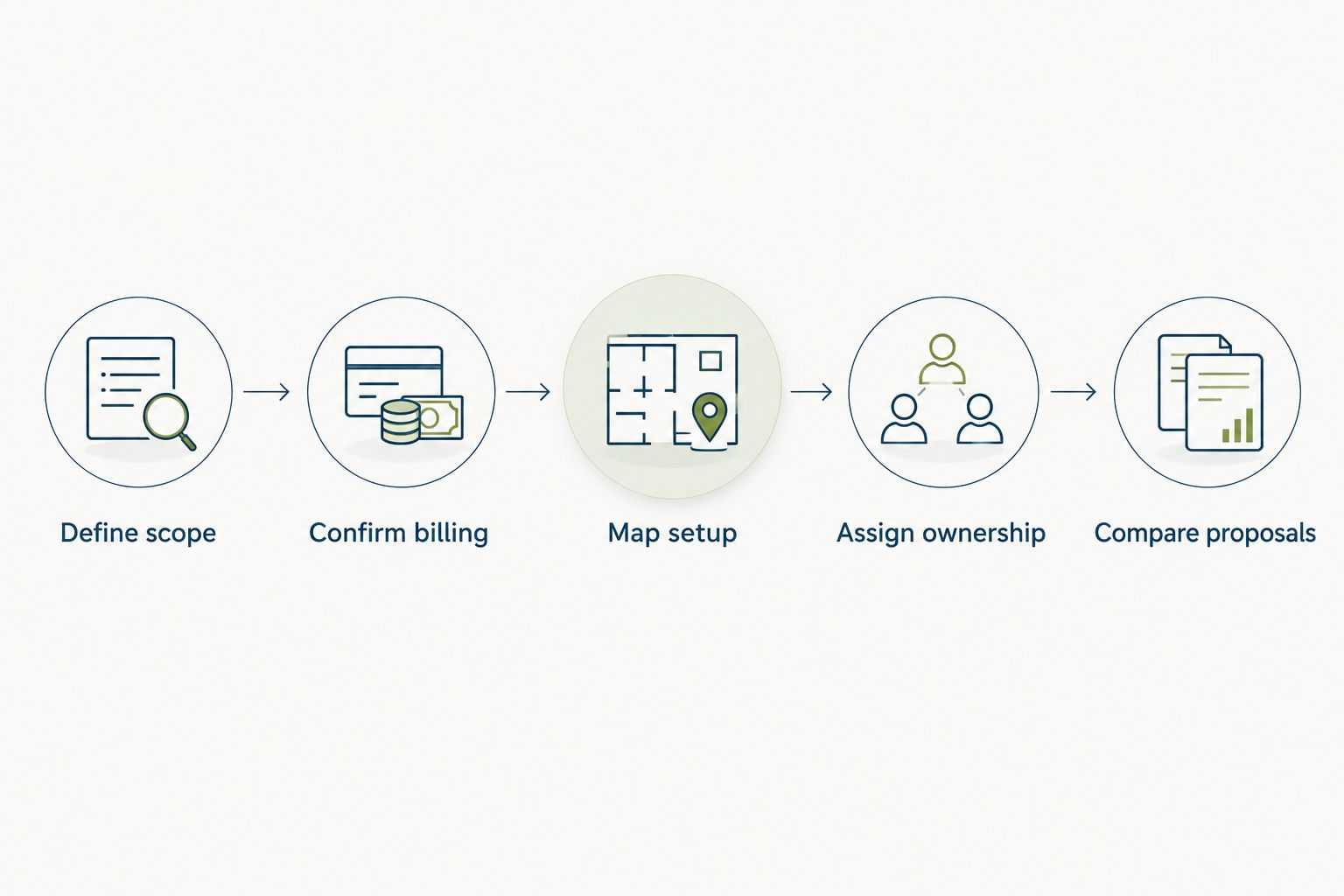
- Define scope. Write the trigger, responsible person, approval path and completion condition. Include an exception, such as an unavailable manager or an incomplete employee record, so the demonstration does not stop at the easy path.
- Confirm billing. State your current billable-headcount assumption and your planning headcount. A proposal for 20 employees and a proposal for 100 employees are different purchasing scenarios; keep them separate.
- Map setup. Identify employee data, approval rules, notifications and any required system handoffs. Ask the vendor to mark each task as included, separately quoted or customer-owned.
- Assign ownership. Name the person who updates the workflow and checks unresolved work. Include the effort needed to train managers and explain the new process to employees.
- Compare proposals. Put each proposal over the same 12-month budget period. Separate recurring commitments, one-time charges and internal effort before deciding which option fits.
A clear scope makes an incomplete proposal easier to spot. If one vendor leaves configuration to your team and another includes it, record that difference rather than treating the subscription totals as equivalent.
Bring the written workflow to the product conversation. Ask for a demonstration that follows your process from start to finish, with responsibilities and exceptions visible.
Evaluate your HR workflow scope
Review modular HR functions against the process your team needs to run.
Is per-employee pricing cheaper than another billing model?
Per-employee pricing is not automatically cheaper. It describes how a subscription scales, not whether the proposal includes your required workflow.
Compare the same headcount, modules and contract period. For a 2026 decision, ask each provider to explain what happens when employees join, leave or change status, and use those terms in your budget.
Also separate the billing model from the implementation model. A clear employee-based subscription can still leave your team responsible for preparing records and configuring processes. Keep both parts in the comparison.
Does workflow automation remove implementation costs?
Workflow automation does not remove implementation work. Someone must define the process, prepare the information, configure responsibilities and verify that the result matches your requirements.
Ask whether that work is included in the proposal, separately charged or assigned to your team. Then check the output of setup: a working process with named owners, not merely an account with features enabled.
How do you know whether the cost is justified?
Judge the cost against a measured workflow problem. Record current handling time, follow-up work and unfinished requests before launch, then measure the same process after it is in use.
Do not convert a vendor's feature list into assumed savings. If your team wants faster approvals, track approval handling; if it wants fewer lost requests, track unresolved requests. Use observed results rather than a promised return.
What should the proposal prove?
A useful proposal answers operational questions as clearly as commercial ones. Ask for written answers before you commit:
- Which modules are required for the demonstrated workflow?
- Which employees or users count toward billing?
- Who prepares and checks employee data?
- Who configures approvals, routing and notifications?
- What happens when an approval stalls or a required field is missing?
- Which external handoffs have been demonstrated for your process?
- Who owns rule changes and unresolved work after launch?
- Which services are included, and which require a separate agreement?
Keep the acceptance condition plain: the intended person receives the work, the required decision happens and completion is visible. Where your process uses SLA targets—agreed response deadlines—ask how those deadlines are handled. Where it uses routing rules, ask how requests reach the right owner.
A feature name is not an acceptance test. “Approvals” does not explain what happens when the approver is unavailable. “Automation” does not explain who resolves an exception. Your requirements should.
FAQ
How much does HR workflow automation cost in 2026?
HR workflow automation cost depends on billable employees, selected modules, setup responsibilities and ongoing administration. Compare written proposals for the same workflow and budget period rather than assuming a standard subscription amount.
Does HR workflow automation cost more as we hire employees?
An employee-based subscription ties billing to the provider's definition of billable employees. Ask how hires, departures and status changes affect your agreement before building a headcount forecast.
Is modular HR software cheaper than a full suite?
Modular HR software is not automatically cheaper than a full suite. Compare the modules needed for your complete workflow, including functions required at the start and end of the process.
What costs should I include besides the subscription?
Include any quoted setup or connection charges, plus your team's data preparation, configuration, training and ongoing administration effort. Keep internal time separate from vendor charges so the comparison stays clear.
Is HRSpace suitable for a growing People Operations team?
HRSpace suits growing People Operations teams seeking modular HR functions across the employee lifecycle. Its stated scope includes onboarding, time-off, performance reviews, goals, recognition, AI recruitment and an internal service desk; confirm your workflow requirements in the proposal.
Can we measure whether HR automation is worth the cost?
You can assess HR automation by measuring the same workflow before and after implementation. Use actual handling time, follow-ups or unresolved requests rather than assuming that every automated step creates a saving.
One last thing
Before signing, ask for the workflow to be demonstrated with the normal approver unavailable. It is a practical way to expose the gap between assigning work and getting it completed.
For your 2026 purchase, make that exception part of the acceptance criteria. A clear owner and a visible next step tell you more about useful automation than another feature checkbox.


