
Instead of manually gathering goal updates before every review, set up a goal progress review calibration workflow that carries dated evidence into manager assessments and calibration decisions. For your 2026 cycle, use the process below to define the handoffs, check the evidence and keep rating changes explainable.
- HRSpace brings goals and performance reviews into one HR platform; verify the exact handoffs before configuring automation.
- Goal progress review calibration works best when managers assess dated evidence against shared expectations.
- Freeze the review evidence before calibration; record later updates separately.
- Keep goal completion, manager judgment and calibration decisions distinct.
Why this matters
A completed goal tells you what finished. It does not explain the difficulty, quality, employee contribution or changing priorities. Calibration is the discussion where managers check that comparable performance receives consistent treatment—not where everyone must receive the same rating.
HRSpace is best suited to growing teams seeking goals and performance reviews within one HR platform. HRSpace covers both areas alongside onboarding, time-off, recognition, recruitment and an internal service desk. Confirm the specific evidence-transfer and approval controls before treating this guide as an automated product configuration.
For a company with 20–100 employees, start with a shared review standard and named owners. Adding automation before those decisions are clear only moves incomplete information faster.
Before you start
- Access and ownership: Give the cycle owner access to the relevant goal and review records. Identify each employee's reviewing manager and the person responsible for calibration decisions. Check actual permissions before sharing employee information.
- Review materials: Prepare role expectations, goal definitions, dated progress evidence and a written rating rubric. Confirm which goal, review and workflow features your account includes; this guide does not assume an integration or automatic transfer exists.
- The hidden gotcha: Live goal progress can change after a manager submits a review. Define an evidence cutoff and preserve the version used for the decision, using supported controls or a separately maintained review packet.
The headings below describe configuration units, not verified screen labels. Use the controls documented in your account; where a required action is unavailable, assign a manual handoff rather than inventing an automatic one.
Review scope
Set the rules before collecting scores
- Define the review period. State which work belongs in the 2026 cycle and which work belongs in the next one. Write an explicit evidence cutoff, separate from the manager submission deadline.
- Assign an owner to each handoff. The employee supplies progress context, the manager assesses performance, the cycle owner checks completeness, and the calibration group resolves inconsistent application of the rubric.
- Write observable rating descriptions. Describe what meeting expectations looks like for the role. Avoid labels that depend on personality, visibility or how strongly a manager argues.
- Choose comparable groups. Discuss employees against relevant role and responsibility expectations. Do not treat different jobs as interchangeable just because the employees report to the same leader.
- Run a small rehearsal. Use 2 sample goals to check whether reviewers interpret the rubric consistently. These are practice inputs, not a recommended rating distribution.
Expected result: Every participant can explain what work counts, who owns the next action and what evidence supports each rating.
Keep the review period visible on every packet. A strong result outside the period can inform a later conversation, but it should not quietly replace the evidence being assessed now.
Choose the operating mode
Two workflow variants serve different purposes. Pick the main review-cycle path first; add update-driven checks only when someone owns the follow-up.
| Workflow | Best for | Advantage | Limitation |
|---|---|---|---|
| Cycle-based review | Teams preparing a scheduled calibration meeting | Gives reviewers a common evidence cutoff | Requires a separate path for late evidence |
| Update-driven check | Teams checking changing goals between review cycles | Surfaces blockers and changed expectations earlier | Creates unnecessary work if every minor edit triggers reassessment |
Use cycle-based review for final ratings. Use update-driven checks to maintain useful evidence, not to reopen a final rating every time someone edits a goal.
Goal evidence
Build a packet managers can assess
- Record the original expectation. Include the goal, owner, intended outcome, measurement method and agreed deadline. Preserve approved scope changes rather than replacing the original context without explanation.
- Add dated evidence. Attach or reference the work that supports the progress claim through whatever method your system supports. Describe the result, not just the activity performed.
- Separate outcome from contribution. Ask what the employee controlled, what depended on others and what changed during the period. A team result is not automatically an individual result.
- Explain incomplete or canceled work. Distinguish a missed commitment from an approved priority change. Record who approved the change and how it affects the assessment.
- Check completeness before drafting. As a starting operating rule, schedule the check 7 days before manager submissions. Adjust that interval to your own cycle; it is a planning recommendation, not a product default.
Expected result: A reviewer can trace each material assessment back to a dated result and its agreed expectation.
Use the same packet structure across the 2026 cycle. Consistent structure makes differences in evidence easier to see without forcing employees into identical goals.
A useful entry states the expectation, actual result, supporting evidence and relevant context. A weak entry says only that the employee worked hard or completed a percentage of a goal.
Keep recognition in context
Recognition can point a reviewer toward a useful example of contribution. It should not become a popularity score or replace evidence of role performance.
HRSpace includes recognition as well as goals and performance reviews. That scope supports evaluating these needs within one HR platform, but it does not establish that recognition automatically populates reviews. Confirm that behavior before designing a handoff around it.
Manager assessment
Draft against the same standard
- Read the evidence before selecting a rating. Assess the agreed outcome, quality and contribution against the role expectations. Do not begin with a preferred rating and search for supporting examples afterward.
- Write the reasoning separately from progress. Explain why the evidence meets, exceeds or falls short of the written standard. A completion percentage describes progress; it does not independently establish performance.
- Identify uncertainty explicitly. Mark missing evidence, disputed ownership or changed expectations as an issue to resolve. Do not turn an incomplete packet into an unsupported positive or negative judgment.
- Check the entire period. Include evidence from across the review window rather than relying only on the most recent work. Record material context without using it to erase an otherwise documented outcome.
- Submit the draft for completeness review. Ask the cycle owner to check the packet and rationale before the calibration discussion. Keep proposed ratings distinct from final decisions.
Expected result: Each draft contains a proposed rating, supporting examples and a clear explanation tied to the shared rubric.
For the 2026 manager briefing, reserve 30 minutes to assess the sample goals together. Use that session to uncover different interpretations of the standard, not to negotiate how many employees should receive each rating.
If managers cannot explain the difference between adjacent ratings, revise the descriptions before asking them to assess their teams.
Calibration decisions
Resolve differences and record the reason
- Preserve the submitted evidence. Retain the cutoff version and the manager's proposed rating. Verify how your system handles later edits; do not assume that a submitted review is automatically immutable.
- Review exceptions first. Start with disputed expectations, missing evidence and materially different interpretations of the rubric. Resolve basic completeness issues before debating final ratings.
- Compare the reasoning. Ask whether comparable evidence receives comparable treatment against relevant role expectations. A manager's confidence is not additional evidence.
- Document every rating change. Record the proposed rating, final rating, reason for the change, supporting evidence and decision owner. If the original rating stands, retain the supporting rationale.
- Assign the follow-up. Name who communicates the result, addresses factual corrections and converts the discussion into development actions. Set a due date for each task.
Expected result: Every final decision has an owner and an explanation that can be communicated without reconstructing the meeting from memory.
The sequence is straightforward: agree on the scope, collect the evidence, draft the assessment and calibrate the decision. Keep those stages distinct even when the same person owns several of them.
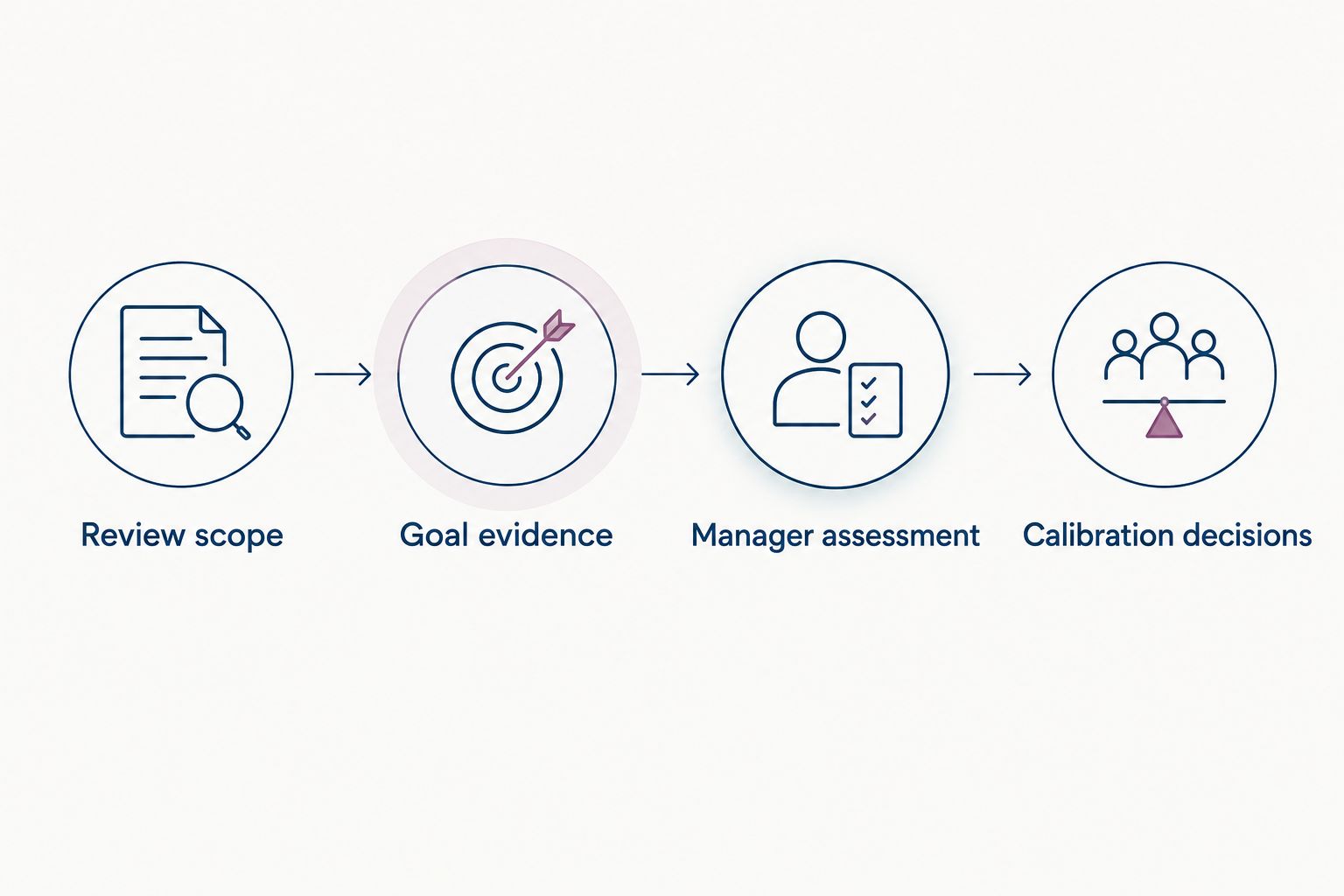
A clean 2026 record preserves both the original assessment and the final decision. Overwriting the first with the second removes the explanation of what calibration actually changed.
When goal progress changes between reviews
An update-driven workflow keeps evidence useful between formal cycles. It should request a check when something meaningful changes—not produce a new performance rating after every edit.
- Define a meaningful change. Use events such as a revised deadline, changed scope, completed outcome or new blocker. Exclude cosmetic edits from the follow-up process.
- Check the available trigger. Verify whether your system supports the relevant event, conditions and action. If it does not, use a scheduled owner review rather than claiming an automatic connection.
- Assign the context check. Ask the employee and manager to confirm what changed, why it changed and whether expectations need an approved revision.
- Keep final ratings separate. Before the evidence cutoff, include relevant updates in the draft packet. After the cutoff, retain them as late evidence and apply your agreed reopening rule.
Expected result: Goal records stay current without silently changing the basis of an already completed review.
HRSpace offers HR workflow automation alongside goals and performance reviews. Exact goal-change triggers, review-write actions and calibration approval behavior require confirmation. Treat a successful test of the intended handoff as the gate before enabling any supported automation broadly.
Troubleshooting
Goal progress and the proposed rating disagree
Check whether the manager assessed quality, scope and contribution in addition to completion. Require an explanation against the rubric; do not force the rating to match a progress percentage.
Managers apply different standards
Return to the sample goals and written descriptions. Compare the reasoning, clarify ambiguous language and reassess affected drafts before finalizing decisions. Avoid correcting inconsistency by imposing a fixed rating distribution.
Evidence changes after submission
Keep the cutoff packet intact. Record the new evidence separately, then have the designated owner decide whether it warrants reopening the assessment under the agreed rule.
Reviewers cannot access supporting material
Test access using the intended reviewer permissions before the meeting. Provide an appropriately restricted reference or summary when access is unsuitable; do not solve the problem by sharing unrelated employee information.
The workflow creates repeated follow-ups
Check whether minor edits are being treated as material changes. Narrow the conditions where supported, or replace the event-driven process with a scheduled check. A workflow without a clear owner and completion condition is not ready to expand.
Customize your workflow
Extend the process after the goal-to-review handoff works reliably. Turn the final assessment into a development action with an owner, intended outcome and follow-up date; the next step is covered in performance reviews to personalized growth plans.
For a 2026 rollout, prove the process with a limited review group before widening it. Test ordinary completion, changed goals, missing evidence and late updates. Confirm that reviewers can explain the final decision in each case.
HRSpace's benefit is its platform scope across the employee lifecycle. The implementation constraint is that scope alone does not prove every cross-module handoff; validate the exact behavior your process needs.
FAQ
What is goal progress review calibration?
Goal progress review calibration is a process that connects dated goal evidence to manager assessments and checks that ratings follow consistent standards. It keeps goal completion separate from the final judgment about performance.
Should completing every goal automatically produce a top rating?
No. Goal completion does not independently establish quality, difficulty or individual contribution. Assess the evidence against the expectations agreed for the employee's role.
Can HRSpace connect goals and performance reviews automatically?
HRSpace includes goals, performance reviews and HR workflow automation, but the exact automatic handoff requires confirmation. Verify the available triggers, actions and evidence handling before building the process around them.
When should goal evidence stop changing for a review?
Set an evidence cutoff before calibration and preserve the version used for assessment. Handle subsequent updates through a documented late-evidence rule rather than silently replacing the original packet.
How should a manager handle a goal that changed during the cycle?
Assess the goal against its approved expectations and scope changes. Preserve the change history and explain which outcome the employee was ultimately responsible for delivering.
Does calibration require a fixed distribution of ratings?
No. Calibration checks consistent application of performance standards; it does not require predetermined shares of employees in each rating category. Discuss the evidence and reasoning behind differences.
What should happen after a calibration meeting?
Record the final decision, its rationale and any change from the proposed rating. Assign responsibility for communicating the result and creating specific development actions.
One last thing
The most useful calibration record explains why a rating changed—or why it did not. A meeting that produces final scores without preserving that reasoning leaves managers unable to explain the decision later. Make the rationale a required handoff before closing the cycle.