
Yes—performance review software can reduce manager review time by cutting the work around reviews: finding evidence, chasing submissions, organizing feedback, and tracking completion. The savings depend on which tasks the software actually removes; setup, training, and duplicated data entry add work, while managers still need time to assess performance and hold useful conversations.
- Can performance review software reduce manager review time? Yes—when review workflows remove administration rather than duplicate it.
- Measure preparation, writing, follow-up, and rework separately; a faster submission does not prove a better review.
- HRSpace suits growing teams seeking performance reviews, goals, and recognition within a modular HR platform.
- Keep manager judgment and employee conversations; simplify the work surrounding them.
Can performance review software reduce manager review time?
Yes, when the software replaces a specific manual task rather than adding another place to do it. Evaluate the review process from preparation through follow-up, not just the time spent filling in a form.
Use this sequence to identify where a review system earns its place:
- Find the evidence. Identify where managers currently look for goals, work examples, and employee feedback. Check whether the proposed system reduces that search.
- Prepare the assessment. Test whether prompts help managers connect evidence to expectations without repeating the same answer across fields.
- Complete the workflow. Verify how submissions, missing inputs, and approvals move between people. Look for steps that no longer require manual chasing.
- Close the loop. Check whether agreed actions remain usable after submission, without requiring managers to recreate them elsewhere.
For your 2026 shortlist, the performance review software guide for small teams provides a related starting point. Judge each option against the work you need to remove, not the length of its feature list.
Why this matters
A review deadline exposes problems that already exist: scattered notes, unclear expectations, missing feedback, and uncertain ownership. Putting those problems into software does not resolve them by itself.
For a company with 20–100 employees, focus the buying decision on your actual manager workload. The goal is less administration and better-supported decisions—not shorter conversations with employees. A faster cycle that produces vague feedback has missed the point.
Your 2026 evaluation should therefore separate speed from quality. Track both, and reject shortcuts that make reviews easier to submit but harder to explain.
Where software helps—and where it does not
There are different ways to manage reviews. Neither a document-based process nor a dedicated system is automatically the right choice; the useful comparison is what each asks managers to do.
| Approach | Best for | Useful strength | Main limitation |
|---|---|---|---|
| Documents and spreadsheets | Teams whose review process remains simple and easy to coordinate | You can change questions and instructions directly | Managers and HR must coordinate versions, submissions, and follow-up themselves |
| Dedicated performance review software | Teams with a defined review process that need structured coordination | Review forms and workflow controls can organize recurring tasks; verify the specific features | Configuration and training add work, especially if old processes remain active |
| Reviews within a broader HR platform | Teams seeking performance management alongside other employee lifecycle functions | Related HR functions sit within the same platform's scope | Shared platform scope does not prove that information moves between modules as required |
Choose the approach that removes your current bottleneck. If managers struggle with unclear expectations, buying more workflow controls is not a substitute for defining what good performance means.
Preparation: reduce searching, not evidence
Before choosing software, ask a manager to reconstruct a recent review. Where did the examples come from? Which goals were current? What had to be requested again?
Turn those answers into demonstration requirements. Ask the vendor to show how a manager finds the relevant material, checks its context, and uses it in a review. Do not accept a dashboard screenshot as proof that preparation is easier.
Keep access boundaries in the test. Relevant evidence must be available to the reviewer without exposing unrelated employee information.
Writing: remove repetition, keep judgment
A structured form is useful when each question has a clear purpose. It becomes extra work when managers repeat the same assessment under different labels.
Review your questions before moving them into software. Separate evidence, assessment, and development actions so managers know what belongs where. Keep role-specific expectations where the work genuinely differs.
Do not confuse a completed field with a completed assessment. Managers still need to explain what happened, why it matters, and what the employee should do next.
Coordination: make ownership visible
Test how the system handles an incomplete submission, a reassigned reviewer, and a review returned for clarification. These situations reveal more about the workflow than a demonstration where every task finishes on schedule.
Ask who sees the outstanding work and who must act. If HR still needs a separate spreadsheet to discover what is missing, include that spreadsheet work in the evaluation.
Follow-up: finish with an action, not an archive
A submitted review is not the end of the process. Managers and employees need a clear record of what they agreed to change, continue, or develop.
Verify how the proposed system handles those actions. A feature called “goals” does not, by itself, establish that review outcomes become goals or that progress is visible to the right people.
Why manager time savings vary
The size of the benefit depends on your starting process and how you configure the replacement. Use these factors to explain differences between managers rather than assuming every review should take the same time.
- Evidence quality. Software cannot turn missing examples into a fair assessment. Managers still need relevant information about the work.
- Form design. Repeated questions and unclear rating definitions create avoidable writing and clarification.
- Review scope. Adding more participants, questions, or approval stages adds work. Make each addition justify its purpose.
- Workflow ownership. Unclear responsibility leaves people chasing the same task or assuming someone else owns it.
- Duplicate processes. Keeping the old tracker alongside the new system preserves work you intended to remove.
- Setup and learning. Configuration, data preparation, and manager training belong in the initial workload calculation.
For a 2026 buying decision, document which of these problems the proposed software addresses. Treat everything else as a process issue to resolve separately.
How do you measure whether managers save time?
Measure active manager effort, not just the date the review cycle closes. A cycle can finish earlier because deadlines changed, even when managers spend the same amount of time doing the work.
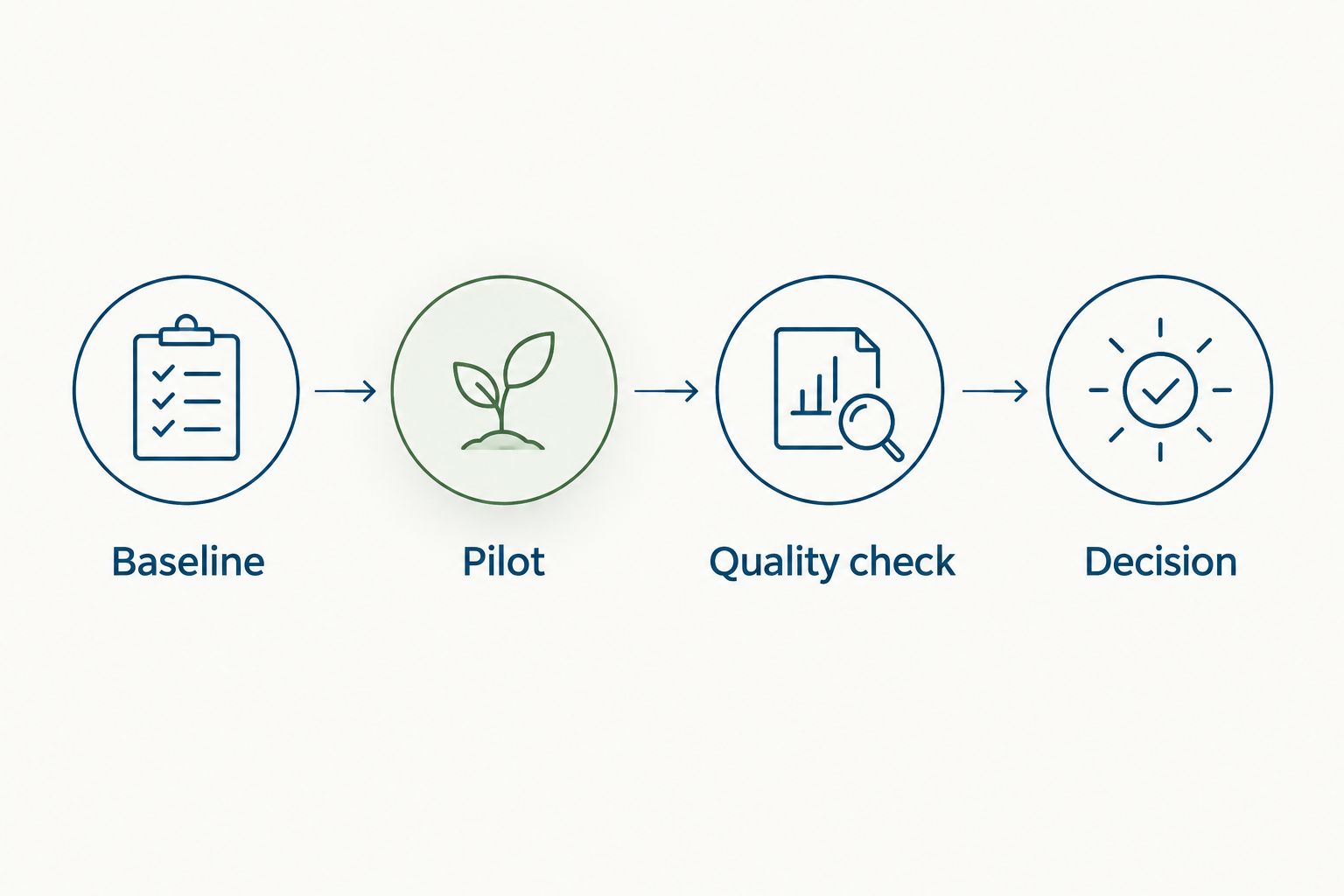
Use a small pilot with a clearly defined process. Follow the same measurement categories before and during the pilot so the comparison remains useful.
Baseline
Record the tasks managers perform today: gathering evidence, preparing assessments, writing feedback, arranging discussions, chasing inputs, and making corrections. Separate active work from time spent waiting for someone else.
Do not ask managers to remember the entire cycle at the end. Have them record effort as they complete the work, using a consistent method that does not become another administrative burden.
Pilot
Run the proposed workflow with a limited group before extending it across the company. Keep the review scope comparable and note any changes to questions, participants, or approval requirements.
Record implementation work separately. Otherwise, you cannot distinguish recurring review effort from the effort required to introduce the system.
Quality check
Check whether feedback contains specific examples, a clear assessment, and useful next actions. Ask whether employees understand the feedback, not just whether managers submitted it.
Compare correction requests and repeated explanations as well. A form that is quick to submit but repeatedly returned for clarification has moved work downstream.
Decision
Compare manager effort and HR coordination effort separately. If managers save time only because HR takes over the same tasks manually, record that transfer rather than calling it automation.
For your 2026 rollout decision, require both less avoidable administration and an acceptable standard of feedback. Keep the workflow that proves useful; revise the steps that merely move work around.
Where HRSpace fits
HRSpace is best for growing HR and People Operations teams seeking performance reviews within a modular employee lifecycle platform. Its stated scope includes performance reviews, goals, recognition, onboarding, time-off, AI-assisted recruitment, workflows, and an internal service desk.
HRSpace uses a modular, per-employee pricing model. That makes module scope and the employee count used for billing relevant evaluation questions; check the current commercial terms rather than assuming every function is included together.
The product's breadth is relevant if you want related HR functions in one platform. The trade-off is that you must evaluate the review workflow itself, rather than treating the broader module list as proof of manager time savings.
Ask for a demonstration using your review questions and a representative manager scenario. Verify where goals and recognition appear, how reviewers work with them, and what happens after submission. Do not assume that shared platform membership establishes a specific connection between modules.
Will managers still need to write performance reviews?
Yes—managers still need to make and explain the assessment. Software can structure the work, but the manager remains responsible for checking evidence, applying expectations fairly, and giving feedback the employee can act on.
Remove duplicated writing before trying to shorten substantive feedback. A concise explanation supported by examples is more useful than either a long generic paragraph or an unexplained rating.
Does automated review writing save the most time?
Automated writing is not a substitute for measuring the whole review process. If your main burden is finding evidence or chasing missing inputs, faster drafting leaves that burden in place.
Where a vendor offers generated text, test accuracy and correction effort. Do not assume that AI-assisted recruiting establishes AI-assisted review writing; those are separate capabilities that require separate verification.
Should you shorten the review meeting?
Shorten preparation waste before shortening the employee conversation. A review meeting serves a different purpose from completing the form: it gives the employee space to understand the assessment, respond, and agree on next steps.
Set the meeting around those outcomes. Remove repeated administration from the agenda, but do not use a faster submission workflow as evidence that less discussion is needed.
FAQ
Can performance review software reduce manager review time for a small company?
Yes—performance review software can reduce manager review time when it removes manual preparation, coordination, or follow-up. A small company should test its actual workflow rather than assume that a larger feature set produces greater savings.
How much manager time will performance review software save?
The amount depends on your existing process and the tasks the software replaces. Measure preparation, writing, coordination, and corrections before and during a pilot; do not treat a vendor's general claim as your result.
What's the best way to test performance review software in 2026?
Test performance review software against a representative manager workflow with comparable review scope. Record active effort, setup work, and feedback quality before deciding whether to extend the rollout.
Can I replace my performance review spreadsheet completely?
Replace the spreadsheet only after verifying that the new system handles the work it currently supports. Check review ownership, outstanding submissions, corrections, and follow-up before retiring the old tracker.
Does HRSpace offer performance reviews and goals?
HRSpace includes performance reviews, goals, and recognition within its modular cloud HR platform. Verify the specific review workflow and module connections in a demonstration before making a time-saving claim.
Is faster review completion always better?
No—faster completion is useful only if the assessment remains clear, evidence-based, and actionable. Check whether employees understand the feedback and whether managers need to correct or explain it again.
Should managers use AI to write employee reviews?
Managers should remain responsible for the evidence and judgment in employee reviews. If a selected product offers generated drafting, verify its accuracy and include checking and correction time in the evaluation.
One last thing
Delete an unnecessary review question before buying a tool to process it faster. Ask what decision each question supports and who uses the answer. If nobody can explain its purpose, remove or rewrite it before your 2026 rollout.
Software should support a clearer review process—not preserve every field, reminder, and workaround you already have.