
PrismHR’s strength is payroll, benefits and HR administration for professional employer organizations (PEOs) and administrative services organizations (ASOs). That service-provider focus is a different requirement from running HR inside your own growing company. The best PrismHR alternative in 2026 is HRSpace if you need modular HR software for your own team; Rippling if you need HR, payroll and IT together.
- For PrismHR alternatives, choose HRSpace for modular HR software covering onboarding, performance, recruitment and employee support.
- Shortlist Rippling when payroll and IT administration belong in the same buying decision.
- Compare BambooHR and HiBob when employee records and people management drive your requirements.
- Keep PrismHR on the shortlist when you administer payroll and benefits for client employers.
Why this matters
A PEO buying software for client employers and a founder buying software for employees are solving different problems. Start there. A feature checklist alone will not tell you whether a platform fits your operating model.
For a company with 20–100 employees, the decision often centers on who handles onboarding, leave approvals, reviews and employee questions. For an HR service provider, client administration and payroll operations belong at the center of the evaluation instead.
This 2026 comparison separates those buying needs. It is a shortlist by use case, not a claim that every platform replaces every PrismHR function.
PrismHR alternatives at a glance
| Platform | Best for | Standout focus | How it differs from PrismHR |
|---|---|---|---|
| PrismHR | PEOs and ASOs serving client employers | Payroll, benefits and HR administration for service providers | The benchmark when client-service operations drive the purchase |
| HRSpace | Growing companies buying modular HR software | Onboarding, time-off, performance, recruitment and an internal service desk | Focuses on an employer’s employee lifecycle rather than establishing a replacement for PEO operations |
| Rippling | Employers evaluating HR, payroll and IT together | Connected employee administration across those functions | Suits a broader employer-side systems decision |
| BambooHR | Employers prioritizing core HR and employee records | Employee information, onboarding and people-management tools | Centers the internal HR team’s work rather than PEO client administration |
| HiBob | Companies prioritizing people management and employee engagement | Core HR, performance and employee experience | Emphasizes employer-side people processes |
Do not read a longer feature list as a better fit. First decide whether you need to serve client companies, operate your own HR function or combine HR with payroll and IT.
1. HRSpace: best for modular HR at growing companies
HRSpace is the best-fit PrismHR alternative for growing companies that need modular HR software rather than a PEO operating platform. It covers onboarding, time-off, performance reviews, goals, recognition, AI recruitment, workflow automation and an internal service desk. The modules use a per-employee pricing model, so define the scope you need before comparing proposals.
The practical benefit is breadth across everyday people operations. You can evaluate hiring, joining, development and employee support within one platform instead of treating each as an unrelated software purchase.
Where it shines
- Employee lifecycle coverage: Assess recruitment, onboarding, time-off, reviews, goals and recognition together.
- Modular scope: Choose around the HR work your team needs rather than assuming every module belongs in the initial rollout.
- Internal service desk: Give employee requests a defined support process, with routing rules, SLA targets and approval chains.
- AI-assisted recruitment: Include recruiting in the same platform evaluation as onboarding and ongoing employee management.
Where it falls short
- Not an established PEO replacement: Do not select it as a substitute for client payroll and benefits administration without validating those requirements separately.
- Separate systems still need decisions: If you retain payroll or IT tools, confirm the required data exchange before committing.
- Modularity requires ownership: Someone still needs to select modules, configure workflows and keep approval responsibilities current.
| Decision area | This alternative | PrismHR |
|---|---|---|
| Primary buyer | Internal HR and people operations teams | PEOs and ASOs |
| Main evaluation | Employee lifecycle modules and internal support | Client HR, payroll and benefits administration |
| Payroll-dependent replacement | Validate separately | Central to its service-provider focus |
| Employee requests | Internal service desk with routing and SLA targets | Validate the required request workflow in a demonstration |
Best for: A growing employer that wants onboarding, performance, recruitment and employee support in a modular HR platform.
Verdict: Buy for internal HR needs after validating your payroll boundaries; skip as an assumed like-for-like PEO replacement.
2. Rippling: best for HR, payroll and IT together
Rippling belongs on the shortlist when the purchase extends beyond HR. Its product scope includes HR, payroll and IT administration, making it relevant when employee changes need attention across several business systems.
The distinction from PrismHR is the buying context. Evaluate Rippling around your own employee operations, then test any service-provider requirements separately.
Where Rippling shines
- Broader administrative scope: Compare HR, payroll and IT within the same platform decision.
- Employee-change workflows: Ask how a hire, role change or departure affects the functions you select.
- Cross-functional ownership: Bring HR, finance and IT into one evaluation rather than running disconnected selections.
Where Rippling falls short
- More scope to evaluate: A broader platform means more purchasing and implementation decisions when you only need core HR.
- Not automatically a PEO operating substitute: An employer-facing payroll capability does not establish support for your client-service model.
- Package fit matters: Confirm which products and workflows are included in the proposed scope.
| Decision area | Rippling | PrismHR |
|---|---|---|
| Core shortlist reason | HR, payroll and IT administration | PEO and ASO administration |
| Buying team | HR, finance and IT stakeholders | HR service-provider operations |
| Demonstration priority | Employee changes across selected functions | Client payroll and benefits workflows |
Best for: An employer that wants to evaluate HR, payroll and IT as a connected administrative purchase in 2026.
Verdict: Buy when cross-functional administration is the requirement; skip the broader scope when it does not solve a defined problem.
3. BambooHR: best for core HR and employee records
BambooHR is a relevant alternative when your main requirement is managing employees inside your own company. Its established scope includes employee records, onboarding, time-off and performance management.
Use the evaluation to test ordinary HR work. Find an employee record, process a leave request and show a manager completing their part of onboarding.
Where BambooHR shines
- Core HR focus: Employee information and everyday HR processes sit at the center of the evaluation.
- Onboarding and time-off: Test processes that employees and managers use directly.
- Performance management: Include review workflows in the same shortlist as core employee administration.
Where BambooHR falls short
- Different operating model: Core employer HR is not equivalent to administering PEO client companies.
- Support workflows need scrutiny: Demonstrate your employee-request process rather than assuming an HR record resolves support needs.
- Scope needs confirmation: Check the exact package and any additional products required for your workflow.
| Decision area | BambooHR | PrismHR |
|---|---|---|
| Primary use case | Internal employee administration | HR service-provider operations |
| Demonstration focus | Records, onboarding, time-off and reviews | Client administration, payroll and benefits |
| Best-fit question | Can your managers complete everyday HR tasks? | Can your team operate its client services? |
Best for: An employer whose 2026 shortlist starts with employee records and core HR processes.
Verdict: Buy for a validated core HR fit; skip if your primary requirement is PEO client administration.
4. HiBob: best for people management and engagement
HiBob is relevant when core HR, performance and employee experience lead the purchase. Compare it with BambooHR when you are selecting an internal people platform, not simply searching for another payroll administration system.
Where HiBob shines
- People-management focus: Evaluate employee information, performance and engagement together.
- Manager involvement: Test how managers participate in the processes you intend to introduce.
- Employee experience: Include the employee’s side of a workflow, not just the administrator’s controls.
Where HiBob falls short
- Not a like-for-like category match: People-management software does not establish PEO operating capability.
- Payroll requirements remain separate checks: Confirm the relevant country, provider and data-handling requirements.
- Configuration still matters: A people platform needs clear process owners and maintained employee data.
Best for: An employer that puts performance, engagement and internal people processes ahead of service-provider administration.
Verdict: Buy for demonstrated people-management fit; skip as an assumed replacement for PrismHR’s service-provider role.
Why people switch from PrismHR
The clearest reason to consider alternatives is a mismatch between your operating model and your software requirements. That is not a criticism of PrismHR. A platform designed around service providers answers a different question from software selected by an internal HR team.
Use these requirements to decide whether switching belongs on the agenda:
- Internal HR: You need onboarding, leave, reviews and hiring for your own employees.
- Employee support: You need requests assigned, tracked and resolved rather than left in chat.
- Connected administration: You want HR, payroll and IT evaluated together.
- Client administration: You need to serve multiple employer clients, making PEO and ASO requirements central.
The first three requirements justify exploring different platform categories. The fourth is a reason to keep PrismHR in serious consideration. None establishes that your current system is failing.
For approval-heavy work, use the HR workflow automation tools guide to define the process before selecting software.
Prove the fit before switching
A useful 2026 demonstration follows work from beginning to end. Ask each vendor to use the same scenarios and identify every manual handoff. Do not compare a polished onboarding tour from one vendor with a payroll presentation from another.
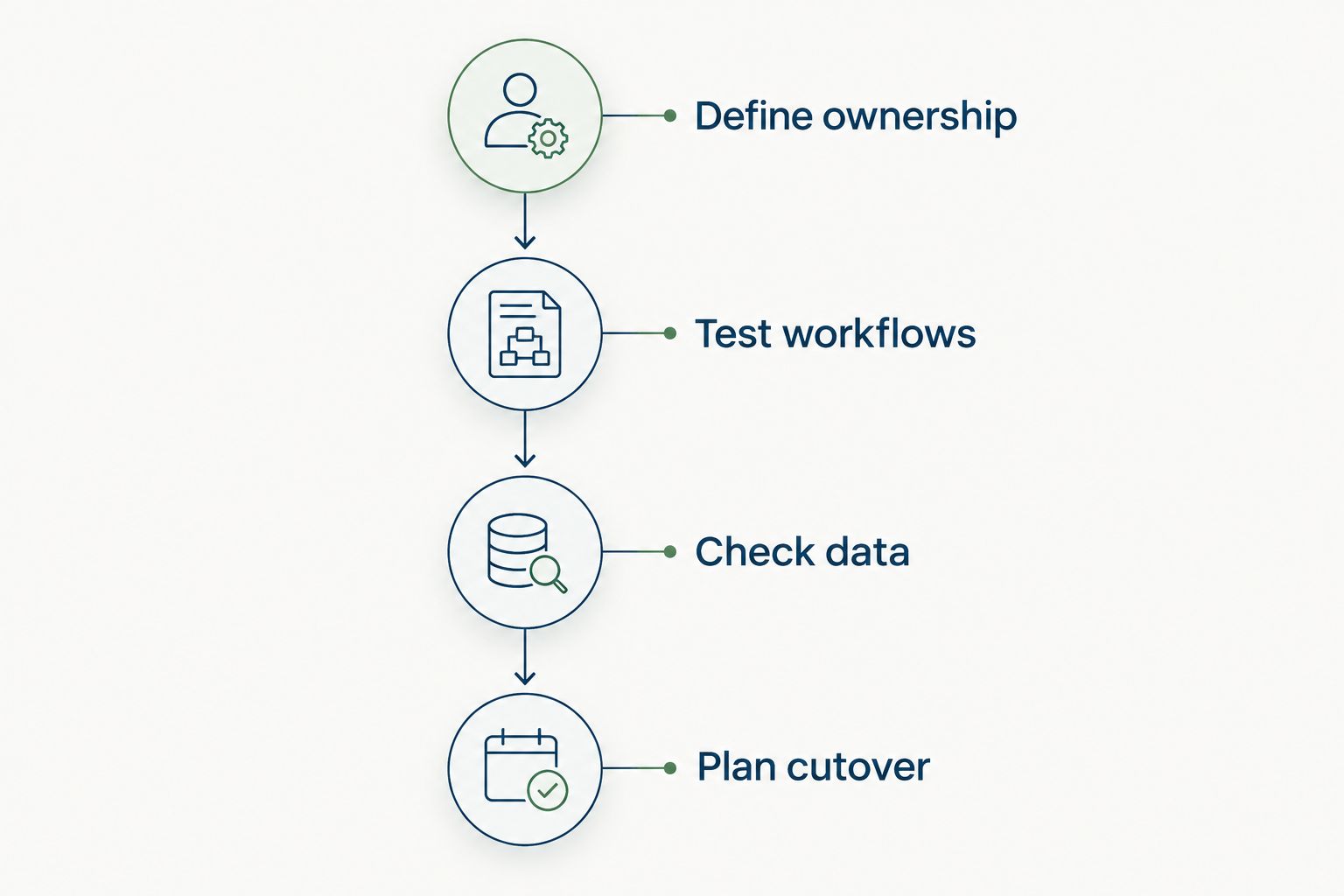
Use this evaluation sequence:
- Define ownership: Decide whether your company, a PEO or another provider owns each process.
- Test workflows: Demonstrate a new hire, a leave request, a review and an employee support request.
- Check data: Confirm required fields, historical records, exports and access responsibilities.
- Plan cutover: Assign migration, validation, employee communication and rollback responsibilities.
Ask the vendor to show an exception, not just a successful path. What happens when an approver is absent, a start date changes or a required field is missing? The answer reveals who must intervene.
Compare proposals at 20 employees, 50 employees and 100 employees as planning scenarios, not forecasts. Keep the module list and service requirements identical across proposals so a smaller scope does not masquerade as better value.
For HRSpace, include the internal service desk in that demonstration. Follow a request through routing, approval and resolution, then confirm which payroll responsibilities remain outside the selected scope.
When staying with PrismHR is right
Stay with PrismHR when PEO or ASO operations remain the requirement and your current workflows meet it. A change in interface or a broader employee-experience feature list is not, by itself, a reason to replace a service-provider platform.
Before approving a switch in 2026, identify which client, payroll and benefits responsibilities must continue without interruption. Require evidence that the replacement covers those responsibilities. If the shortlist only solves internal HR, it is not yet a replacement shortlist.
FAQ
What is the best PrismHR alternative for a small company?
HRSpace is the best-fit option in this shortlist for a growing company seeking modular internal HR software. Its scope includes onboarding, time-off, performance, recognition, AI recruitment and an internal service desk; validate payroll requirements separately.
Can an HR platform replace PrismHR for a PEO?
An internal HR platform is not automatically a replacement for PrismHR at a PEO. Validate client administration, payroll, benefits and service-provider workflows before treating any product as equivalent.
Is Rippling better than PrismHR?
Rippling is the more relevant shortlist option when an employer wants HR, payroll and IT administration together. PrismHR remains relevant when the buyer operates a PEO or ASO serving client employers.
Should I compare BambooHR with PrismHR?
Compare BambooHR with PrismHR when you need to establish whether internal HR or service-provider administration is the real requirement. BambooHR belongs on an employer-side shortlist centered on employee records and everyday HR processes.
When should I consider HiBob instead of PrismHR?
Consider HiBob when your buying priorities are internal people management, performance and employee engagement. Validate payroll and client-service requirements independently rather than assuming those categories are interchangeable.
How should I compare PrismHR alternative proposals?
Compare proposals using the same employee count, modules and operational requirements. Include implementation responsibilities, data migration and any separate payroll or IT arrangements in the evaluation.
What should I test before changing HR software in 2026?
Test complete onboarding, leave, performance and employee-support workflows before changing HR software in 2026. Include exceptions, data exports and process ownership rather than relying on a feature checklist.
One last thing
The decisive comparison is not the dashboard. It is the handoff.
Take one employee change and ask who owns every consequence: the HR record, payroll update, approval and employee question. Choose the platform that fits those responsibilities, not the one that merely displays them.