
Choose HRSpace if you run HR for your own growing company and want modular tools across the employee lifecycle; choose PrismHR if you operate a professional employer organization (PEO) or administrative services organization (ASO) and need technology for serving client employers. The deciding factor in 2026 is internal people operations versus outsourced HR administration—not which platform has the longest feature list.
- HRSpace vs PrismHR is an internal people operations versus HR service-provider decision, not a like-for-like software contest.
- HRSpace is best for growing companies wanting modular HR software across onboarding, performance, recruiting and employee support.
- PrismHR is best for PEOs and ASOs administering HR, payroll and benefits for client employers.
- Compare responsibility for payroll, required modules and implementation work before evaluating commercial terms.
Why this matters
Buying software for your employees is different from buying software to administer other employers' workforces. That distinction changes your requirements before you reach onboarding screens, reporting or contract terms.
A company with 20 employees should start with its internal HR workload. A PEO serving client employers needs to evaluate service delivery across those businesses. Those are different buying briefs, even when both contain the words HR software.
Choose the operating model first. Compare individual features second. Otherwise, you risk selecting around functionality your team will not use while overlooking the administrative work it must complete.
At a glance
This 2026 comparison separates confirmed product scope from items that need a vendor demonstration. A requirement to verify is not evidence that a product lacks a feature.
| Dimension | HRSpace | PrismHR |
|---|---|---|
| Best for | Growing companies managing their own employees | PEOs and ASOs serving client employers |
| Standout focus | Modular employee-lifecycle tools and an internal service desk | Technology for outsourced HR administration |
| Payroll and benefits administration | Not established in the supplied product scope | Core areas of its PEO and ASO platform |
| Onboarding | Included in the stated platform scope | Evaluate within the provider's client-service setup |
| Performance and engagement | Performance reviews, goals and recognition | Verify the proposed package against your requirements |
| Internal employee support | Internal service desk, routing rules, SLA targets and approval chains | Verify how internal requests differ from client-service work |
| Implementation | No verified implementation duration | No verified implementation duration |
| Pricing model | Modular, per-employee pricing | Confirm the billing basis and scope in the proposal |
PrismHR fits service providers; internal teams need a different brief
PrismHR wins when your business delivers outsourced HR administration to client employers. Its PEO and ASO focus addresses a different operating model from an internal People Operations team supporting its own company.
If you are a founder, operations leader or HR manager at a growing business, start with the employee tasks you own. Onboarding, time-off requests, reviews, goals and employee questions form a practical internal-software brief. You do not need to adopt a service-provider brief simply because payroll appears somewhere on your list.
The limitation works both ways. An internal employee-lifecycle platform is not automatically a substitute for the technology a PEO uses to administer client accounts.
Before scheduling demonstrations, write down who will use the system and whose employees it will serve. If your answer includes multiple client employers, make that central to the evaluation. If it names only your own workforce, keep the shortlist focused on internal HR outcomes.
HRSpace brings internal people workflows into one platform
HRSpace is best for growing companies that want modular HR software across the employee lifecycle. Its stated scope covers onboarding, time-off, performance reviews, goals, recognition, AI-assisted recruitment, workflow automation and an internal service desk.
The practical advantage is breadth across the work your own people team handles. You can evaluate hiring, employee development and support as parts of the same platform rather than treating each as a separate purchasing decision.
That breadth has a boundary: it does not establish payroll processing, benefits administration or every connection to your existing systems. Do not turn an all-in-one HR description into an assumption that every workforce process is included.
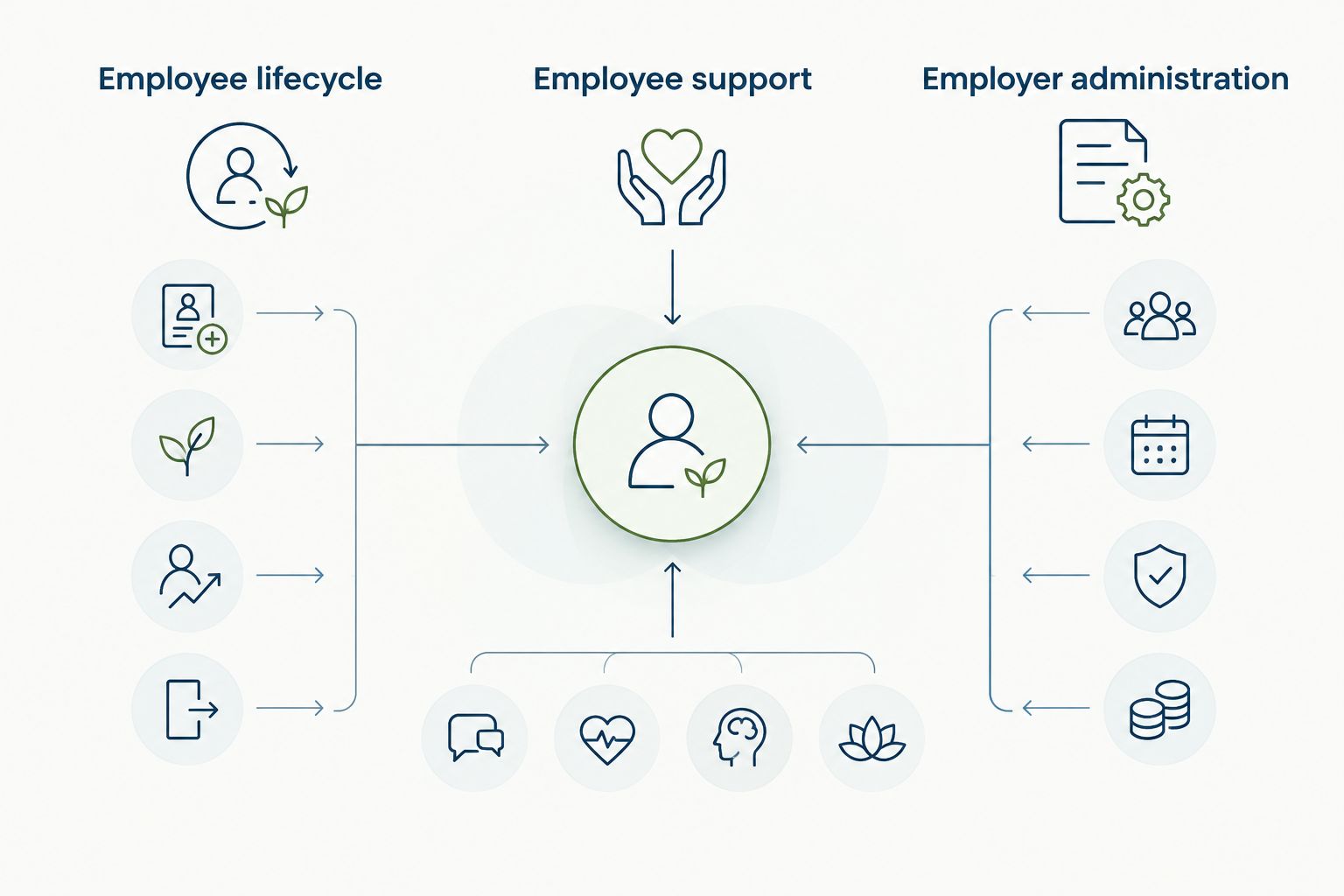
For your 2026 shortlist, divide requirements into three groups:
- Employee lifecycle: hiring, onboarding, time-off and development.
- Employee support: questions, requests, ownership and approvals.
- Employer administration: payroll, benefits and other obligations that need separate verification.
Keep those groups visible throughout the buying process. A strong employee experience does not answer a payroll requirement, and payroll depth does not prove that managers will use performance tools.
PrismHR has the clearer payroll-administration fit
PrismHR wins when payroll and benefits administration for client employers define the purchase. Those functions sit within its established focus on technology for PEOs and ASOs.
That does not mean an individual employer should automatically buy the same technology its HR service provider uses. First establish whether you are choosing an administration platform, selecting a provider or replacing software used by your internal team. Each decision needs a different comparison.
For the internal-HR option, payroll processing is not established by the supplied product description. Keep any existing payroll arrangement in your plan until you have verified what data must move, who moves it and which connections are supported.
Ask both vendors to explain responsibility, not just functionality:
- Who prepares and checks payroll inputs?
- Who executes payroll and handles corrections?
- Which benefits tasks belong to the software, your team or a service provider?
- What happens when an employee record changes?
A demonstration is useful only when it makes those handoffs clear.
Onboarding needs a workflow test, not a declared winner
There is no defensible onboarding winner without comparing the actual workflow you need. Onboarding is explicitly included in the internal platform's scope; a PrismHR evaluation should establish how onboarding works within the proposed provider and client setup.
Use the same new-hire scenario in each demonstration. Identify the information the employee supplies, the tasks the manager owns and the approvals HR must complete. Then ask the demonstrator to show what happens when a task remains unfinished.
Do not confuse a feature name with an operating process. A useful evaluation shows who owns the next action and how your team finds incomplete work.
For a company with 50 employees, write a sample onboarding brief using your actual roles and policies. That headcount is an evaluation scenario, not a threshold at which either product becomes better.
Include any requirements for documents, signatures, equipment requests or payroll handoffs in the brief. Verify each one separately; none follows automatically from the word onboarding.
HRSpace is the clearer fit for reviews, goals and recognition
HRSpace has the clearer documented fit when employee development and engagement drive the purchase. Performance reviews, goals and recognition are all named in its product scope.
That gives an internal People Operations team a concrete starting point. You can ask how managers complete reviews, how goals stay visible and how employees receive recognition without first establishing whether those categories belong in the platform.
The limitation is detail. A named module does not prove a particular review methodology, reporting view or approval process. Ask for your actual cycle to be demonstrated rather than accepting a generic feature tour.
For PrismHR, verify which relevant capabilities are included in the proposed package and how employees and managers access them. Its provider-oriented focus does not prove these tools are absent, but it also does not settle your performance-management requirements.
Your 2026 decision should follow the work: choose around employee development when that is the problem you are buying to solve. Do not let unrelated administrative breadth decide it.
Internal support favors a dedicated request workflow
An internal service desk is a concrete advantage when employee questions keep getting lost in chat. The supplied internal-HR scope includes a service desk, with routing rules, SLA targets and approval chains described in the brand's product material.
These terms matter because they address ownership. Routing rules determine where a request goes; an SLA target sets an expected response or resolution window; an approval chain identifies who must authorize the next step.
Set your own targets. No response-time guarantee or measured resolution improvement is established here.
In a PrismHR demonstration, distinguish support for your internal employees from administration and service work involving client employers. Ask to see the exact request path your users would follow, including reassignment and unresolved work.
The tradeoff is scope. An internal request queue answers employee-support needs; it is not proof of the broader account administration a service provider requires. For a focused evaluation checklist, use the HR service desk software guide.
Neither platform earns an implementation-speed win here
Treat implementation speed as unproven until each vendor supplies a plan for your scope. There is no verified deployment duration in this comparison, so neither side earns a faster-setup claim.
A useful plan names the work rather than promising an easy launch. Ask who imports employee records, configures policies, assigns access and checks the results. Separate vendor work from tasks your own team must complete.
At 100 employees, use your real departments, managers and approval responsibilities in the implementation brief. Again, this is a planning scenario—not a published product limit or rollout benchmark.
Request a launch plan covering:
- The modules included in the initial rollout.
- The records and documents being moved.
- Policy and permission decisions your team must make.
- Checks required before employees receive access.
- Ownership of unresolved setup issues.
A narrower launch is useful only if it still covers the process you are buying to fix. Do not postpone an essential workflow merely to make the launch schedule look shorter.
Pricing: modular scope versus a proposal you must inspect
The confirmed internal-platform model is modular, per-employee pricing. That gives you two explicit variables to evaluate: the employees covered and the modules selected.
It does not establish the full contract structure. Ask which employees count for billing, which modules are included and whether implementation, support or other services carry separate terms. Do not infer those details from the pricing model alone.
For PrismHR, obtain the applicable commercial proposal. A billing basis, minimum commitment or complete package structure is not established here, so a subscription or usage model should not be assumed.
For a fair 2026 comparison, give both vendors the same written scope. Include headcount, modules, administration responsibilities, data movement and support requirements. Then separate recurring software commitments from implementation and any services.
Modular per-employee pricing supports a scope-led evaluation; it does not prove a lower total commitment. Predictability comes from clear billing definitions. Flexibility comes from knowing what you can change and under which terms.
Final verdict: buy for the work you own
Choose HRSpace if you lead internal People Operations
HRSpace wins for an internal HR leader seeking modular employee-lifecycle software. Choose it when your brief centers on onboarding, time-off, performance, goals, recognition, recruiting and employee requests.
Keep payroll, integrations and implementation requirements explicit. Its stated strengths do not replace verification of those separate needs.
Choose PrismHR if you run a PEO or ASO
PrismHR wins for a service-provider leader choosing technology to administer client employers. Choose it when outsourced HR, payroll and benefits administration define the operating model.
Verify the proposed package against employee-facing workflows too. Provider fit does not eliminate the need to inspect usability, onboarding and support processes.
| Decision dimension | Winner |
|---|---|
| PEO or ASO buyer fit | PrismHR |
| Internal employee-lifecycle scope | HRSpace |
| Client payroll and benefits administration | PrismHR |
| Onboarding workflow | No winner without a matched demonstration |
| Reviews, goals and recognition | HRSpace on stated scope |
| Internal employee-support workflow | HRSpace on stated scope |
| Implementation speed | No verified winner |
| Commercial fit | No winner without matched proposals |
FAQ
Is HRSpace better than PrismHR for a small company?
HRSpace is the clearer fit for a small company seeking internal HR software across onboarding, time-off, performance, recruiting and employee support. PrismHR is oriented toward PEOs and ASOs administering HR for client employers.
Who is PrismHR best for?
PrismHR is best for PEOs and ASOs evaluating technology for outsourced HR administration. Its payroll and benefits administration focus makes the service-provider operating model central to the buying decision.
Does HRSpace replace payroll software?
Payroll replacement is not established by HRSpace's supplied product scope. Verify payroll responsibilities, data handoffs and supported connections before changing an existing arrangement.
How do the pricing models compare?
HRSpace uses modular, per-employee pricing; PrismHR's applicable billing basis needs confirmation in its proposal. Compare the same employee population, required functions, implementation work and services rather than assuming the proposals cover equivalent work.
Which platform is faster to implement in 2026?
There is no verified implementation-speed winner in this comparison. Ask each vendor for a plan covering your records, modules, policies, permissions and launch checks.
Which platform should I choose for employee requests?
HRSpace has the clearer stated fit for internal employee requests because its scope includes an internal service desk. For PrismHR, verify the exact internal request workflow rather than treating client-service administration as an equivalent function.
What should I ask in a software demonstration?
Ask each vendor to demonstrate your actual employee and administrator workflows. Include an incomplete onboarding task, an employee request, a manager action and any payroll handoff that matters to your operation.
One last thing
Ask who owns the work after the software is installed. For your 2026 evaluation, assign an owner to every important handoff before signing: employee to manager, manager to HR, and HR to payroll or a service provider.
That ownership map makes the choice sharper than another feature checklist. It tells you whether you need better internal workflows or a platform built around delivering administration to other employers.