
Yes, performance review software can replace annual reviews entirely when you replace the yearly meeting with ongoing feedback, documented performance decisions, and clear ownership. Software supports that process; it does not replace a manager’s judgment or a conversation about difficult feedback. Remove the annual event only after you have a reliable replacement for its decisions and records.
- Can performance review software replace annual reviews? Yes, if continuous feedback includes documented decisions and clear ownership.
- Keep compensation and promotion decisions explicit, even when you remove the yearly review meeting.
- HRSpace suits growing teams seeking performance reviews, goals, and recognition within a modular HR platform.
- Choose continuous performance management for timely coaching, not to avoid difficult conversations.
Can performance review software replace annual reviews entirely?
Yes—but replacing the calendar is not the same as replacing the process. An annual review often combines coaching, goal assessment, development planning, and decisions about pay or progression. You can separate those responsibilities and handle them throughout the year instead of collecting them into one meeting.
The useful question for your 2026 review redesign is not whether employees still complete an annual form. It is whether employees understand expectations, receive actionable feedback, and know how consequential decisions get made. Your performance review software for small teams should support that operating model rather than dictate it.
| Review model | Best for | Main advantage | Main limitation |
|---|---|---|---|
| Annual reviews | Teams that need a scheduled formal summary | Creates a defined point for reviewing the full period | Feedback loses timeliness when managers save it for the meeting |
| Continuous feedback | Teams whose work needs frequent adjustment | Connects coaching to current work | Informal conversations leave gaps if nobody documents outcomes |
| Hybrid reviews | Teams changing their process without removing a formal checkpoint | Combines ongoing coaching with a recorded summary | Duplicates work when the summary repeats every check-in |
These are process choices, not software tiers. None eliminates the need to explain expectations, assess evidence, and give employees a chance to respond.
Why this matters
A yearly review can become a container for everything managers postponed: unclear goals, unresolved friction, development requests, and promotion discussions. Moving the form online does not fix those habits. It simply puts the same backlog in software.
For an HR or People Operations leader serving a company with 20–100 employees, the practical benefit is separating timely coaching from formal decisions. Employees should not wait for a review season to learn that their work needs to change. Managers should not have to reconstruct a long period from memory when a promotion decision arrives.
Your 2026 performance process needs both responsiveness and a record. Continuous feedback without documented decisions is not a complete replacement for annual reviews.
Annual reviews: keep the decision, question the ceremony
An annual review remains useful when it produces a clear summary that employees and managers actually use. The problem is treating that summary as the only opportunity to discuss performance.
Best for: teams that need a shared formal checkpoint and have not yet established consistent ongoing feedback.
Keep the checkpoint if it helps you compare expectations with outcomes, agree on development priorities, or explain progression decisions. Remove repetitive questions that add no information beyond existing goal updates and conversations.
The limitation is timing. If a manager waits until the annual meeting to raise a concern, the employee loses the opportunity to address it when the work is still current. Software cannot make delayed feedback timely after the fact.
Recommendation: retain the formal summary when it serves a decision; stop using it as a substitute for coaching.
Continuous feedback: replace the event with a working rhythm
Continuous feedback means discussing work while there is still an opportunity to change it. That includes recognizing effective behavior, clarifying expectations, addressing problems, and revising goals when priorities change.
Best for: teams that can make feedback part of normal management and record meaningful outcomes consistently.
The strength is relevance. A conversation about a recent project can focus on specific choices and a clear next action. The employee can ask questions while the context is fresh.
The limitation is consistency. Some managers document decisions carefully; others assume a chat message or a brief conversation is enough. Without shared expectations, employees receive different levels of clarity depending on who manages them.
Recommendation: remove annual reviews only when continuous feedback produces an understandable record, not just more conversations.
Hybrid reviews: change the process without losing the checkpoint
A hybrid model keeps a formal review while moving feedback and goal discussions into everyday management. The final review becomes a synthesis of known information rather than a reveal.
Best for: teams that want more timely feedback but still need a shared review checkpoint.
This model gives you a way to test your replacement process before removing the annual event. You can see whether managers record useful evidence and whether employees understand their progress without relying on review season.
Its weakness is duplicate administration. Asking employees to rewrite every check-in into a long self-assessment makes the new process feel like extra work rather than a replacement.
For a 2026 transition, make the formal summary answer a distinct question: what does the accumulated evidence mean for development or progression? Keep synthesis; remove repetition.
Why the right review model varies
The right choice depends on how your team manages performance, not simply which software you buy. Use these factors to decide what you can safely remove:
- Company size: a company with 20 employees can coordinate expectations through direct discussion; at 100 employees, a written standard helps managers apply the same process.
- Manager readiness: managers need to give specific feedback and document outcomes before the yearly checkpoint disappears.
- Decision purpose: coaching, development, recognition, and promotion serve different purposes. Give each an explicit place in the process.
- Goal clarity: employees need current expectations before anyone assesses whether they met them.
- Workflow ownership: someone must own follow-up when a discussion produces an action, approval, or unresolved question.
- Platform scope: decide whether performance belongs in a standalone tool or alongside onboarding, goals, recognition, and other HR work.
Do not select a review model because its name sounds modern. Select the model your managers can operate consistently and your employees can understand.
How do you replace annual reviews without losing accountability?
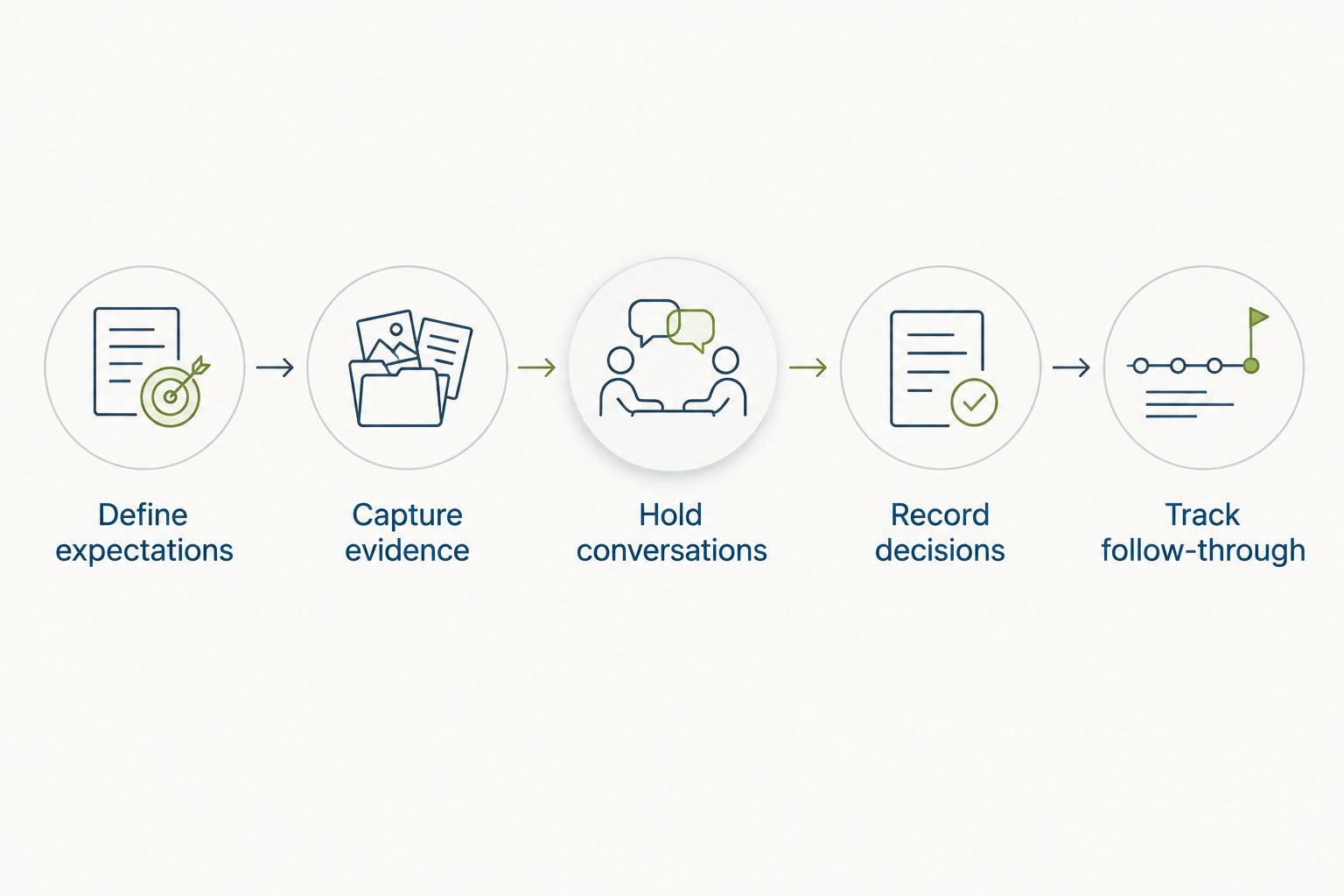
Replace the annual event in a deliberate sequence. Start with the decisions it currently supports, then build the feedback and documentation needed to support those decisions elsewhere.
1. Define expectations
Write down what effective performance means for the role. Separate outcomes from behaviors so employees understand both the work they need to deliver and how they are expected to work with others.
Avoid a broad label such as good attitude when you mean something specific. Describe the behavior that matters and the situation in which it matters. Clear expectations give feedback a reference point.
2. Capture evidence
Ask managers and employees to record meaningful examples alongside the relevant goal or responsibility. Capture context, the observed outcome, and the action agreed during the conversation.
Do not turn documentation into a transcript of every interaction. The record should explain progress and decisions, not reward whoever writes the most notes. Employees should understand which information informs their assessment.
3. Hold conversations
Use check-ins to discuss current work, blockers, feedback, and development. Close the conversation with an agreed next action rather than a vague instruction to improve.
Match the timing to the work. A changed priority or a significant problem deserves a conversation when it happens, regardless of the review calendar. Do not postpone necessary feedback until the next scheduled form.
4. Record decisions
Document promotion, compensation, development, and performance decisions separately from everyday coaching notes. Explain the criteria, the relevant evidence, and who owns the decision.
Give employees a clear route to ask questions or correct factual errors. A decision is not transparent merely because it appears in software; the reasoning must be understandable.
5. Track follow-through
Connect agreed actions to an owner and a follow-up point. If a conversation identifies a development need, the next step should be visible rather than buried in meeting notes.
The performance reviews to personalized growth plans workflow addresses this transition from assessment to action. The test is simple: can the employee explain what happens next, and can the manager identify who is responsible?
What should performance review software actually do?
Evaluate software against your intended process, not the length of its feature list. Your 2026 evaluation should show how an employee understands expectations, how a manager records feedback, and how an agreed action reaches completion.
HRSpace is best for growing teams that want performance reviews, goals, and recognition within a modular HR platform. Its stated scope also includes onboarding, time-off, AI-assisted recruitment, workflow automation, and an internal service desk. That breadth is relevant when you want performance management alongside the rest of the employee lifecycle.
HRSpace uses modular per-employee pricing. Check current commercial terms and the scope of the modules you need rather than assuming every capability is included in the same arrangement.
The limitation of a broad HR platform is that breadth alone does not prove fit for your review process. Confirm the specific documentation, employee response, review approval, and reporting behavior you require. Treat those as evaluation questions, not assumed capabilities.
Use the same test for any vendor. Ask the vendor to demonstrate your actual process, including an awkward case: a disputed assessment, a changed goal, or an overdue development action. A polished review form is not evidence that the complete workflow works.
Can you remove annual reviews but keep pay and promotion decisions?
Yes, you can remove annual reviews while retaining formal pay and promotion decisions. Separate the decision schedule from the coaching schedule, then explain what evidence informs each decision and who approves it.
Employees need to know when a decision will be considered and how their work is assessed. Do not replace a familiar annual process with an unexplained promise that advancement will happen when the time is right.
Does continuous feedback mean employees never get a formal assessment?
No, continuous feedback does not require you to eliminate formal assessments. You can provide a written assessment when a development, progression, or performance decision needs one without making every assessment an annual event.
The distinction is purpose. Routine feedback helps someone adjust their work; a formal assessment records a judgment and its consequences. Both need clear language, but they do not need to share a calendar.
Can recognition replace performance feedback?
No, recognition cannot replace performance feedback. Recognition highlights contributions; performance feedback also addresses unmet expectations, improvement, and development.
Keep the distinction visible in your 2026 process. Praise can provide useful context, but the absence of recognition is not a documented performance assessment, and positive recognition does not resolve an outstanding concern.
FAQ
Can performance review software replace annual reviews completely?
Yes, performance review software can replace annual reviews completely when ongoing feedback, documented assessments, and explicit decision ownership take their place. Removing the meeting without replacing those responsibilities leaves an incomplete process.
Is continuous feedback better than an annual review?
Continuous feedback is better suited to timely coaching, while an annual review provides a scheduled formal summary. Choose based on the purpose you need to serve, or combine them without duplicating the paperwork.
Do we still need a written performance assessment?
Keep a written assessment when a consequential decision needs a clear explanation. Removing annual reviews does not remove the need to document the evidence and reasoning behind performance decisions.
How often should managers give performance feedback?
Give performance feedback when the work or behavior needs attention, and use a predictable check-in rhythm for ongoing discussion. Match that rhythm to your work rather than adopting an unsupported universal interval.
What if managers are not documenting their check-ins?
Keep the formal checkpoint until managers produce a usable record of expectations, feedback, and agreed actions. More conversations alone do not provide a reliable replacement for documented reviews.
Can HRSpace support a broader performance management process?
HRSpace includes performance reviews, goals, and recognition within its modular HR platform. Confirm how the specific review and follow-up workflow you need operates before choosing it.
Will software make performance decisions fair automatically?
No, software does not make performance decisions fair automatically. Managers still need clear criteria, relevant evidence, understandable reasoning, and a way for employees to raise factual concerns.
One last thing
Before deleting the annual review from your 2026 calendar, delete surprises from the assessment. Ask each manager whether the employee already knows the expectations, the feedback, and the next action that would appear in a formal review.
If the answer is no, the problem is not the annual meeting. It is the missing conversation. Fix that first, then decide whether the yearly event still earns its place.