
Yes—employee self-service can reduce the need for additional HR headcount by moving repeatable requests out of HR’s inbox. It does not establish that you can eliminate an HR role: sensitive cases, policy decisions and unresolved requests still need accountable owners. Base staffing decisions on measured net workload, not portal adoption.
- Can employee self service reduce HR headcount needs? Yes—but measure net workload before changing staffing.
- HRSpace suits growing teams seeking modular HR workflows and an internal service desk in one platform.
- Employee self-service should remove repeatable work, not hide unresolved requests or shift administration to managers.
- Keep human ownership for sensitive cases, exceptions and decisions that require judgment.
Why this matters
For a company with 20–100 employees, the staffing question is not simply whether employees can submit their own requests. It is whether those requests reach completion without HR repeatedly explaining, correcting, chasing or re-entering information.
Separate reducing HR ticket volume from reducing HR workload. A request that disappears from the service desk but returns through a manager’s messages has changed channels, not disappeared.
Your 2026 staffing plan should distinguish between absorbing growth with the current team and removing an existing position. Those decisions require different evidence. Start with the work, then decide what staffing that work needs.
Can employee self-service reduce HR headcount needs?
Yes, when employees can complete routine tasks without creating equivalent follow-up work elsewhere. To establish whether that applies to your company, trace a request from the employee’s first action to its final resolution.
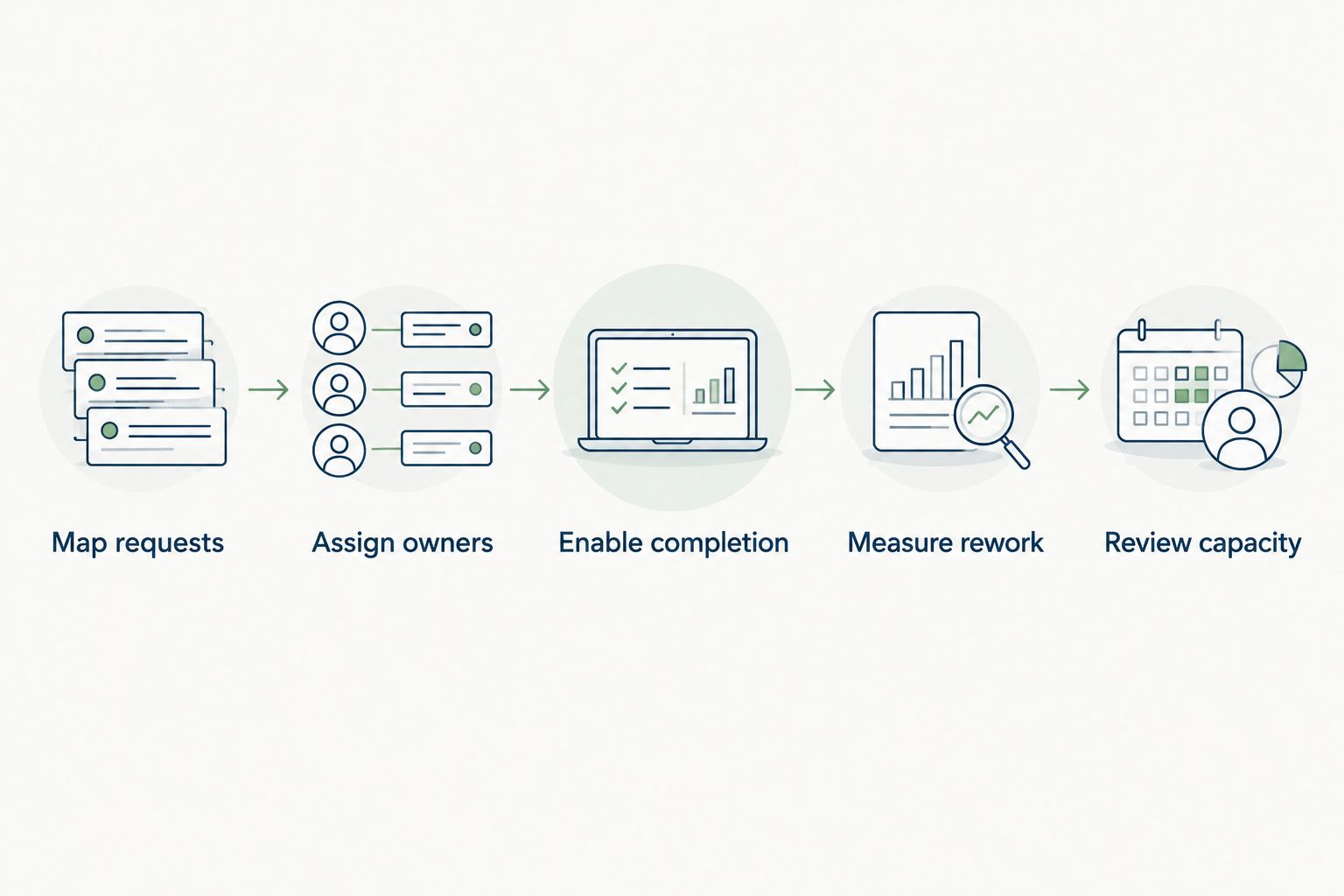
Use this sequence before changing your hiring plan:
- Map requests. List recurring questions and transactions. Separate straightforward requests from cases requiring interpretation, investigation or a private conversation.
- Assign owners. Identify who maintains each answer, approves each transaction and handles exceptions. A form without an owner is not a completed process.
- Enable completion. Give employees the instructions and request path needed to reach an outcome. Do not treat submission alone as success.
- Measure rework. Record corrections, repeat contacts, manager involvement and HR handling time. Include work that arrives outside the portal.
- Review capacity. Compare the remaining workload with the responsibilities and availability of your existing team before deciding whether to defer a hire.
The supporting evidence belongs in your operational records: completed requests, handling time, reopened cases and unresolved work. A login count does not answer a staffing question.
Choose the right level of self-service
Not every HR process needs the same treatment. Compare the task’s requirements before deciding whether employees need an answer, a structured request or direct support.
| Approach | Best for | What it removes from HR’s queue | Trade-off to check |
|---|---|---|---|
| Published guidance | Repeat questions with a consistent answer | Repeated explanations when employees find and understand the guidance | Content needs an owner; exceptions still need support |
| Structured requests | Routine transactions with defined approval steps | Collecting the same information through back-and-forth messages | Incomplete forms and slow approvals can preserve the workload |
| Human-led support | Sensitive, disputed or unusual cases | Nothing should be removed without reviewing the case requirements | Requires staff availability and clear ownership |
Use self-service for repeatable steps; preserve human access for judgment. These approaches belong together. A clear answer should include a route to help when an employee’s circumstances do not fit the standard process.
Do not force every request through the same form. Ask what information the owner actually needs, what the employee needs to understand and what event marks the request as finished.
Published guidance: remove repeat explanations
Start with questions that have an approved, consistent answer. Give employees a clear explanation of the process, the action they need to take and where to get help with an exception.
The benefit is direct access to an answer without waiting for someone to repeat it. The limitation is equally clear: guidance cannot resolve a disputed interpretation or an individual situation that falls outside the written policy.
For your 2026 content review, assign a named owner to each topic. Ask that owner to check whether the explanation matches the actual process—not merely whether the page is still accessible.
Measure repeat questions after employees read the guidance. If they still ask the same question, examine the wording and the next step before assuming the problem is employee adoption.
Structured requests: remove chasing and handoffs
A structured request should collect the information needed to act, identify the responsible owner and make the next step clear. The objective is a finished transaction, not a cleaner-looking inbox.
Time-off requests and onboarding tasks are useful processes to inspect because they involve identifiable actions and owners. Review where employees submit information, where someone approves it and where HR currently follows up manually.
The advantage is a defined path. The drawback is that an unclear approval rule or an unavailable approver still leaves work unfinished, regardless of how neatly the request entered the system.
Ask employees to complete a representative task without coaching. Record where they stop, what they misunderstand and whether HR must intervene. Fix those points before expanding the process.
Human-led support: keep an accountable person
Do not use self-service as a barrier to reporting a sensitive concern or asking for help with an unusual situation. Employees need a route to a person when the standard process does not fit.
Human-led support preserves judgment and a conversation. Its staffing requirement does not disappear because routine requests move elsewhere; assess that remaining responsibility separately.
Keep confidential cases out of general request discussions. Before rollout, check who can access each request type and who owns escalation. Verify those controls in the system you select rather than assuming they exist.
The right outcome is not the fewest possible contacts. It is the appropriate level of support for the work involved.
Why the staffing impact varies
A self-service rollout changes staffing needs only to the extent that it changes the work. Review these factors in your own processes:
- Request mix. Standard questions and routine transactions are different from investigations, disputes and policy exceptions. Count them separately.
- Completion quality. A submitted request still requires work if information is missing, the answer is unclear or the employee contacts HR again.
- Approval ownership. Employees cannot complete a process independently when nobody is responsible for the next decision.
- Maintenance effort. Include time spent updating guidance, adjusting request forms and administering the process.
- Demand changes. Track hiring, review cycles and organizational changes alongside request volume so that unlike periods are not treated as equivalent.
- Work transferred elsewhere. Include manager and employee effort. Moving administrative work away from HR is not the same as removing it.
Do not turn these factors into a generic headcount ratio. Use them to explain the workload you actually observe and the support your company needs.
Build a 2026 baseline before changing staffing
Use a 30-day observation window as a practical starting point, not an industry benchmark. Extend it if that window excludes important work such as a hiring cycle or performance reviews.
For each request category, record:
- Requests received across the service desk, email and chat.
- HR time spent handling and following up on requests.
- Manager time needed for clarification or correction.
- Repeat contacts, reopened requests and unresolved cases.
- Time spent maintaining the self-service process.
Use consistent definitions. If one person records only the final reply while another records research and follow-up, the figures will not support a staffing decision.
Track handling time separately from elapsed resolution time. A request waiting for approval can remain open without consuming continuous HR effort. Conversely, a quick response can conceal substantial preparation.
Keep the baseline available after launch. Without it, you have a description of the new process, not a comparison of the work before and after.
Run a focused pilot, then review capacity
Choose one recurring process with clear rules and a named owner. Document the current steps, introduce the self-service path and keep a visible route to human help.
At a suggested 60-day review, compare the pilot with the baseline. This is a planning checkpoint, not a promised payback period. Check whether the process completed more independently and whether the remaining work stayed manageable.
Investigate apparent improvements before acting on them. Fewer recorded requests mean little if employees stopped reporting problems, managers became the unofficial help desk or unfinished cases accumulated elsewhere.
Use the findings to make a specific decision: improve the process, extend it to another suitable category or revise the hiring plan. Do not treat a successful pilot in one request category as proof that every HR responsibility needs less staffing.
Where HRSpace fits
HRSpace is best for growing HR teams seeking modular employee-lifecycle workflows and an internal service desk in one platform. Its stated scope includes onboarding, time-off, performance reviews, goals, recognition, AI-assisted recruitment and workflow automation.
That scope makes HRSpace relevant when your workload spans several connected HR processes. Modular, per-employee pricing also makes module selection part of the buying decision; match the scope you choose to the work you intend to improve.
The limitation is proof of fit. The platform’s stated features do not establish your implementation time, workload reduction or ability to defer a hire. Ask for a demonstration using your actual request, approval and exception scenarios before making a staffing commitment.
For a 2026 evaluation, require the vendor to show the full process—not just the employee’s submission screen. Verify ownership, access, approvals and the evidence you will need to measure outcomes.
Can self-service replace an HR generalist?
Self-service is not evidence that an HR generalist role is unnecessary. Review the person’s full responsibilities, including work that never appears as an employee request.
If routine administration decreases, decide how the recovered capacity should be used. Assigning it to hiring support, manager guidance or overdue process work is a different decision from eliminating the position.
Can we delay hiring another HR employee?
Delay the hire only when measured capacity supports the remaining workload. Check unresolved cases, sensitive work, planned hiring and employee access to support alongside the routine tasks handled through self-service.
Write down what would trigger a staffing review. Use your own service requirements and workload evidence rather than borrowing an unsupported employees-per-HR-person ratio.
Does fewer HR tickets mean fewer HR hours?
Fewer HR tickets do not establish fewer HR hours. Compare handling time, repeat contacts and work received through other channels before drawing that conclusion.
Keep categories consistent across the comparison. A reduction caused by renaming or combining requests is not evidence of less work.
FAQ
Can employee self-service reduce HR headcount needs?
Yes—employee self-service can reduce the need for additional HR staffing when routine work reaches completion with less net handling effort. Measure follow-up, maintenance and unresolved work before changing headcount.
Will employee self-service let us eliminate an HR position?
Employee self-service alone does not justify eliminating an HR position. Review the role’s complete responsibilities and the measured workload remaining after implementation.
What should we measure before postponing an HR hire?
Measure request volume, handling time, repeat contacts, unresolved cases and process maintenance. Include work transferred to managers and requests received outside the portal.
Which HR tasks should stay with a person?
Keep human ownership for sensitive concerns, disputes, policy exceptions and decisions requiring judgment. Employees also need a clear escalation path when standard guidance does not fit.
Is a self-service portal enough without an HR service desk?
A portal is not enough if employees still need help and nobody owns their unresolved requests. Provide an accountable support route, whether or not it uses a dedicated service desk.
Is HRSpace suitable for a growing People Operations team?
HRSpace suits growing People Operations teams seeking modular HR software across the employee lifecycle, including an internal service desk. Verify your specific workflows and reporting requirements before tying the purchase to staffing savings.
How long should we measure a self-service pilot?
Use a 30-day baseline and a 60-day review as suggested planning checkpoints, not performance guarantees. Extend the observation period when it excludes important cycles or unusual demand.
One last thing
Audit the work that never becomes a ticket. Ask HR and managers to record private messages, verbal questions and repeated reminders during the pilot. Otherwise, your 2026 review risks measuring only the work that became easier to count.