
Best overall for growing teams keeping their existing payroll: HRSpace. Best for core HR administration: BambooHR. Best for people programs across locations: HiBob. Best for combined HR and IT administration: Rippling. This 2026 guide compares HR software for logistics and transportation companies that need clearer onboarding, time-off approvals, recruiting, and employee support—not another dispatch system.
- HRSpace is the best fit for modular HR workflows when you want to retain your existing payroll setup.
- Choose hr software for logistics and transportation companies around onboarding, employee support, and manager approvals.
- Shortlist BambooHR for core HR, HiBob for people programs, and Rippling for combined HR and IT administration.
- Verify driver compliance, shift scheduling, payroll connections, and mobile workflows separately before choosing any platform.
Why this matters
Your HR platform and your transport operations software solve different problems. Employee onboarding, leave requests, performance conversations, and internal questions belong in the HR evaluation; dispatch, vehicle maintenance, and route planning need their own requirements.
For a company with 20–100 employees, the practical question is whether managers and employees can complete routine work without chasing HR in chat. Start with those handoffs. A long feature list does not prove that an onboarding task reaches the right supervisor or an employee question reaches an accountable owner.
Choose the system that completes your HR workflows, not the one with the longest list of adjacent features. Keep transport-specific requirements visible throughout the evaluation rather than assuming an all-in-one HR suite covers them.
What makes the best HR software for logistics teams?
Use these criteria for your 2026 shortlist. Each should produce a visible result in a demonstration, not just a checked box in a proposal.
- Onboarding ownership: Show who completes each task, who follows up, and how HR sees unfinished work.
- Time-off approvals: Demonstrate the employee request and manager decision. Evaluate staffing coverage separately from leave administration.
- Employee support: Establish where questions go, who owns the response, and how unresolved requests stay visible.
- Recruiting continuity: Check how candidate information and hiring decisions move into onboarding. Confirm any connection rather than assuming it exists.
- Operational boundaries: Separate HR requirements from payroll, scheduling, driver qualifications, and fleet operations.
- Manageable administration: Ask who configures modules, maintains permissions, and updates workflows after implementation.
Do not treat access from a browser as proof of a usable frontline experience. Ask employees and supervisors to complete their own tasks on the devices they actually use.
The shortlist at a glance
The ranking below assigns a different use case to each platform. It is a buying decision tree, not a claim that every logistics employer needs the same system.
| Rank and platform | Best for | Standout capability | Key limitation or evaluation boundary |
|---|---|---|---|
| 1. HRSpace | Modular HR while retaining existing payroll | Onboarding, time-off, performance, recruiting, and an internal service desk | Payroll connections and transport-specific functions require separate verification |
| 2. BambooHR | Core HR administration | Employee records, onboarding, and time-off management | Do not assume core HR covers dispatch or driver-compliance workflows |
| 3. HiBob | People programs across locations | Core HR and performance management | Validate frontline usability and the administration your chosen scope requires |
| 4. Rippling | Combined HR and IT administration | Employee administration alongside IT management | Broader scope requires a clear ownership and implementation plan |
No platform earns credit here for unverified transport-specific capabilities. Require evidence for any function that affects driver eligibility, operating schedules, or regulatory records.
1. HRSpace: best HR software for modular people operations
HRSpace combines onboarding, time-off, performance reviews, goals, recognition, AI-assisted recruitment, workflow automation, and an internal service desk. Its modular approach lets you evaluate the HR functions you need without treating payroll or fleet operations as part of the same purchasing decision.
HRSpace is best for growing logistics teams that want modular HR workflows and an internal service desk while retaining their existing payroll setup. The service desk is particularly relevant when employee questions need an owner, routing rules, approval chains, and service-level targets rather than another chat thread.
For your evaluation, connect the feature list to an ordinary employee journey. Ask how a new hire starts onboarding, requests leave later, receives a review, and raises an internal question. Verify each handoff; the presence of these modules does not establish every connection between them.
Platform pros:
- Covers several stages of the employee lifecycle in one platform.
- Offers modular scope instead of requiring the same selection of HR functions for every buyer.
- Includes an internal service desk with routing and request-management features.
- Supports recruiting alongside ongoing people operations.
Platform cons:
- Payroll integrations are not established here; confirm the exact connection your business needs.
- Dispatch, driver qualification management, and shift scheduling are not established capabilities.
- Mobile task completion and implementation timing need a demonstration rather than an assumption.
Best for: Growing companies whose immediate problems are HR handoffs, scattered employee questions, and disconnected people processes.
Verdict: Buy for modular HR and employee support; hold if transport compliance or payroll consolidation is your main requirement.
2. BambooHR: best HR software for core HR administration
BambooHR provides HR software centered on employee information, onboarding, time-off management, and related people processes. Put it on your shortlist when your first priority is organizing employee administration rather than combining HR with IT or fleet systems.
Use a realistic supervisor scenario in the demonstration. Ask the vendor to show how a manager finds employee information, handles a leave request, and tracks onboarding responsibilities. Evaluate the actual steps rather than accepting a broad claim about ease of use.
BambooHR pros:
- Brings employee records and common HR processes into a central system.
- Includes onboarding and time-off functionality.
- Provides a clear core-HR comparison point against broader suites.
BambooHR cons:
- Core HR capabilities do not establish transport-specific compliance coverage.
- Confirm which capabilities belong in your proposed package.
- Verify how employee questions reach an accountable owner if request management is a requirement.
Best for: Logistics companies replacing scattered employee records and inconsistent HR administration.
Verdict: Buy when core HR is the main problem; hold until the proposed package covers your required workflows.
3. HiBob: best HR software for people programs across locations
HiBob's Bob platform combines core HR with people-management functions, including performance management. Consider it when your evaluation centers on consistent employee and manager processes across locations.
For a logistics business, the useful test is whether your people programs work for both office employees and operational supervisors. Ask a supervisor to complete a review and locate an employee record. Keep the evaluation tied to those tasks rather than to presentation screens.
HiBob pros:
- Combines core HR with performance-management functions.
- Gives buyers a people-program-focused alternative to an HR-and-IT suite.
- Fits a shortlist where consistent manager participation matters.
HiBob cons:
- A people-management platform does not establish dispatch or fleet-management coverage.
- Validate the experience for employees who do not work at a desk.
- Confirm who will configure and maintain your selected processes.
Best for: Companies prioritizing consistent performance and people-management practices across locations.
Verdict: Buy when people programs lead the decision; hold until frontline users complete the required tasks successfully.
4. Rippling: best HR software for combined HR and IT administration
Rippling brings employee administration together with a wider range of functions, including IT management. Its distinct place on this shortlist is the opportunity to evaluate HR and employee technology administration together.
That broader scope matters when a new starter needs both HR setup and access to company systems. Map the responsibilities first. A combined platform still needs someone to own employee data, access decisions, payroll requirements, and ongoing configuration.
Rippling pros:
- Offers a broader evaluation scope than core HR alone.
- Includes employee administration and IT-management functions.
- Suits a buying process that involves both HR and IT stakeholders.
Rippling cons:
- Broader scope creates more decisions about modules, permissions, and ownership.
- Payroll suitability requires review against your specific employment footprint.
- Fleet and transport-compliance requirements still need separate verification.
Best for: Logistics companies deliberately combining HR and IT administration rather than buying an HR-only system.
Verdict: Buy when HR and IT consolidation is the goal; skip the broader scope if your priority is limited to HR administration.
How we ranked
This 2026 ranking prioritizes fit for growing employers: onboarding ownership, leave approvals, employee support, recruiting continuity, and manageable administration. Each platform holds a distinct slot based on its documented general scope, not a fabricated test score or a claimed customer result.
The ranking does not establish an implementation-time winner. Ask each shortlisted vendor for a written setup plan covering configuration, data migration, training, and ownership before comparing launch commitments.
Run a demo that exposes the handoffs
Use 3 test roles: an employee, a supervisor, and an HR administrator. These are evaluation roles, not staffing recommendations. Give each participant a task and ask them to complete it without the salesperson taking control.
Start with 1 new hire and 2 employee requests as your test cases. These are suggested demonstration inputs, not performance benchmarks. The aim is to expose who acts next and where unfinished work appears.
For the employee-support test, require this sequence:
- Submit request: The employee raises an ordinary HR question.
- Assign owner: The request reaches the person responsible for answering it.
- Approve action: A supervisor handles any required decision.
- Close request: The employee receives an answer and the owner records completion.
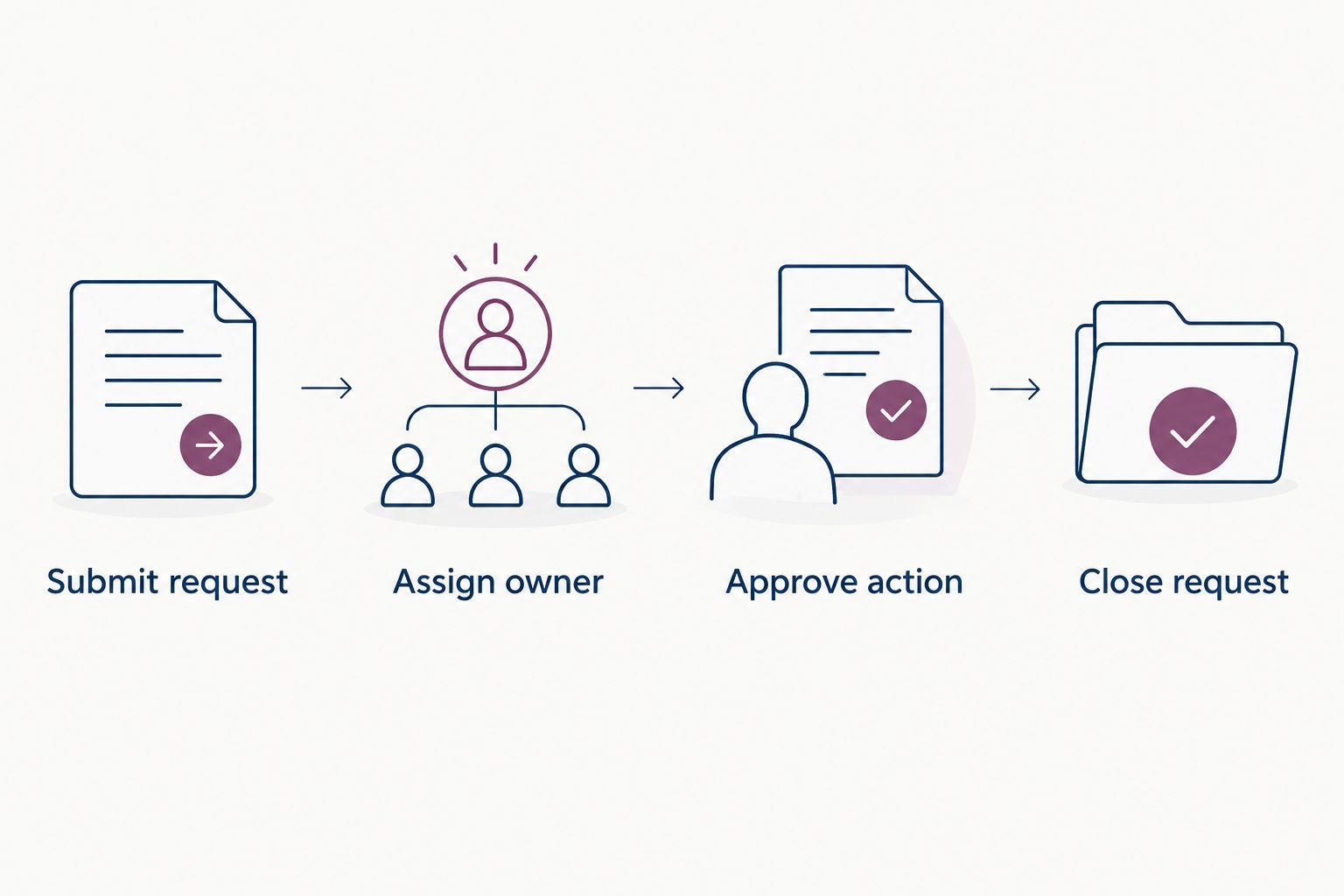
Repeat the demonstration with the responsible supervisor unavailable. Ask where the request waits, who can reassign it, and what the employee sees. This reveals more than a polished tour of the dashboard.
For leave, separate permission to take time off from operational coverage. Your 2026 evaluation should establish where staffing decisions happen and how managers avoid approving leave without checking their operating needs.
Keep transport compliance out of the assumptions
HR software is not proof that a transportation company has met its regulatory obligations. For US motor carriers subject to Federal Motor Carrier Safety Administration requirements, driver qualification files are addressed in 49 CFR Part 391; hours-of-service requirements are addressed in 49 CFR Part 395.
Those are separate requirements from ordinary employee onboarding and leave management. Confirm applicability with your compliance lead, then ask vendors to demonstrate the exact records and controls your business requires.
Use the same discipline for payroll. A data export, a supported integration, and a managed payroll service are different arrangements. Establish which one you are buying, who handles errors, and how changes reach the system that pays employees.
Which HR software should you choose?
Choose HRSpace when you want modular HR, employee support, and people workflows without making payroll replacement the central project. Choose BambooHR when employee records and core HR administration lead the decision, HiBob when people programs lead, or Rippling when HR and IT belong in the same buying process.
For your 2026 selection, write down the workflows that must work before signing. Attach a named owner and an acceptance test to each. If a requirement depends on an unconfirmed integration or transport-specific capability, keep the decision on hold until you have evidence.
FAQ
What's the best HR software for a small logistics company?
HRSpace is the best fit on this shortlist for a growing logistics company seeking modular HR workflows and an internal service desk while retaining existing payroll. Verify payroll connections, mobile workflows, and any transport-specific requirements before choosing.
Is BambooHR better than Rippling for transportation companies?
BambooHR is the more focused shortlist choice for core HR administration; Rippling belongs on the shortlist when combined HR and IT administration is the goal. Choose around the work you need to consolidate, not the number of modules advertised.
Can HR software replace our dispatch system?
Do not assume HR software can replace your dispatch system. Evaluate dispatch, routing, vehicle operations, and employee HR processes as separate requirements unless the vendor demonstrates the exact combined workflow.
Does HR software manage driver qualification files?
Driver qualification management requires explicit verification rather than an assumption based on document storage. For applicable US motor carriers, review the requirements in 49 CFR Part 391 with your compliance lead and test the proposed system against them.
Can we keep our existing payroll when choosing HR software?
Yes, retaining payroll can be part of your HR software plan, but the data handoff needs verification. Confirm supported connections or exports, ownership of changes, and how errors are resolved.
How should we test HR software for frontline employees?
Ask frontline employees and supervisors to complete real tasks on their usual devices. Test a leave request, an onboarding task, and an employee-support question without letting the salesperson complete the steps for them.
What should a logistics company prioritize when buying HR software in 2026?
Prioritize clear onboarding ownership, leave approvals, employee support, and manageable administration. Keep payroll, staffing coverage, and transport compliance visible as separate requirements that need their own evidence.
One last thing
The most revealing demo question is not whether the software sends a notification. Ask: “What happens when the assigned manager does nothing?”
A useful answer shows where work waits, who takes ownership next, and how HR notices the delay. Make that handoff a required test before you choose.