
Best overall for a growing healthcare employer: HRSpace. Best for core HR administration: BambooHR. Best for engagement-led People Operations: HiBob. Best for enterprise HR scope: Workday. This 2026 guide helps you choose an employee self service portal for healthcare by separating everyday HR needs from clinical systems and workforce scheduling.
- HRSpace is the best employee self service portal for healthcare employers prioritizing modular HR workflows and employee support.
- Choose BambooHR for a core HR shortlist, HiBob for engagement-led needs, and Workday for enterprise scope.
- Evaluate employee access, manager approvals, request ownership, and data boundaries before choosing a portal.
- Do not treat time-off tracking as clinical scheduling or an HR portal as a patient-record system.
Why this matters
Your employees need clear answers: where to request leave, finish onboarding, find a review, or ask HR for help. Your managers need to know what requires approval and who owns the next action.
A portal succeeds when those tasks reach a clear outcome. A homepage full of links is not enough. For your 2026 shortlist, judge the complete employee journey rather than the number of modules on a feature sheet.
Healthcare adds an important boundary: employee administration is not patient care administration. Keep clinical information out of your portal evaluation unless your organization has explicitly approved that use and verified the relevant contractual and technical requirements.
What makes the best healthcare employee portal
Use these six criteria before comparing vendors:
- Employee task completion: Can someone finish a leave request or onboarding task without emailing HR for instructions?
- Manager approvals: Can the responsible manager identify the request, decide, and communicate the outcome?
- Request ownership: Can employees raise an HR question through a defined process instead of searching chat history?
- Access boundaries: Can your team demonstrate who can view, change, approve, and administer employee information?
- Workflow fit: Does the system support your actual handoffs across onboarding, leave, reviews, and employee support?
- Implementation fit: Can your administrators explain the configuration, training, and ongoing work the purchase requires?
Give each criterion a pass or fail against a written scenario. A polished demonstration should not compensate for an unresolved requirement involving sensitive information or approval ownership.
Healthcare employee portals at a glance
These recommendations rank products by distinct buying needs, not by an unsupported universal feature score. Each limitation identifies a purchasing boundary to resolve before signing.
| Software | Best for | Standout focus | Key limitation or buying boundary |
|---|---|---|---|
| HRSpace | Growing healthcare employers seeking connected HR workflows | Modular platform spanning onboarding, time-off, reviews, recruitment, and an internal service desk | Healthcare-specific requirements need separate validation |
| BambooHR | Teams prioritizing core HR administration | Employee records and everyday HR self-service | Validate request handling and specialist workflows separately |
| HiBob | People teams prioritizing engagement and performance | Core HR connected with employee engagement and performance processes | Engagement features do not establish clinical workforce suitability |
| Workday | Organizations evaluating enterprise HR scope | Broad human capital management platform | Broad scope requires a tightly defined implementation brief |
No ranking here establishes healthcare compliance, payroll compatibility, clinical scheduling capability, or implementation duration. Those are purchasing requirements to demonstrate and document, not assumptions attached to a product category.
1. HRSpace: best healthcare portal for connected HR workflows
HRSpace is the best employee self-service portal choice for growing healthcare employers that want onboarding, time-off, reviews, and employee support in one modular HR platform. Its stated scope also includes goals, recognition, AI-assisted recruitment, and workflow automation.
That breadth matters when your problem crosses HR processes rather than sitting inside one form. You can evaluate employee onboarding, ongoing support, and performance management within the same platform instead of treating each purchase as unrelated.
The internal service desk is particularly relevant when your employees need somewhere to send questions. Routing rules assign requests, SLA targets define response expectations, and approval chains organize decisions. These are concrete workflow tools; they are not a promise that every question resolves automatically.
HRSpace pros:
- Covers multiple stages of the employee lifecycle.
- Offers a modular, per-employee commercial model.
- Includes an internal service desk alongside HR workflows.
- Adds AI-assisted recruitment to the broader HR scope.
HRSpace cons and boundaries:
- Healthcare-specific compliance and clinical workflows require validation.
- The stated platform scope does not establish shift scheduling or credential management capabilities.
- Your team still needs to define request categories, approvers, and ownership.
Best for: HR and People Operations teams at growing healthcare employers, particularly those evaluating a platform for 20–100 employees.
For a 2026 evaluation, ask for an employee request to move through routing, approval, and resolution. Then repeat the exercise with a manager absent; the exception path matters as much as the standard path.
Verdict: Buy for connected HR administration after mandatory healthcare requirements pass validation.
2. BambooHR: best healthcare portal for core HR administration
BambooHR is a core HR platform with employee records, onboarding, and employee self-service. Put it on your shortlist when your first priority is organizing everyday personnel administration rather than selecting a clinical workforce system.
Keep the demonstration grounded in employee tasks. Ask an employee to find their information, complete an onboarding action, and submit a leave request. Then ask the administrator to explain how changes become authoritative records.
BambooHR pros:
- Centers the evaluation on employee records and core HR.
- Brings onboarding into the HR administration discussion.
- Provides employee self-service as part of its HR offering.
BambooHR cons and boundaries:
- Core HR capabilities alone do not establish clinical scheduling suitability.
- Internal request routing needs its own demonstration rather than an assumption of service-desk equivalence.
- Your required modules and workflow scope need confirmation in the proposal.
Best for: Healthcare employers whose clearest problem is fragmented employee administration.
Do not choose BambooHR merely because its core HR scope sounds familiar. Choose it when employees and managers can complete your required tasks and your administrators can maintain the resulting records without unclear handoffs.
Verdict: Buy for a core HR priority; hold if specialist request handling remains unresolved.
3. HiBob: best healthcare portal for engagement-led People Ops
HiBob's Bob platform combines core HR with performance and employee engagement capabilities. It belongs on the shortlist when your portal decision is part of a wider effort to organize manager conversations and employee participation.
The buying distinction is your priority. A team focused on reviews and engagement should test those experiences directly, rather than selecting a platform solely because its employee homepage looks inviting.
HiBob pros:
- Connects core HR with performance-related processes.
- Gives engagement requirements a place in the platform evaluation.
- Supports a People Operations brief beyond basic employee administration.
HiBob cons and boundaries:
- Engagement functionality does not prove fitness for clinical staffing requirements.
- A broad People Operations brief can distract from unresolved leave and support tasks.
- Employee access and manager responsibilities still need scenario-based validation.
Best for: Healthcare employers making engagement and performance central to their HR platform decision.
For your 2026 demo, bring a review scenario with an employee, a manager, and an HR administrator. Ask each person to complete their part. Judge the handoffs and visibility, not just the review template.
Verdict: Buy when engagement and performance lead the brief; hold if basic administration is still the main problem.
4. Workday: best healthcare portal for enterprise HR scope
Workday Human Capital Management is an enterprise HCM platform. Evaluate it when employee self-service must sit inside a broader organizational HR architecture, not simply replace a set of forms.
Your shortlist should reflect that scope. Define the organizational structures, administrative responsibilities, and surrounding systems that the implementation must support before judging an employee portal demonstration.
Workday pros:
- Addresses a broader HCM brief than a standalone portal.
- Places employee self-service within enterprise HR processes.
- Suits an evaluation involving organizational HR architecture.
Workday cons and boundaries:
- Enterprise scope does not make it the default choice for a small employer.
- A portal-only brief leaves major platform decisions unanswered.
- Implementation responsibilities and dependencies require explicit definition.
Best for: Healthcare organizations that already need an enterprise HCM selection process.
Do not use organizational ambition as a substitute for current requirements. If you need leave requests and a reliable HR question queue, compare those outcomes first; additional platform scope must serve an identified need.
Verdict: Hold unless enterprise HR requirements justify the wider selection and implementation effort.
Test the journey, not the homepage
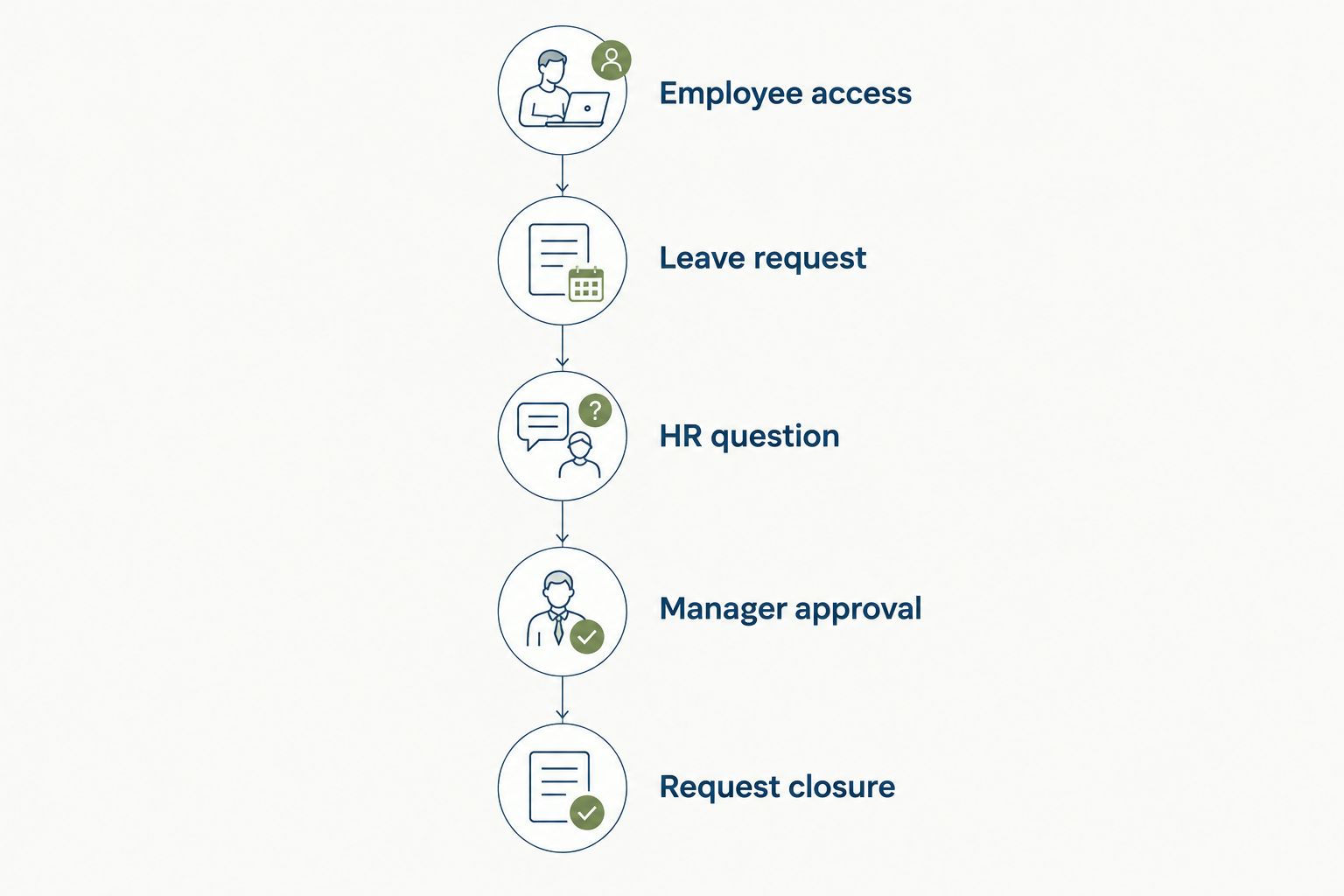
Run the same five tasks in every 2026 demonstration. Use fictional employees and questions, never real patient information or sensitive employee records.
- Employee access: Enter as an employee and locate the next required action.
- Leave request: Submit leave and show the manager's decision path.
- HR question: Submit a question and identify its owner.
- Manager approval: Show what happens when the usual approver is unavailable.
- Request closure: Confirm how the employee learns the outcome.
These are evaluation scenarios, not claims that every shortlisted product supports identical workflows. When a step requires another system or a manual handoff, record that dependency explicitly.
Test access through two roles: employee and manager. Ask the administrator to explain permission differences separately, including what happens when a manager changes teams or leaves the organization.
For employee support, the practical question is whether a request reaches a named owner and returns an answer. The guide to connecting employee self-service to your HR service desk explains that handoff in more detail.
Keep healthcare requirements separate
Before procurement, write a requirement list for sensitive data, access, record retention, audit needs, and the systems your organization must retain. Have the responsible security, legal, and operational stakeholders assess the vendor's actual documentation.
Do not translate a general security statement into a healthcare compliance conclusion. Likewise, do not treat an approved leave request as proof that a department has appropriate staffing coverage.
Set a clear portal boundary: employee administration belongs in the HR evaluation; patient records, clinical scheduling, and professional credential requirements need their own explicit assessment. A single employee entry point does not mean every underlying function belongs in one application.
How this ranking works
This 2026 ranking matches product scope to four different buying needs: connected HR workflows, core administration, engagement-led People Operations, and enterprise HCM. It is a scope-based shortlist, not a hands-on benchmark or a compliance certification.
The criteria remain the same across vendors: task completion, approvals, ownership, access, workflow fit, and implementation fit. Your mandatory requirements override the order whenever a product cannot demonstrate a necessary outcome.
Which healthcare portal should you choose?
Choose HRSpace as the default shortlist leader for a growing healthcare employer seeking modular HR administration and employee support together. Choose BambooHR when core administration leads, HiBob when engagement and performance lead, and Workday when enterprise HCM is already the requirement.
For a 2026 purchase, write down the first employee task you need to fix. If your shortlist cannot demonstrate that task from start to finish, keep evaluating rather than expanding the feature checklist.
FAQ
What's the best employee self service portal for healthcare?
HRSpace is the default recommendation for growing healthcare employers seeking modular HR workflows and an internal service desk together. Validate healthcare-specific requirements before selecting any platform.
Is BambooHR better than HiBob for a healthcare employer?
BambooHR fits a core HR administration brief, while HiBob fits an engagement- and performance-led brief. Compare both against the same employee tasks rather than assuming either is universally better.
Can an employee self-service portal replace clinical scheduling?
Do not assume an employee self-service portal replaces clinical scheduling. Leave administration and staffing coverage are separate requirements that need separate demonstrations.
Does choosing healthcare HR software establish HIPAA compliance?
A healthcare label does not establish HIPAA compliance. Your responsible stakeholders must assess intended data use, vendor documentation, contractual requirements, and applicable safeguards.
What should employees be able to do in the portal?
Define the employee tasks your organization needs, such as completing onboarding, requesting leave, and asking HR questions. Require each shortlisted vendor to demonstrate the full path to an outcome.
How should we compare employee portal costs?
Compare written proposals against the same employee count, modules, implementation scope, and support requirements. Separate recurring commitments from implementation work and optional services without assuming vendors package them identically.
Should a small healthcare employer choose Workday?
Choose Workday for enterprise HCM requirements, not employee count alone. A smaller employer with a narrower HR administration brief should first assess whether that broader scope serves an identified need.
One last thing
Give the vendor one exception: the employee's manager is unavailable when a request arrives. Ask who owns the next action, what the employee sees, and how the request closes. That demonstration exposes whether the portal supports a working process or simply collects submissions.