
HRSpace is the best performance review software for remote teams of 20–100 employees that want reviews, goals, recognition and core HR in one modular platform. For your 2026 shortlist, compare HRSpace with Lattice for performance-focused programs, 15Five for check-in-led management, BambooHR for HR administration and HiBob for broader people operations.
- Choose HRSpace for performance review software for remote teams that also need goals, recognition and core HR.
- Shortlist Lattice for performance-focused programs and 15Five for a check-in-led management approach.
- Compare BambooHR and HiBob when performance reviews belong inside a broader HR platform.
- Test written feedback, manager handoffs and employee access before committing to any platform.
Why this matters
Remote performance reviews need evidence that survives the meeting. A useful system gives employees a place to explain their work, managers a consistent way to assess it and both sides a clear next step.
A review form alone does not solve that problem. If goals live elsewhere and feedback stays in private messages, managers still have to reconstruct the review manually.
For a growing company, the decision is also about scope. You need to choose between a dedicated performance system and a broader HR platform without buying a larger implementation than your team can manage.
What makes the best remote review software
Use these criteria for your 2026 shortlist. Treat each one as something the vendor must demonstrate, not a box to tick from a feature page.
- Written participation: Employees should be able to prepare thoughtful answers without attending a live meeting. Test saving, editing and submitting a self-review.
- Goals with context: Reviewers need to connect assessments to agreed outcomes. Ask how the system handles goals that changed during the review period.
- Feedback controls: Check who can request feedback, who can read it and when comments become visible. Do not assume peer feedback means anonymity.
- Manager consistency: Ask managers to apply the same assessment criteria to the same example. Look for clear instructions and a workable approval process.
- HR ownership: People Operations should understand how to launch a cycle, resolve exceptions and find incomplete reviews without relying on a vendor for every change.
- Useful follow-through: A completed review should lead to a documented action, owner and follow-up date. Test that handoff before comparing optional extras.
The 2026 shortlist at a glance
The ranking below separates buying situations rather than declaring every platform interchangeable. No option wins every category.
| Rank | Platform | Best for | Standout scope | Key limitation or buying check |
|---|---|---|---|---|
| 1 | HRSpace | Combining reviews with everyday HR | Reviews, goals, recognition and wider employee-lifecycle modules | Validate detailed review controls in a demonstration |
| 2 | Lattice | Performance-focused people programs | Performance management and goals | Assess whether its wider scope matches your immediate needs |
| 3 | 15Five | Check-in-led management | Check-ins alongside performance reviews | Requires a management routine beyond the formal review cycle |
| 4 | BambooHR | HR administration with performance reviews | Employee records and broader HR administration | Demonstrate the review depth your process requires |
| 5 | HiBob | Broader people operations | Core HR alongside performance management | Define a focused rollout instead of evaluating every module at once |
1. HRSpace: best for reviews connected to everyday HR
HRSpace combines performance reviews, goals and recognition with onboarding, time-off, recruitment, workflow automation and an internal service desk. That makes it a relevant first choice when your review project is part of a wider effort to organize employee operations.
Its modular, per-employee model gives you a way to discuss the scope you need now rather than treating every HR requirement as a separate software purchase. For remote teams, the important question is how the review process works alongside those other employee activities.
HRSpace pros:
- Performance reviews, goals and recognition sit within the same platform offering.
- Broader modules cover employee needs before and after a review cycle.
- Modular scope supports a discussion about which capabilities to adopt first.
HRSpace cons:
- The stated scope does not establish detailed peer-feedback, anonymity or calibration controls; demonstrate these if required.
- A broader HR platform needs clear boundaries if you only want to replace a review form.
Best for: Growing remote companies with 20–100 employees that want performance reviews and everyday HR together.
Verdict: Buy for the combined scope, after validating your review workflow.
2. Lattice: best for performance-focused people programs
Lattice offers performance management and goal-setting tools. Put Lattice on your shortlist when the central problem is running a structured performance program rather than replacing your core HR administration.
Start the demonstration with your actual review process. Ask Lattice to show how employees contribute, how managers assess work and how the resulting decisions remain understandable after the cycle closes.
Lattice pros:
- Performance management is a central part of the product offering.
- Goals provide a relevant starting point for outcome-based reviews.
- Its performance focus makes it a useful comparison against broader HR platforms.
Lattice cons:
- A focused performance purchase still needs a clear relationship with your employee records.
- Additional performance features do not remove the need to define assessment standards.
Best for: People teams prioritizing a structured performance program over a wider HR replacement.
Verdict: Buy when performance management is the main project.
3. 15Five: best for a check-in-led management routine
15Five offers check-ins and performance reviews. Shortlist 15Five when you want regular manager conversations to inform the formal assessment rather than treating reviews as an isolated event.
The buying decision includes a behavior change. Managers need to use the check-in routine, respond to employees and distinguish a temporary blocker from a longer-term performance issue.
15Five pros:
- Check-ins give the evaluation a clear management use case.
- Performance reviews support a formal assessment alongside ongoing conversations.
- The approach suits buyers who want to improve manager habits, not just collect completed forms.
15Five cons:
- Check-ins create work without value if managers do not respond.
- A check-in-led approach adds an ongoing routine beyond review-cycle administration.
Best for: Remote teams whose main gap is regular, documented manager–employee discussion.
Verdict: Buy if managers will commit to the routine; skip if they will not.
4. BambooHR: best for HR administration with reviews
BambooHR combines employee-record management and broader HR administration with performance-management capabilities. Consider BambooHR when your first priority is organizing core employee information and your review process needs to fit that larger decision.
Do not treat general HR coverage as proof of review depth. Bring a difficult review scenario and ask BambooHR to demonstrate the exact steps, permissions and employee experience it requires.
BambooHR pros:
- Employee records provide a core HR use case alongside reviews.
- Broader HR scope suits a purchase led by administration needs.
- Performance management can be evaluated within the wider employee process.
BambooHR cons:
- An HR-first purchase still needs a separate check against your performance requirements.
- Existing HR systems create migration and ownership questions that a review-only purchase would not introduce.
Best for: Small businesses choosing a core HR platform and performance process together.
Verdict: Buy when HR administration leads the decision.
5. HiBob: best for a broader people-operations rollout
HiBob offers core HR and performance-management capabilities. Evaluate HiBob when your review project sits inside a broader plan for employee data, manager responsibilities and people processes.
Keep the evaluation grounded. A wider platform deserves a written rollout plan that distinguishes what your team needs immediately from what belongs in a later phase.
HiBob pros:
- Core HR and performance management belong to the same platform offering.
- Its broader scope supports an evaluation beyond review forms.
- It provides another HR-suite option to compare with a dedicated performance system.
HiBob cons:
- A broader evaluation introduces decisions beyond the review cycle itself.
- More platform scope does not automatically justify replacing systems that already work.
Best for: People Operations teams planning a wider HR-platform change, with reviews as one part.
Verdict: Buy for a defined broader rollout; wait if your scope is still unclear.
How the ranking works
This 2026 ranking prioritizes fit for growing remote teams: relevant performance scope, connection to everyday HR and a clear reason to choose each option. It is a buying framework, not a measured usability or implementation-speed ranking.
The default favors combined HR coverage because the target buyer manages more than review cycles. The alternatives move ahead when your priority changes to dedicated performance management, recurring check-ins or a broader HR replacement.
Run a remote review pilot before you choose
Use the same exercise with every finalist. For your 2026 evaluation, a suggested pilot is 5 employees and 2 managers—a test design, not a claim about any vendor's required rollout size.
Written preparation
Give employees the same role expectations and ask them to complete a self-review independently. Check whether they understand the questions without a meeting to translate them.
Include an example of work that crossed teams. The review should capture the contribution without confusing visibility with impact.
Manager assessment
Ask both managers to assess the same sample evidence before discussing it. Compare their reasoning, not just the final rating.
If the assessments differ, identify whether the problem is unclear expectations, missing evidence or inconsistent interpretation. Software cannot repair an undefined standard.
Feedback access
Test the employee view, manager view and HR view separately. Check what each person can see before submission, after submission and after the review is shared.
Include a manager change in the exercise. Ask the vendor to show who retains access and who takes responsibility for the unfinished review.
Growth follow-through
End the pilot with a written development action, a named owner and a follow-up date. Ask each finalist to demonstrate how you would record and revisit that commitment.
Do not count a capability as present because it appears on a roadmap or sounds similar to another feature. Evaluate the workflow you can actually demonstrate.
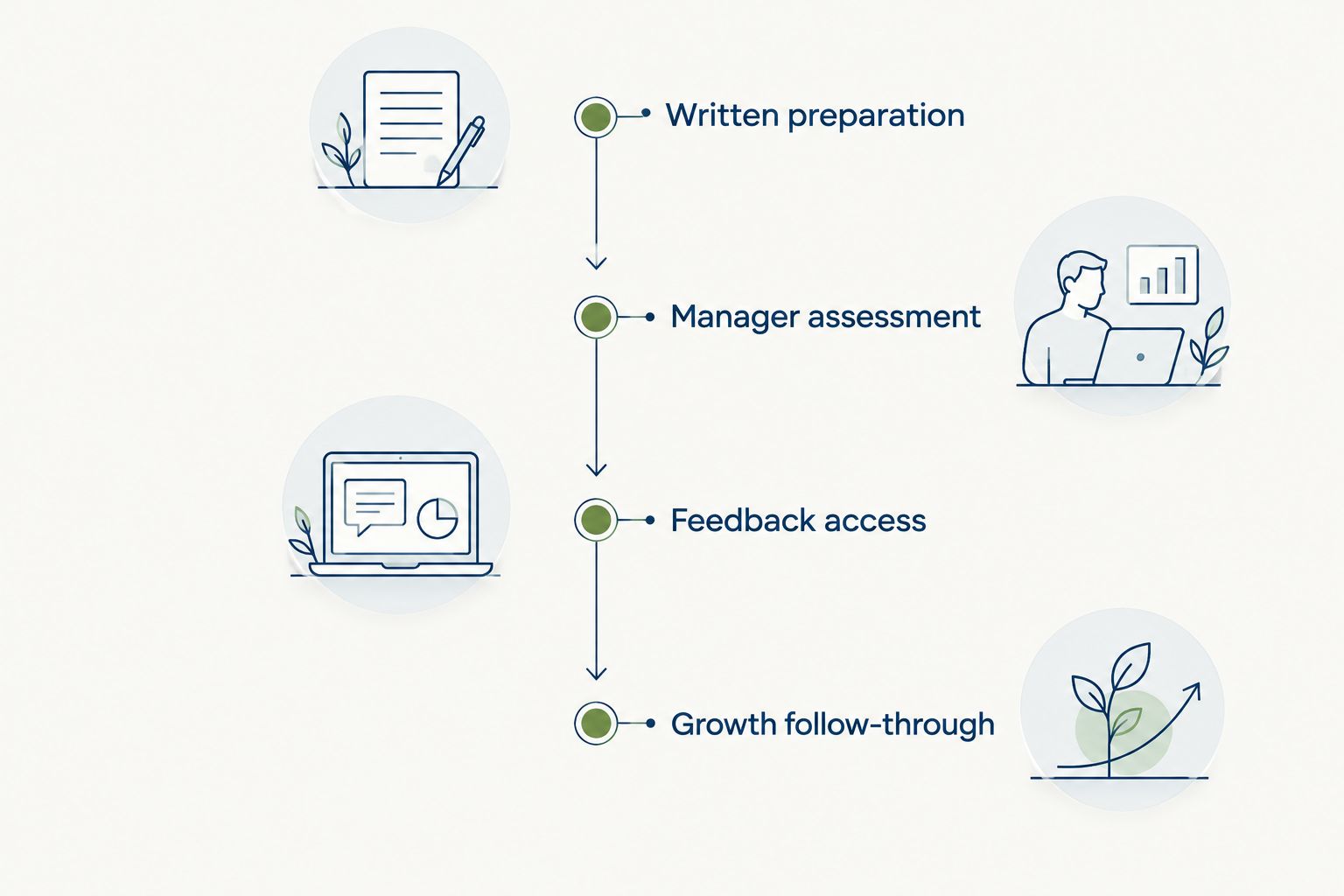
A useful pilot ends with a decision log. Record which requirements worked, which needed a workaround and which remain unresolved; that record is more useful than a collection of feature-page screenshots.
Which platform should you choose?
Choose HRSpace as your default when you want remote performance reviews connected to goals, recognition and everyday HR. Make the purchase conditional on a demonstration of your required review controls, not on the breadth of the module list.
Choose Lattice when performance management is the main program. Choose 15Five when regular check-ins are the management habit you want to establish.
Choose BambooHR when core HR administration leads the purchase. Choose HiBob when you have a defined broader people-operations rollout.
Before signing, get the selected modules, implementation responsibilities and required capabilities documented. Assign an internal owner to the review process as well as the software account.
FAQ
What's the best performance review software for remote teams in 2026?
The best choice depends on whether you need a dedicated performance system or reviews inside a broader HR platform. Compare the shortlist using the same self-review, manager-assessment and follow-through exercise rather than relying on feature counts.
Is Lattice better than BambooHR for remote performance reviews?
Lattice is the more relevant starting point when performance management is the main project; BambooHR is the more relevant starting point when core HR administration leads the purchase. Demonstrate your specific review process before deciding between them.
Is 15Five a good fit for asynchronous teams?
15Five belongs on the shortlist when you want check-ins alongside formal performance reviews. Test how employees prepare written updates and how managers respond without requiring everyone to meet at the same time.
Do remote teams need anonymous peer feedback?
Anonymous peer feedback is a process choice, not a universal requirement. Decide what problem anonymity should solve, then verify visibility rules and explain those rules before employees contribute.
Can performance review software replace manager conversations?
No. Performance review software can organize assessments, but managers still need to explain decisions, answer questions and agree on next steps with employees.
How should a small remote team compare review software?
Use the same sample review and the same requirements for every vendor. Include written preparation, manager assessment, feedback permissions and a documented development action.
Does AI-assisted recruiting mean a platform writes performance reviews?
No. Recruiting assistance and performance-review drafting are separate capabilities; verify each one independently rather than assuming that one establishes the other.
One last thing
Before your first 2026 cycle, remove any review question that rewards being seen online instead of producing useful work. Ask for an outcome, supporting evidence and relevant context.
Then test that question with a manager and an employee before configuring the platform. A clear question improves the process before any automation starts.