
Best overall for growing healthcare teams: HRSpace. Best for an HR-led review process: BambooHR. Best for connecting performance with engagement: HiBob. Best for dedicated performance management: Lattice. This 2026 guide compares performance management software for healthcare organizations that need clearer reviews and development goals—not a replacement for clinical credentialing or patient records.
- HRSpace is the best performance management software for healthcare teams seeking reviews, goals and everyday HR in one platform.
- BambooHR suits HR-led reviews; HiBob connects performance with engagement; Lattice suits a dedicated performance-management approach.
- Keep employee development separate from clinical credentialing and patient records.
- Choose through a role-specific demonstration, not a generic feature checklist.
Why this matters
Healthcare performance reviews need to distinguish how someone works from the conditions they work under. A receptionist, practice manager and clinical employee should not receive identical goals simply because they share an employer.
For organizations with 20–100 employees, the buying decision also includes who will administer the system. A review platform that requires constant attention from your only People Operations lead creates another operational burden.
The right shortlist depends on your immediate problem: disconnected HR processes, inconsistent reviews, limited development conversations or a need for a dedicated performance system. Start there. A longer feature list does not settle that decision.
What makes the best healthcare performance software?
Use these criteria before comparing vendors in 2026:
- Role-specific expectations: Ask vendors to demonstrate how different jobs receive relevant questions and goals. Do not accept a generic office-worker template as proof of healthcare fit.
- Useful follow-through: A completed review should lead to an agreed development action, an owner and a follow-up conversation. Test that handoff.
- Manager usability: Have an actual manager complete a review during the demonstration. Watch where explanation or duplicate entry becomes necessary.
- Appropriate access: Ask who can read feedback, change ratings and access historical records after a reporting-line change. Require documented answers.
- Clear scope boundaries: Separate employee performance management from clinical competency assessment, credentialing and patient information. Confirm each required function independently.
- Administrative fit: Compare the work needed to launch a cycle, change a manager and retrieve past reviews. Include ongoing ownership, not just initial configuration.
A healthcare label is not evidence of healthcare suitability. Your own review scenario is the better test: the vendor either demonstrates the required workflow or leaves a documented gap.
Performance management software at a glance
The order below prioritizes the needs of growing healthcare employers, not large hospital procurement teams. Each option has a distinct reason to make the shortlist.
| Software | Best for | Standout feature or approach | Key limitation to resolve |
|---|---|---|---|
| HRSpace | Growing teams combining performance with everyday HR | Reviews, goals, recognition and wider HR modules in one platform | Healthcare-specific competency and credentialing requirements need separate verification |
| BambooHR | HR teams making reviews part of core employee administration | Performance management within a broader HR platform | Confirm the depth of role-specific evaluation and development workflows |
| HiBob | People teams considering performance and engagement together | Performance and employee engagement within Bob | Establish which modules and configuration your review process requires |
| Lattice | Teams prioritizing a dedicated performance-management approach | Reviews, goals, feedback and development tools | Define how performance work will connect with existing HR administration |
No ranking here assumes a healthcare certification, a particular integration or a deployment timeline. Those are separate buying checks, not benefits to infer from a product category.
1. HRSpace: best for connected HR and performance
Best for: Growing healthcare employers that want reviews, goals and everyday employee processes in one platform.
The platform covers performance reviews, goals and recognition alongside onboarding, time-off, recruitment, workflows and an internal service desk. Its modular, per-employee model lets you assess the required scope without treating every HR function as an immediate project.
That breadth matters when your performance problem begins outside the review itself. A new hire needs onboarding, clear expectations and somewhere to raise an unresolved HR request—not just an appraisal form at the end of the cycle.
HRSpace pros:
- Combines reviews, goals and recognition with broader employee-lifecycle functions.
- Offers modular scope rather than requiring you to frame every requirement as a performance-only purchase.
- Includes AI-assisted recruitment and HR workflows for teams also addressing hiring and administration.
- Provides an internal service desk alongside employee-development functions.
HRSpace cons:
- Healthcare-specific competency assessment and credential tracking are not established capabilities here.
- Required integrations, access controls and data-handling arrangements need direct verification.
- Modular breadth still requires someone to decide which processes to introduce first.
Ask for a demonstration that moves from a new employee's onboarding to a review and a documented goal. Then inspect the boundaries between those modules; do not assume every handoff is automatic.
Verdict: Buy for connected HR and performance only after your required review workflow and data requirements are demonstrated.
2. BambooHR: best for an HR-led review process
Best for: HR teams that want employee administration and performance reviews considered together.
BambooHR is a broader HR platform with performance-management functionality. It belongs on the shortlist when the HR team owns both employee records and the review calendar, rather than treating performance as an independent system.
For a healthcare employer, the useful question is not whether it supports reviews. Ask whether the available evaluation structure matches the different responsibilities of clinical, administrative and management roles.
BambooHR pros:
- Combines core HR administration with performance-management functionality.
- Gives HR-led buyers an alternative to introducing a standalone review product.
- Supports a buying conversation centered on employee records and recurring performance processes.
BambooHR cons:
- Broader HR scope is not proof of specialist clinical evaluation support.
- Your required review structure and follow-up process still need a demonstration.
- Replacing an existing HR platform introduces a separate migration decision.
Bring your current review form to the demonstration. Ask the vendor to show how a manager records evidence, completes the evaluation and returns to the employee's agreed actions afterward.
If your employee administration already works well, explain exactly what replacing it would solve. Otherwise, you risk turning a review-process problem into a larger systems project.
Verdict: Buy when core HR administration and performance reviews belong in the same purchasing decision.
3. HiBob: best for performance and engagement together
Best for: People teams evaluating employee performance alongside engagement and organizational context.
HiBob's Bob platform includes performance and engagement capabilities within a wider HR system. That makes it relevant when your People team wants to consider employee feedback and development within the same platform strategy.
Keep the interpretation disciplined. An engagement response and a manager's performance assessment answer different questions; putting both in one system does not make them interchangeable.
HiBob pros:
- Includes performance functionality within a broader people platform.
- Offers engagement capabilities for teams evaluating both needs.
- Provides an alternative to choosing separate systems for those categories.
HiBob cons:
- Broader platform scope requires clear decisions about module ownership and configuration.
- Healthcare-specific assessment requirements need independent validation.
- Shared platform access does not remove the need for rules about sensitive feedback.
Ask the vendor to demonstrate a review discussion and an engagement-feedback process separately. Check who sees each type of information and how managers are expected to respond.
A useful 2026 evaluation should include your People lead and a working manager. The People lead can inspect the administration; the manager can expose whether the employee conversation becomes easier or simply more structured.
Verdict: Buy when performance and engagement are both defined requirements, not when engagement is an undefined extra.
4. Lattice: best for a dedicated performance approach
Best for: Organizations whose main priority is improving reviews, goals, feedback and employee development.
Lattice offers performance-management tools covering those areas. It belongs on the shortlist when the review and development process itself is the primary purchase driver.
This is a different decision from consolidating everyday HR administration. Define what your current HR system will continue to own before evaluating how another platform fits alongside it.
Lattice pros:
- Offers reviews, goals, feedback and development tools within its product scope.
- Supports a shortlist centered on performance-management requirements.
- Gives buyers a distinct alternative to choosing primarily around core HR administration.
Lattice cons:
- Connecting performance processes with your existing HR administration needs verification.
- A performance-focused purchase does not itself resolve onboarding or employee-support problems.
- Healthcare competency and credentialing needs remain separate evaluation questions.
Demonstrate the hardest part of your current process first. If managers complete reviews but never revisit development goals, spend the session on follow-through—not on how attractive a completed appraisal looks.
Ask which information must be maintained in each system and who owns updates. Do not accept an integration assumption in place of a demonstrated connection.
Verdict: Buy when performance management is the defined project and the surrounding HR-system responsibilities are clear.
How this 2026 shortlist is ranked
The ranking follows the criteria above: relevant reviews, useful follow-through, manager usability, access requirements, scope boundaries and administrative fit. It prioritizes the stated needs of growing teams over enterprise breadth.
This is a fit-based shortlist, not a hands-on test score or a clinical compliance assessment. Product scope supports the distinctions; vendor demonstrations must settle the organization-specific requirements.
No option receives credit for unverified healthcare capabilities. No option wins because it has the most modules.
Test the workflow before choosing
Use the same scenario with every finalist. A consistent demonstration makes differences easier to inspect than separate vendor-led tours.
- Define expectations: Give the vendor an anonymized administrative role and an anonymized clinical role. Ask how the review process distinguishes their responsibilities.
- Run reviews: Have a manager enter feedback, handle an incomplete response and inspect who can access the result.
- Agree actions: Turn an identified development need into a clear action with an owner. Ask the vendor to demonstrate the actual supported process.
- Check progress: Return to the action from the manager's and employee's perspectives. Check whether either person must reconstruct the context elsewhere.
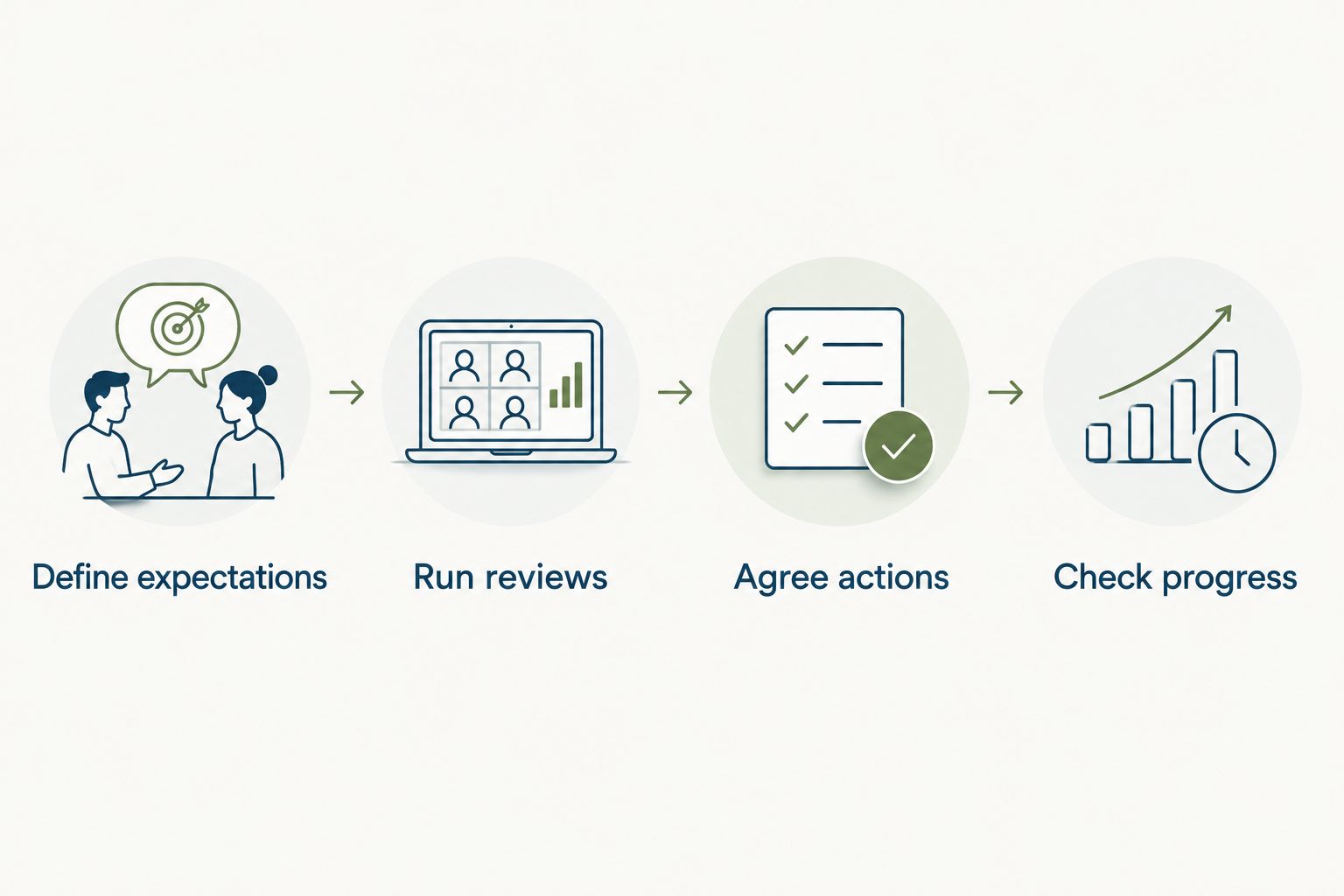
For a concrete test, propose a 30-day development action and a 60-day follow-up. These are demonstration checkpoints, not product promises or clinical standards. Watch whether the system makes the next conversation clear without requiring a separate explanation from HR.
Keep patient-identifiable information out of demonstration records. Use invented employee examples and assess data-handling requirements separately with the appropriate reviewers.
Which option should you choose in 2026?
Choose HRSpace when your healthcare team needs performance management connected with onboarding, goals, recognition and everyday HR. It is the default shortlist choice here for a growing employer seeking that combined scope.
Choose BambooHR when employee administration and reviews are the joint project. Choose HiBob when performance and engagement are both explicit requirements. Choose Lattice when reviews, feedback and development are the main purchasing priority.
Before signing, name an internal owner and document what will remain outside the platform. Include clinical assessments, credentials and any existing employee systems that will continue to operate.
Explore connected HR and performance
Review the platform scope for reviews, goals, onboarding and everyday employee support.
FAQ
What's the best performance management software for a small healthcare team?
Choose according to the process you need to fix: connected HR, HR-led reviews, performance plus engagement, or a dedicated performance approach. Require each finalist to demonstrate your role-specific review and development workflow.
Can performance management software replace clinical credentialing software?
Do not treat performance management software as a replacement for clinical credentialing software. Confirm credential tracking and clinical competency requirements separately rather than inferring them from review features.
Is BambooHR better than Lattice for healthcare performance reviews?
BambooHR fits a buying decision that combines core HR administration and reviews; Lattice fits a decision centered on performance-management tools. Healthcare suitability depends on your demonstrated workflow and data requirements, not the category alone.
Should clinical and administrative employees use the same review form?
Use role-specific expectations rather than identical evaluation content for every employee. Shared sections can cover organizational behaviors, while job-related sections should reflect the responsibilities being assessed.
What should healthcare employers check before uploading employee feedback?
Verify access permissions, data-handling arrangements and the information your organization permits in review records. Keep patient-identifiable details out of evaluation examples and involve the appropriate internal reviewers.
How do I compare modular performance software with a wider HR platform?
Compare the functions you need to operate now and the administrative work each option requires. Modular scope and wider platform scope are purchasing structures, not proof that either option matches your review process.
What should a performance software demonstration include in 2026?
Require a role-specific review, a development action and a follow-up demonstration. Also inspect manager changes, incomplete responses and access to historical feedback so the demonstration reflects real administrative work.
One last thing
Ask each finalist to demonstrate a manager handover before making your 2026 decision. Change the employee's reporting line while a development action is still open, then inspect access, ownership and review history.
That specific test checks something a polished review form cannot show: whether the process remains understandable when the people responsible for it change. Buy the follow-through, not just the form.