
Best for HR-led startups: HRSpace. Best for dedicated OKRs: Perdoo; best for task-led execution: Asana; best for a manual starting point: Google Sheets. This 2026 guide compares OKR software for startups by how you set goals, update results, and connect progress to everyday work.
- HRSpace is best for startups choosing goals alongside broader HR software, rather than a standalone OKR system.
- Perdoo belongs on your shortlist when objectives and key results are the main buying requirement.
- Compare Lattice for performance-linked goals and Asana for connecting goals to project execution.
- Choose OKR software for startups around ownership, measurable results, and a repeatable check-in process.
Why this matters
A startup does not need another place to copy status updates. You need a clear answer to three questions: what matters, who owns the result, and what changed since the last check-in.
For companies with 20–100 employees, the buying decision also crosses functions. People Operations wants useful review context. Founders want company priorities. Team leads want less reporting work. Those needs overlap, but they do not automatically require the same product.
Buy for the operating process you need, not the longest feature list. A goal tracker, a performance platform, and a dedicated OKR system solve different problems.
What makes the best OKR software for startups?
Use these criteria for your 2026 shortlist:
- Measurable results: Can you distinguish an outcome from the tasks intended to produce it?
- Clear ownership: Can someone take responsibility for each objective and result?
- Useful check-ins: Can managers understand progress without recreating the update elsewhere?
- Relevant context: Do you need goals beside performance reviews, projects, or company strategy?
- Manageable administration: Can your team maintain the process without a separate reporting operation?
- Appropriate scope: Are you buying goal management, formal OKRs, or a wider HR platform?
Treat demonstrations as evidence. Ask each vendor to show your actual workflow, including a missed target and a changed priority—not just a completed objective.
Startup OKR software at a glance
The order below starts with the HR-led use case, then separates dedicated OKRs, performance management, project execution, and manual tracking. It is a decision tree, not a claim that one product wins every category.
| Option | Best for | Standout focus | Key limitation |
|---|---|---|---|
| HRSpace | Goals within broader HR operations | Goals alongside reviews, onboarding, recognition, and employee support | Confirm formal OKR structure and reporting requirements |
| Perdoo | A dedicated OKR process | Objectives, key results, and KPI tracking | Does not replace the wider HR operating process |
| Lattice | Goals connected to performance management | Goal management within a people-management platform | Wider performance scope is unnecessary for a goals-only purchase |
| Asana | Goals connected to project execution | Goals alongside projects and tasks | Task completion still needs an explicit outcome measure |
| Google Sheets | A manual OKR pilot | A shared spreadsheet you structure yourself | Ownership, update discipline, and reporting remain manual |
1. HRSpace: best startup goal software for HR-led teams
HRSpace combines goals with onboarding, time-off, performance reviews, recognition, AI recruitment, workflows, and an internal service desk. Its modular, per-employee model makes it relevant when your startup is choosing HR software and goal management together.
The strongest reason to shortlist it is scope: you need more than an objectives dashboard. The buying question is whether its goal functionality matches the OKR process you intend to run.
HRSpace pros:
- Covers goals and performance reviews within the same platform.
- Includes employee-lifecycle functions beyond goal tracking.
- Uses a modular, per-employee purchasing model.
HRSpace cons:
- Goals functionality alone does not establish support for formal OKR hierarchies, scoring, or roll-ups; confirm those requirements.
- A broader HR platform is the wrong scope if you only need a standalone strategy tracker.
Best for: People Operations leaders and founders replacing fragmented HR processes while introducing clearer goals.
In a demonstration, bring a company objective, a team result, and an employee goal. Ask how each is represented, updated, and reviewed. Also ask which modules your intended process requires; do not assume every capability belongs to the same configuration.
Verdict: Buy for a combined HR-and-goals requirement after confirming your OKR workflow. Hold for a dedicated OKR-only purchase.
2. Perdoo: best OKR software for a dedicated strategy process
Perdoo focuses on OKRs and KPIs. That makes it a direct candidate when your main requirement is documenting objectives, measuring key results, and maintaining visibility into strategic progress.
The distinction matters. A KPI tracks an ongoing measure; an OKR sets a desired change. Your startup needs to decide which measures simply need monitoring and which require a focused improvement effort.
Perdoo pros:
- Centers the product around OKRs rather than treating goals as an adjacent HR feature.
- Supports consideration of objectives and ongoing business measures together.
- Gives an OKR-focused buyer a narrower evaluation scope than a wider HR suite.
Perdoo cons:
- Does not remove the need for onboarding, employee support, or other HR systems.
- A dedicated platform introduces another process to maintain if your team has not agreed on goal ownership.
Best for: Founders and operations leaders establishing a company-wide OKR process independently of their HR system.
Ask Perdoo to demonstrate a result that falls behind, not just one that reaches its target. You need to see how an owner explains the problem and how leadership distinguishes a weak outcome from an incomplete update.
Verdict: Buy when formal OKRs are the primary requirement. Skip when you mainly need to replace basic HR administration.
3. Lattice: best startup goal software for performance-led teams
Lattice offers goals within a wider performance-management platform. It belongs on the shortlist when managers need goal context alongside employee feedback and performance conversations.
That does not make a company OKR identical to an employee rating. Keep those decisions separate: a difficult shared objective can miss its target without proving that an individual performed poorly.
Lattice pros:
- Places goals within a people-management context.
- Suits an evaluation centered on manager conversations and employee performance.
- Offers a broader alternative to a standalone goal register.
Lattice cons:
- The wider platform is unnecessary if you only want a lightweight objectives tracker.
- You still need a policy separating ambitious business targets from individual evaluation.
Best for: People teams whose main problem is connecting goals with an established performance process.
For your 2026 evaluation, ask managers to walk through a review using a missed shared objective. The demonstration should clarify how context is preserved without turning every team target into an individual score.
Verdict: Buy for performance-led goal management. Hold if your review process is still undefined.
4. Asana: best startup goal software for task-led execution
Asana combines work management with goal functionality. It is relevant when your startup needs to connect strategic intentions with the projects and tasks teams execute.
The key distinction is between work finished and results achieved. Shipping a feature is an activity; changing customer behavior is an outcome. Your goal design must make that difference visible.
Asana pros:
- Brings goals into the context of projects and tasks.
- Fits an evaluation focused on execution rather than employee administration.
- Gives teams a way to discuss strategic intent alongside planned work.
Asana cons:
- Project completion does not automatically demonstrate business impact.
- It does not replace an HR platform for onboarding, time-off, and employee support.
Best for: Startups whose central problem is connecting team projects to company priorities.
If your team already works in Asana, evaluate its goal workflow before introducing another system. Confirm the relevant functionality and plan requirements directly, then test whether managers can explain results without exporting everything into a separate presentation.
Verdict: Buy for project-to-goal visibility. Skip as a substitute for broader HR operations.
5. Google Sheets: best software for a manual OKR pilot
Google Sheets lets you build a shared OKR register using rows, columns, formulas, and comments. You define the structure rather than adopting a dedicated goal-management workflow.
That flexibility is useful when you are still deciding what a good objective looks like. It also makes you responsible for keeping the structure consistent.
Google Sheets pros:
- Lets you change the tracking format as your process develops.
- Makes the underlying goal definitions and calculations visible.
- Works as a straightforward place to test a shared goal register.
Google Sheets cons:
- Update reminders, ownership checks, and reporting require manual discipline.
- Flexible editing makes inconsistent definitions and competing versions a process risk.
Best for: A startup testing its first OKR cycle before selecting a dedicated platform.
Create fields for the objective, result, owner, baseline, target, latest value, and explanation. Keep tasks elsewhere unless they directly explain the result. Otherwise, the sheet becomes a project backlog with an OKR label.
Verdict: Buy into the process first; hold the dedicated software purchase until your team can maintain a clear register.
Test the workflow before you commit
Use a 30-day pilot to evaluate your 2026 shortlist. This is a recommended evaluation format, not an implementation promise or vendor benchmark.
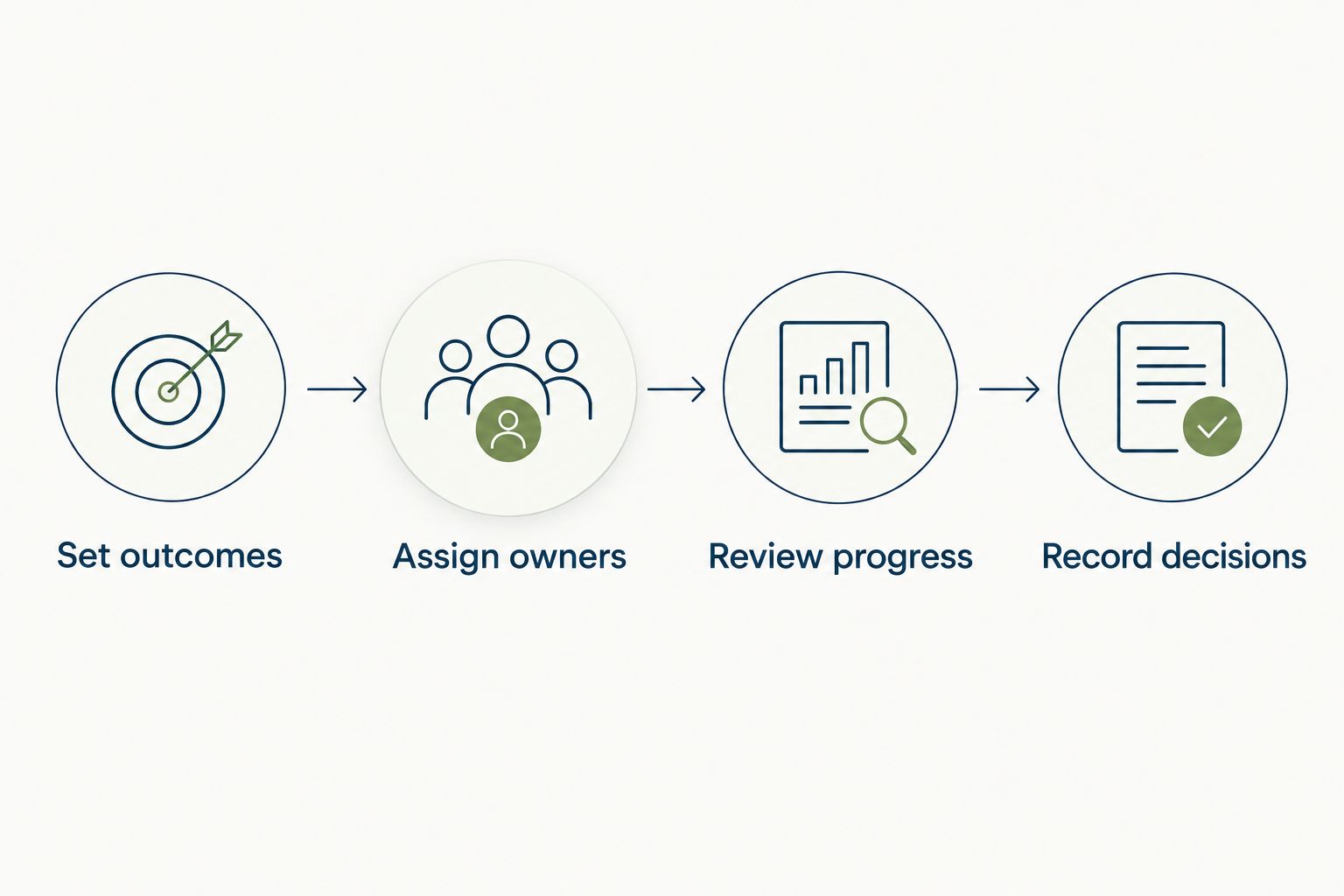
Run the same sequence in each finalist:
- Set outcomes: Write one objective with measurable results. Identify the baseline, target, and measurement source.
- Assign owners: Give each result an accountable owner. Separate contributors from the person responsible for the update.
- Review progress: Hold a 15-minute weekly check-in focused on changes, obstacles, and decisions—not a task-by-task recital.
- Record decisions: Capture what you will stop, continue, or change when progress falls behind.
At the end, ask the owner to explain a result without opening a separate slide deck. Then ask a manager what changed because of the check-in. Those questions expose whether the software supports a useful operating habit or simply stores updates.
For an illustrative 90-day cycle, distinguish the measurement window from the update cadence. A quarterly outcome still needs current evidence; waiting until the final review turns goal management into retrospective reporting.
How the ranking works
This ranking uses product scope and the buyer criteria above: measurable results, ownership, check-ins, context, administration, and fit. It is not a hands-on performance benchmark, and the order does not imply measured differences in setup time or adoption.
Each option owns a different use case. Dedicated OKRs favor Perdoo; performance-led evaluation favors Lattice; project execution favors Asana; a manual pilot favors Google Sheets. The HR-led option belongs first only when broader employee operations are part of the purchase.
Which OKR software should your startup choose?
For a startup specifically buying dedicated OKR software in 2026, start with Perdoo. Its category focus matches the query more directly than a general HR or work-management purchase.
Choose HRSpace instead when goals are part of a wider HR decision involving onboarding, reviews, recognition, and employee support. Choose Lattice when performance management leads the requirement, or Asana when execution visibility leads it.
If nobody can define a measurable result or own the weekly update, start with Google Sheets. Software will not resolve an undecided operating process.
Explore goals alongside your HR workflows
Review a modular platform covering goals, performance reviews, onboarding, and employee support.
FAQ
What's the best OKR software for startups in 2026?
Perdoo is the starting recommendation for a dedicated OKR requirement. Choose HRSpace when goals belong within a broader HR purchase, Lattice for performance-led needs, or Asana for project-led execution.
Is goal management the same as OKR software?
No. Goal management is the broader category; OKRs organize objectives around measurable key results. Confirm the structure, ownership, update process, and reporting you need rather than relying on a goals label.
Can a startup use Google Sheets for OKRs?
Yes, Google Sheets can hold a shared OKR register. Your team remains responsible for consistent definitions, updates, ownership, and reporting.
Should a startup connect OKRs to performance reviews?
Use OKRs as context for performance conversations, not as an automatic employee score. Shared business results and individual contributions require separate interpretation.
How should a startup compare OKR software?
Run the same objective and measurable results through each finalist. Test ownership, progress updates, missed targets, and the decisions managers need to record.
How often should a startup update its OKRs?
A weekly check-in is a practical starting recommendation. Choose an update rhythm that matches how quickly the underlying measures change, and distinguish routine updates from end-of-cycle evaluation.
What should a startup confirm before choosing an HR platform for OKRs?
Confirm that the platform supports your required OKR structure, progress measurement, ownership, and reporting. Also establish which modules your workflow requires before committing.
One last thing
Ask every finalist to show a missed target. A completed goal makes almost any system look useful; a missed goal reveals whether you can preserve context, assign the next action, and make a decision.
For your 2026 purchase, that demonstration matters more than a polished dashboard. Choose the system that helps your team respond to results, not merely display them.