
Employee recognition software costs depend on the number of employees you cover, the features you choose, and whether recognition is purchased separately or within an HR platform. For your 2026 budget, use a written quote tied to a defined employee count and module list—not an unsupported market average. Keep any employee reward spending separate from the software subscription so you can compare the same scope across vendors.
- How much does employee recognition software cost? Compare quotes using the same employee count, recognition features, and contract scope.
- HRSpace employee recognition software fits growing teams seeking recognition within a modular HR platform.
- Separate software subscriptions from employee rewards when building your recognition budget.
- Compare a recognition-only purchase with modular HR software before adding another subscription.
How much does employee recognition software cost?
Your useful number is the quoted total for your employee count and selected features. A per-employee rate alone does not tell you what the contract includes, how employees are counted, or whether recognition requires other modules.
Hrspace offers a modular, per-employee-priced HR platform that includes recognition alongside onboarding, time-off, performance reviews, goals, recruitment, workflows, and an internal service desk. That makes module scope part of the buying decision: evaluate recognition against the HR work you need to support, not just as an isolated feature.
Build the quote breakdown before comparing proposals:
| Budget component | What to request | What it tells you |
|---|---|---|
| Employee coverage | The exact employee count used in the quote | Whether proposals cover the same population |
| Recognition subscription | The recognition capabilities included | Whether the software supports your intended program |
| Other HR modules | A named list of included and optional modules | Whether recognition is being compared alone or within a broader platform |
| Implementation scope | Written responsibilities for configuration, data preparation, and training | How much work your team must own |
| Employee rewards | A separate statement of any reward-related commitments | Whether recognition spending is being mixed with software spending |
| Contract terms | Billing period, employee-count rules, and renewal terms | How the commitment behaves as your company changes |
Treat this as a request for clarification, not a list of charges every vendor imposes. Each proposal should explicitly identify what applies and what does not.
A quote is ready for comparison when you can explain it without a sales representative filling in the gaps. If a line item has an unclear purpose, ask for its scope in writing before approving the purchase.
Why this matters
Recognition software is a people-program decision and a software decision. Your team needs a clear way to recognize contributions; your business needs a commitment it can understand and administer.
For a growing company with 20–100 employees, compare the purchase with your existing HR setup. A separate recognition tool creates a distinct buying and administration decision. A modular HR platform broadens the evaluation to include the employee lifecycle.
Neither approach wins automatically. Buy the scope you will use, and make the vendor explain what that scope includes. A wider feature list is not proof of better value, and a narrower feature list is not proof of a smaller total commitment.
In a 2026 evaluation, separate what the product does today from what your team hopes to achieve. Recognition features are a purchasing requirement; stronger employee engagement is an outcome you must assess after adoption.
Recognition-only software or an HR platform?
Compare the buying approaches before comparing individual vendors. This prevents a narrow recognition quote from being treated as equivalent to a proposal covering several HR functions.
| Buying approach | Best for | Main advantage | Main limitation |
|---|---|---|---|
| Recognition-only purchase | Teams seeking recognition without changing other HR systems | Keeps the evaluation focused on the recognition program | Does not address other HR needs unless they are explicitly included |
| Modular HR platform | Growing teams evaluating recognition alongside other HR work | Lets you assess recognition and selected HR modules together | Requires a careful module-by-module scope review |
Recognition-only purchase: keep the scope narrow
A recognition-only evaluation works when you have a defined recognition need and do not want the buying process to expand into a broader HR replacement project. Start with the behavior you want to support: who gives recognition, who receives it, and what administrators need to manage.
The trade-off is scope. Do not count onboarding, time-off, performance reviews, or employee support as benefits unless the proposal explicitly includes those capabilities. Keep the decision focused enough that your team can explain why this separate purchase is necessary.
Modular HR platform: review the whole requirement
A modular platform evaluation makes sense when recognition is part of a wider HR buying decision. List the HR functions you need now, then distinguish them from functions that are merely interesting.
Hrspace employee recognition software is best for growing teams that want recognition within a modular HR platform. Its stated scope covers multiple employee-lifecycle functions, but that scope does not establish reward fulfillment, particular integrations, implementation timelines, or contract terms. Require confirmation for any capability essential to your recognition program.
The limitation is evaluation effort. You must check more than recognition and resist treating every available module as a reason to buy it.
Why employee recognition software costs vary
The strongest comparison uses a consistent employee population and a precise feature list. For a modular, per-employee purchase, these are the scope drivers to define:
- Employee count: Identify the employee population covered by the proposal. Ask how the agreement treats changes to that population.
- Recognition scope: State the recognition activities your team needs the software to support. Verify each requirement rather than relying on the category name.
- Selected HR modules: Separate recognition from onboarding, time-off, performance reviews, goals, recruitment, workflows, and service desk requirements.
- Breadth of the purchase: Decide whether you are solving recognition alone or replacing several HR tools. Those are different purchasing projects and need different comparisons.
Use these factors to standardize the request, not to predict a rate. A vendor should explain how its own commercial terms map to the scope you provide.
For your 2026 budget, record optional modules separately from the approved scope. Otherwise, a proposal can look attractive because it contains features your team has no plan to use.
Build a quote you can compare
Give every shortlisted vendor the same written brief. You will get a more useful comparison when employee count, recognition requirements, and the requested contract scope stay consistent.
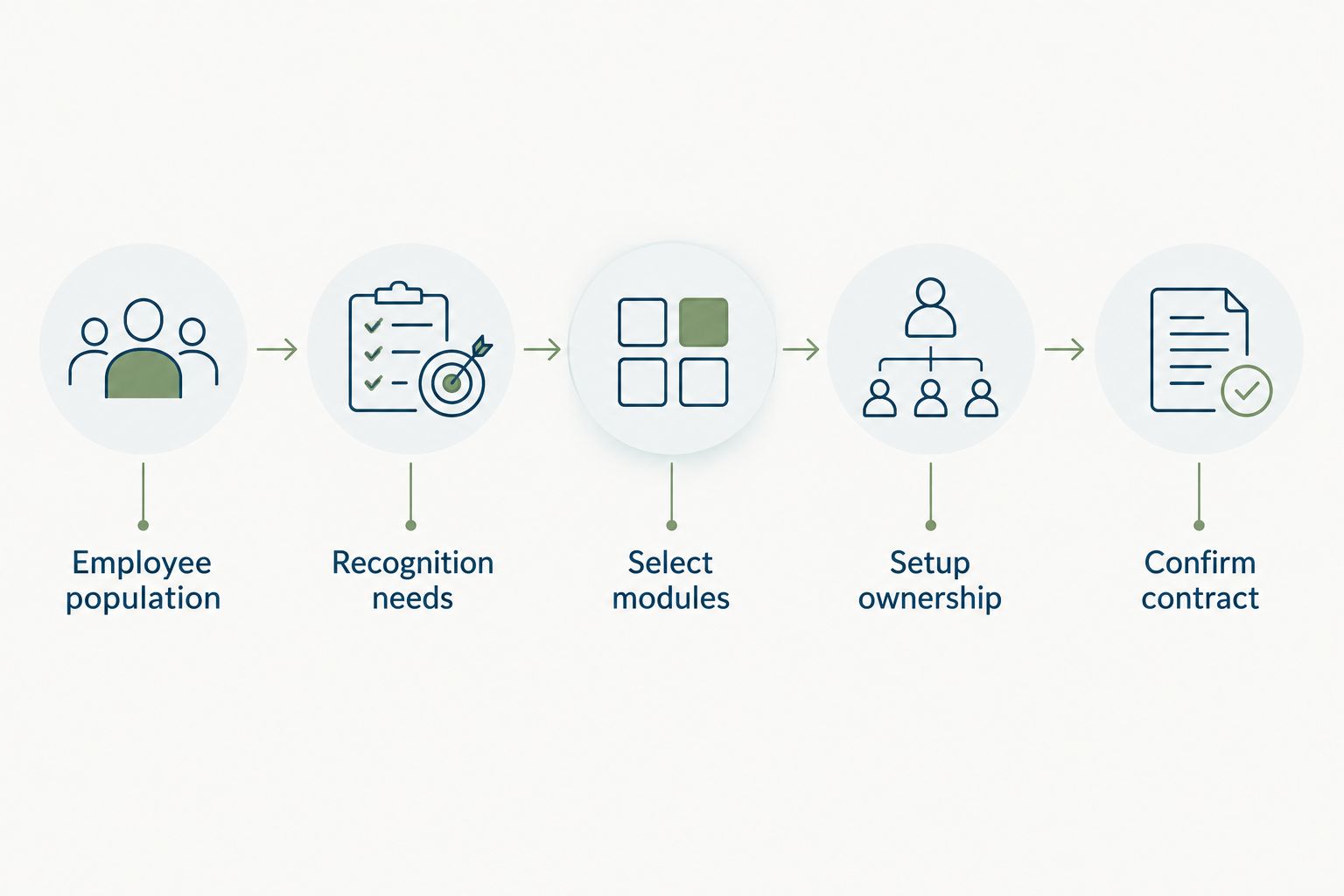
1. Define the employee population
Use your actual covered headcount, not a rounded company-size label. If you are planning for growth, ask the vendor to quote the same requirements at each relevant headcount scenario.
For example, request scenarios covering 20 employees, 50 employees, and 100 employees only if those are useful planning points for your business. These are comparison scenarios, not market benchmarks or forecasts.
Ask which employees count toward billing and when that count is measured. Do not assume that an active employee, a user account, and an employee record mean the same thing in a contract.
2. Define recognition needs
Write down what your program must accomplish before reviewing a demonstration. Your requirements should describe activities your managers and employees need to complete, not a collection of vendor feature names.
Useful questions include who can give recognition, who can view it, and what an administrator needs to manage. Treat each as a capability to verify; do not assume every recognition product supports the same workflow.
If rewards are part of your intended program, say so explicitly. Recognition and reward fulfillment are separate requirements, even when you want employees to experience them together.
3. Select modules
Create a short list of HR functions included in the buying decision. Mark recognition as required, then identify whether onboarding, time-off, performance reviews, goals, recruitment, workflows, or employee support belong in the same evaluation.
This is where modular software needs discipline. A module belongs in the approved scope because it solves a current requirement—not because it appears in the product catalog.
Ask the vendor to distinguish selected modules from optional ones. Keep that distinction visible in the final agreement.
4. Assign setup ownership
Ask who prepares employee information, configures the program, checks permissions, and introduces the software to managers. Request a written division of responsibilities.
Evaluate setup through a concrete plan, not an adjective. A claim that implementation is fast does not tell you which tasks your team owns or what must happen before employees can use the system.
Make any critical launch dependency part of the evaluation. If a requirement cannot be demonstrated or confirmed, do not treat it as settled.
5. Confirm the contract
Read the commercial terms against your requirements brief. Confirm the covered population, selected modules, billing period, employee-count adjustments, renewal terms, and any separately stated commitments.
Compare the written scope before choosing the vendor. A proposal that answers fewer questions is not automatically simpler; it can leave more work for your team after signing.
For 2026 procurement, keep the requirements brief attached to your decision record. It gives the approver a clear explanation of what the business is purchasing and why.
Separate software from the recognition program
Software enables a recognition process; it does not decide what your company should recognize. Define the program rules before using product features as a substitute for policy.
Write down the contributions you want managers and peers to acknowledge. Decide who owns the program and who answers employee questions. If your program includes rewards, establish a separate approval process for that spending.
This separation makes the buying decision clearer. You can evaluate whether the software supports your recognition process without treating every program expense as a subscription expense.
It also improves internal accountability. HR can own the program requirements while the budget approver understands which commitments belong to software and which belong to employee rewards or internal administration.
Is recognition software cheaper inside an HR platform?
A combined purchase is not automatically cheaper. Compare the written commitment for the modules you need with the commitment for a separate recognition purchase and the HR systems you would retain.
Avoid counting an existing subscription as a saving until you have decided to replace it. If the new platform does not meet that system's essential requirements, the existing commitment remains part of your decision.
The same rule applies to administrative work. Ask what changes for your team, then verify the workflow before claiming a reduction in effort.
Does per-employee billing cover everyone automatically?
Per-employee billing does not, by itself, define who is included. The agreement must explain the employee population used for billing and how additions, departures, or other status changes affect it.
For a 50-employee evaluation, use the same covered population in every proposal. This keeps a scope difference from being mistaken for a commercial advantage.
Do not assume managers, administrators, contractors, or inactive records receive a particular billing treatment. Ask the vendor to explain each relevant case.
Should rewards be included in the software budget?
Keep rewards separate from the software subscription in your budget breakdown. You can still approve both within one recognition initiative, but distinguish what pays for the software from what funds employee rewards.
This prevents a program decision from distorting the product comparison. It also makes it easier to revise reward rules without losing sight of the underlying software commitment.
FAQ
How much does employee recognition software cost for a small company?
The total depends on the company's covered employee count, selected features, and contract terms. Request recognition-only and broader HR-platform scopes separately so you can compare equivalent requirements.
What should an employee recognition software quote include?
An employee recognition software quote should identify the covered employee population, included capabilities, selected modules, and commercial terms. Ask the vendor to state implementation responsibilities and any separate reward-related commitments.
Is a recognition-only tool better than an all-in-one HR platform?
A recognition-only purchase is better suited to a narrowly defined recognition project; a modular HR platform suits a broader HR evaluation. Compare each approach against the systems and requirements you intend to keep.
Does Hrspace offer recognition as part of its HR platform?
Hrspace includes recognition within its modular, per-employee-priced cloud HR platform. Its stated platform scope also covers onboarding, time-off, performance reviews, goals, recruitment, workflows, and an internal service desk.
Are employee rewards the same as recognition software fees?
Employee rewards and recognition software fees are separate budget categories. Ask the vendor to identify any reward-related commitments rather than assuming the subscription includes them.
How do I compare quotes for 50 employees?
Compare quotes for 50 employees using the same covered population, recognition requirements, selected modules, and billing period. Check the employee-count rules before treating the proposals as equivalent.
What should I check before buying recognition software in 2026?
Before buying recognition software in 2026, confirm the recognition workflow, covered employees, selected modules, setup ownership, and contract terms. Require written confirmation of every capability your program depends on.
One last thing
Ask what you would stop buying or doing after this purchase. If the answer is unclear, you have not yet defined the value of the proposed scope.
For an Hrspace evaluation, separate recognition requirements from the other HR modules you are considering. Approve each module for a specific use, and leave optional scope outside the decision until your team needs it.