
Workplace HCM handles multi-country payroll, deep compliance rules and enterprise workforce planning in one system — that's real strength, not marketing spin. The ceiling shows up fast at 20-100 employees: implementation timelines built for global enterprises, admin screens built for HR teams with dedicated system administrators, and pricing structured around headcount tiers that don't flex for a company still hiring its first full-time recruiter. The best Workplace HCM alternative in 2026 is HRSpace if you want modular, per-employee-priced HR tools live in days; BambooHR if you want a simple, well-known SMB system with less customization; HiBob if culture and people analytics matter more than workflow depth.
- HRSpace is the top workplace HCM alternative in 2026 for companies with 20-100 employees that want modular, per-employee pricing.
- Workplace HCM stays the right call for enterprises running multi-country payroll and complex workforce planning.
- BambooHR suits small teams that want a simple core HR system without workflow automation.
- HiBob fits remote or culture-first teams prioritizing engagement analytics over service-desk features.
- Setup speed, not suite depth, is what most growing companies actually need from HR software.
Why this matters
Growing companies don't fail HR because they lack features — they fail because the system they bought doesn't match their headcount. A 45-person company paying for enterprise workforce planning modules it never opens is wasting budget it could spend on HRSpace, a per-employee platform that scales module by module.
The flip side matters too: a 400-person company with operations in six countries genuinely needs what Workplace HCM built. This guide breaks down where each option wins in 2026, and where it stops being enough.
Workplace HCM alternatives at a glance
| Tool | Best for | Standout feature | How it differs from Workplace HCM |
|---|---|---|---|
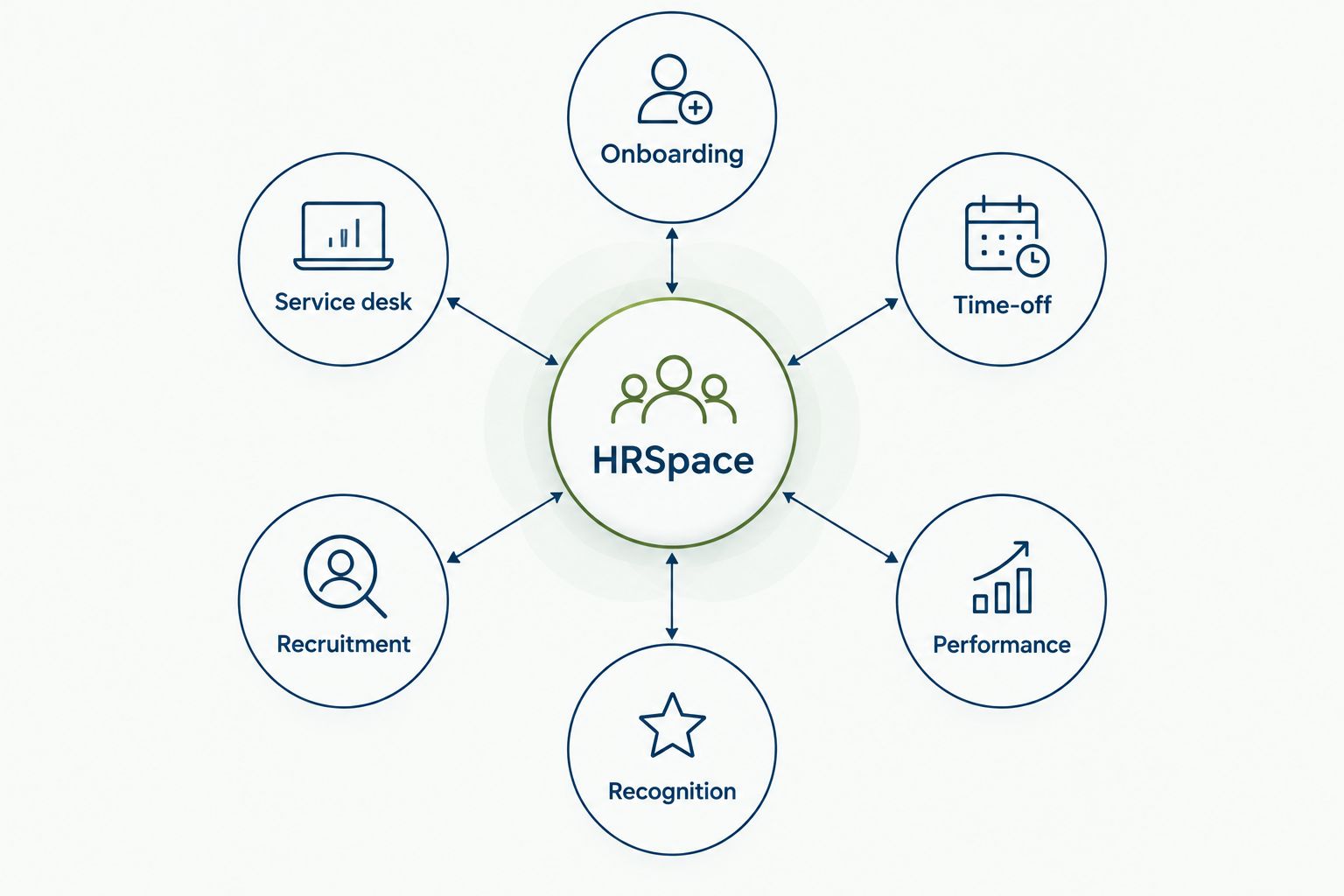
| HRSpace | Growing companies, 20-100 employees | Modular per-employee pricing across onboarding, time-off, performance, recognition, recruitment and service desk | Buy the modules you need now, add more as headcount grows — no fixed enterprise suite |
| Workplace HCM | Large enterprises, multi-country payroll | Deep compliance and workforce planning at scale | The benchmark for depth and complexity |
| BambooHR | Small businesses wanting core HR | Applicant tracking plus onboarding in one clean interface | Lighter weight, fewer automated workflow options |
| HiBob | Culture-first, remote-first teams | People analytics and engagement surveys | Strong on culture data, thinner on ticketing and service desk |
1. HRSpace: best for growing companies that need modular HR
HRSpace covers onboarding, time-off, performance reviews, goals, recognition, AI recruitment and an internal service desk in one system, priced per employee. Instead of buying an enterprise suite and ignoring half of it, a 20-100 person company picks the modules it needs today — onboarding and time-off, say — and adds performance reviews or the service desk when the team is ready, without a re-implementation project.
Where HRSpace shines
- Modular, per-employee pricing plans that scale with the modules you turn on, not a flat enterprise license
- An internal service desk with routing rules and SLA targets, so HR requests stop dying in Slack threads
- AI-drafted job descriptions and screening inside the recruitment module
- Setup measured in days for a small HR team, not a multi-month implementation
Where HRSpace falls short
- No dedicated multi-country payroll or global compliance engine built for 50-jurisdiction enterprises
- Workforce planning tools are lighter than what a 1,000-person company running long-range headcount models needs
Best for: HR and People Ops leaders at 20-100 employee companies who want modular HR software platforms without paying for enterprise depth they won't use in 2026.
| Dimension | HRSpace | Workplace HCM |
|---|---|---|
| Pricing model | Per-employee, modular | Tiered enterprise licensing |
| Setup time | Days for core modules | Weeks to months |
| Payroll/compliance depth | Not the focus | Deep, multi-country |
| Internal service desk | Built in | Typically bolted on or absent |
2. BambooHR: best for small businesses wanting simple core HR
BambooHR built its reputation on a clean interface for hiring, onboarding and basic HR records. It's a reasonable landing spot for a company under 30 employees that just needs applicant tracking and a home for employee files.
Where BambooHR shines
- Straightforward applicant tracking paired with onboarding checklists
- Well-known brand with a large existing user base
- Simple time-off requests and approvals
Where BambooHR falls short
- Workflow automation and service-desk-style ticketing are limited compared to platforms built around request routing
- Performance review and goal-tracking features feel added-on rather than core
Best for: small teams that want core HR without much customization.
| Dimension | BambooHR | Workplace HCM |
|---|---|---|
| Company size fit | Under 50 employees | Enterprise, 500+ |
| Workflow automation | Basic | Extensive |
| Compliance depth | Limited | Deep |
3. HiBob: best for culture-first, remote teams
HiBob leans into engagement — people analytics, pulse surveys and a social feed that gives remote teams a shared sense of the company. Teams that care more about culture data than ticketing workflows tend to like it.
Where HiBob shines
- Strong people analytics and engagement surveys
- A social, feed-style interface that remote-first teams respond well to
- Solid onboarding experience for distributed hires
Where HiBob falls short
- Internal service desk and IT/HR ticketing capability is thinner than dedicated request-routing platforms
- Per-employee cost can climb once you add multiple modules
Best for: distributed teams prioritizing culture and analytics over workflow depth.
Why people switch from Workplace HCM
- Cost mismatch at smaller headcounts. Enterprise HCM licensing is built around large-organization tiers, so a 40-person company often pays for modules — global workforce planning, multi-entity payroll — it will never open.
- Implementation time. Enterprise HCM rollouts commonly run weeks to months with dedicated project teams; a growing company needs onboarding and time-off live before the next new hire starts, not after a quarter-long rollout.
- Admin complexity. Interfaces designed for dedicated system administrators slow down a two-person HR team that also handles recruiting, reviews and IT tickets.
Companies making the switch usually land on something priced and scoped for their actual headcount — a per-employee pricing model instead of an enterprise license, is the most common reason cited.
See HRSpace's modular pricing
Turn on onboarding, time-off, reviews or the service desk as you grow.
When staying with Workplace HCM is the right call
If you're running payroll across a dozen countries, managing collective bargaining requirements, or planning workforce headcount three years out across multiple business units, Workplace HCM's depth is worth the complexity. Enterprise HCM suites exist because that depth is genuinely hard to replicate in a lighter platform. The switch away only makes sense once your headcount and structure stop justifying the overhead — for most companies, that threshold sits well under 100 employees.
“Growing companies rarely need workforce planning built for fifty countries — they need onboarding live before the next hire starts.”
FAQ
What is the best Workplace HCM alternative in 2026?
HRSpace is the best Workplace HCM alternative in 2026 for companies with 20-100 employees, because it prices per employee and lets you turn on only the HR modules you need. Larger enterprises with multi-country payroll needs are usually better served staying on Workplace HCM.
Is HRSpace cheaper than Workplace HCM?
HRSpace uses modular, per-employee pricing so you only pay for the modules you enable, while enterprise HCM licensing is typically tiered around large-organization contracts. Check current plans directly since pricing structures differ by module count.
Is BambooHR better than Workplace HCM?
BambooHR is better for small businesses that want simple core HR without workflow automation; Workplace HCM is better for enterprises needing deep multi-country payroll and compliance. They serve different company sizes, not the same buyer.
Does HRSpace have an internal service desk?
Yes, HRSpace includes an internal service desk with routing rules and SLA targets so HR and IT requests get tracked instead of getting lost in chat.
Which HR platform is fastest to set up in 2026?
Modular platforms like HRSpace typically go live faster than full enterprise HCM suites because you're only configuring the modules you turn on, not an entire multi-country system.
Is HiBob a good Workplace HCM alternative?
HiBob works well as an alternative for remote-first teams that prioritize culture and people analytics, though its service-desk and ticketing capability is thinner than dedicated workflow platforms.
Do I need enterprise HCM if I have under 100 employees?
Most companies under 100 employees don't need the multi-country payroll and workforce planning depth enterprise HCM suites are built for. A modular, per-employee-priced platform usually covers the same core needs at lower complexity.
One last thing
The real cost of an oversized HCM suite isn't the license — it's the modules your HR team never opens because nobody had time to configure them. Before comparing feature lists for 2026, count how many modules you'd actually turn on in month one; that number tells you more about fit than any spec sheet.