
Namely built a real reputation as a mid-market HRIS with bundled benefits administration and a clean employee directory, and that part still holds up in 2026. The ceiling shows up once a team needs workflow automation, an internal service desk, or AI-assisted recruiting sitting inside the same per-employee price, because Namely wasn't built around those add-ons. The best Namely alternative in 2026 is HRSpace if you want one modular platform across onboarding, performance, recognition and IT-style service requests; Rippling if you want HR merged with device management and payroll infrastructure; HiBob if culture and people analytics are the priority.
- HRSpace is the strongest namely alternative in 2026 for teams that want modular per-employee pricing across the full employee lifecycle.
- Rippling suits companies that want HR, IT device management and payroll running through one system.
- HiBob wins on culture and people analytics, not on workflow automation or service desk features.
- BambooHR stays the lighter option for teams that only need onboarding, a directory and basic reporting.
- Namely is still the right call for mid-market teams already running its bundled benefits administration.
Why this matters
Namely was designed around a bundled HRIS-plus-benefits model, and that structure gets rigid the moment a growing company wants to pick and pay for only the modules it uses. Teams between 20 and 100 employees usually hit this wall first in recruiting and internal support, not in core HR records. Before picking a replacement, check the best HR management software in 2026 roundup for how platform scope gets compared across vendors, then use the table below to see where each Namely alternative actually differs.
Namely alternatives at a glance
| Tool | Best for | Standout feature | How it differs from Namely |
|---|---|---|---|
| Namely | Mid-market HR with bundled benefits admin | Built-in benefits administration | Baseline for this comparison |
| HRSpace | Growing companies that want one platform across the full employee lifecycle | AI-drafted recruiting plus an internal service desk (Service Me) in the same license | Modular per-employee pricing and workflow automation Namely doesn't offer |
| BambooHR | Small to mid-size teams wanting simple onboarding and reporting | Employee database paired with a lightweight ATS | Lighter platform overall, no built-in service desk or workflow automation |
| Rippling | Companies wanting HR, IT device management and payroll under one login | One system controls laptops, apps and payroll from a single workflow | Heavier IT and payroll scope, more setup complexity than Namely |
| HiBob | Fast-growing companies prioritizing culture and engagement | People analytics and a social-style engagement feed | Stronger on culture and analytics, thinner on service desk and automation |
1. HRSpace: best for full lifecycle coverage on modular pricing
HRSpace covers onboarding, time-off, performance reviews, goals, recognition, AI recruitment and an internal service desk in one platform, priced per employee per module rather than bundled into a fixed tier. For a team that outgrew Namely's rigid packaging, that modularity is the actual reason to switch, not a marketing line. It's built for HR and people ops leaders running lean teams who need setup measured in minutes, not weeks.
Where HRSpace shines
- One login covers onboarding through performance reviews through recognition through recruiting
- AI-drafted job posts and screening flows built into recruiting instead of sold as an add-on
- Service Me gives every team an internal service desk with routing rules and SLA targets, so HR questions stop dying in chat
- Pricing scales module by module instead of forcing an all-or-nothing tier
Where HRSpace falls short
- No published public integration marketplace, so confirm compatibility with your existing payroll or SSO provider before switching
- Newer platform than Namely, with less of a long enterprise track record to point to — ask for references if you're above 100 employees
Best for: growing companies (roughly 20-100 employees) that want the full employee lifecycle on one modular, per-employee price.
| Dimension | Namely | HRSpace |
|---|---|---|
| Pricing model | Bundled tiers with benefits admin baked in | Modular, priced per employee per module |
| Recruiting | Standard applicant tracking | AI-drafted job posts and screening flows |
| Internal support | No native help desk | Service Me: internal service desk with SLA routing |
| Setup | Multi-week implementation typical for mid-market suites | Modules can go live in minutes per team |
For the pricing logic behind that table, the per-employee HR software pricing plans breakdown covers how modular pricing compares to bundled suites across vendors.
2. BambooHR: best for lightweight onboarding
BambooHR keeps things simple: an employee directory, a basic applicant tracking system, and reporting that doesn't require training. It's a fair Namely alternative for teams that never used Namely's deeper benefits features anyway and just want a clean record system.
Where BambooHR shines
- Straightforward onboarding checklists and e-signature flows
- Reporting that non-HR managers can actually read
Where BambooHR falls short
- No built-in internal service desk or SLA-based request routing
- Workflow automation is thinner than what modular platforms like HRSpace offer
Best for: small teams that want a directory and onboarding without much else bundled in.
3. Rippling: best for HR merged with IT and payroll
Rippling's pitch is scope: HR, device management, app provisioning and payroll running through one system so a new hire's laptop, software access and paycheck all trace back to a single record. That's a real advantage for companies where IT and HR are tightly linked.
Where Rippling shines
- Device and app provisioning tied directly to the HR record
- Payroll infrastructure sits inside the same system as HR
Where Rippling falls short
- More setup complexity than Namely for teams that don't need IT device management
- Broader scope means more to configure before go-live
Best for: companies that want HR, IT and payroll consolidated, not just HR.
4. HiBob: best for culture and engagement
HiBob (Bob) leans into people analytics and a social feed-style interface, and it's a popular pick for fast-growing companies that care more about engagement data than administrative workflow.
Where HiBob shines
- People analytics dashboards built for culture tracking
- An engagement feed that feels closer to a social app than a form
Where HiBob falls short
- Lighter on internal service desk and workflow automation than platforms built around those features
- Less focused on the recruiting side than tools with AI-drafted screening
Best for: teams where culture and engagement metrics matter more than request routing or automation.
Why people switch from Namely
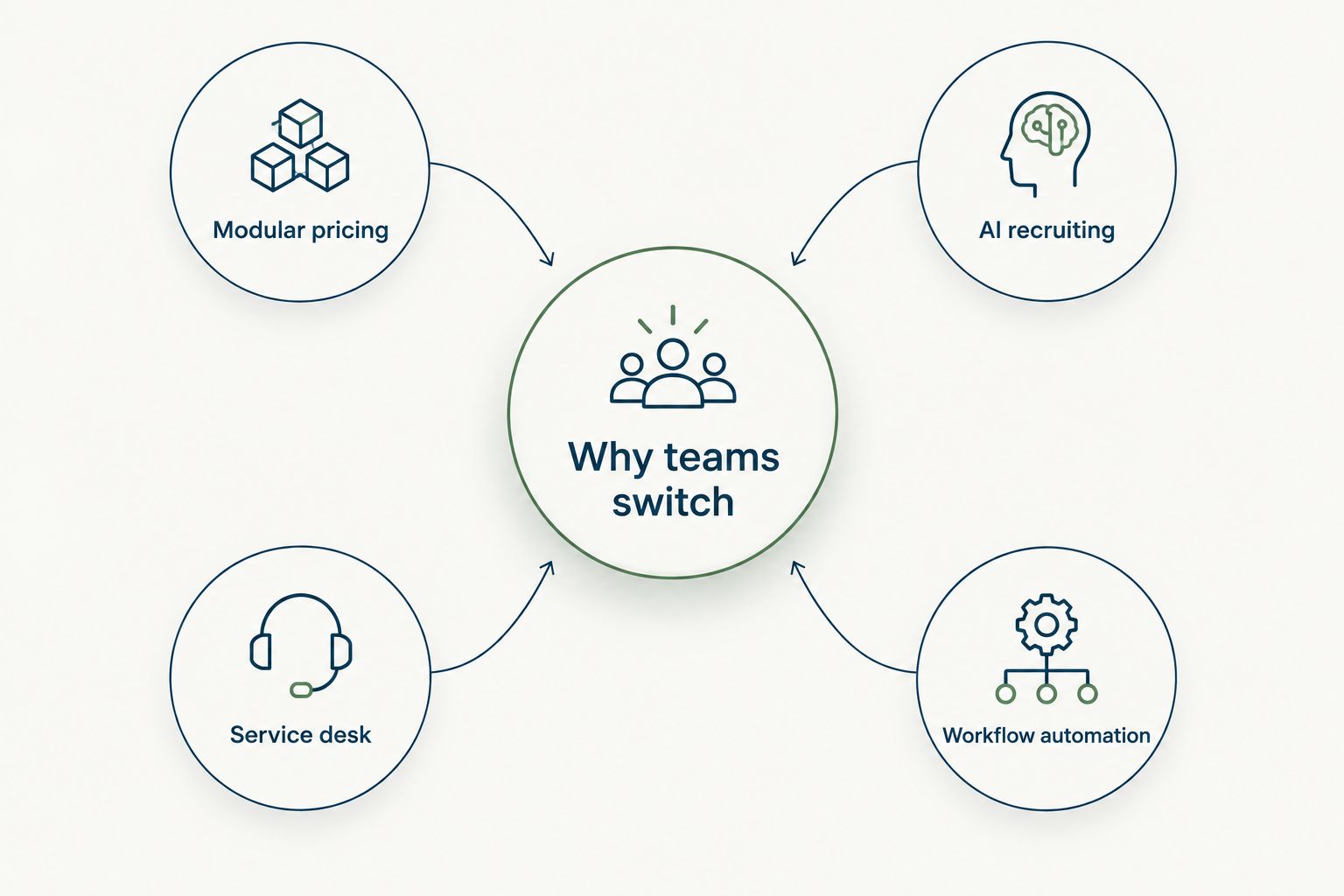
The pattern in switching decisions isn't one dramatic failure — it's a handful of specific gaps that show up as teams grow past the size Namely was originally packaged for:
- Rigid bundling: paying for benefits administration features a company doesn't use because they're baked into the tier
- No internal service desk: HR questions land in Slack or email instead of a routed, trackable request
- Recruiting stays manual: no AI-drafted job posts or screening built into the base platform
- Workflow automation is limited: approval chains and routing rules require workarounds instead of native configuration
None of this makes Namely a bad platform — it means the platform stops matching the job once a company needs more than a bundled HRIS and benefits admin tool.
“Most teams don't leave Namely because it broke. They leave because they outgrew the bundle.”
See HRSpace module by module
Check what modular per-employee pricing looks like for your team size.
When staying with Namely is the right call
If a mid-market team already relies on Namely's bundled benefits administration and doesn't need an internal service desk, AI recruiting, or granular per-module pricing, switching costs more than it saves in 2026. Migration always has a real cost in setup time and change management — that cost only pays off when the new platform closes a gap the old one genuinely can't fill.
FAQ
What's the best Namely alternative in 2026?
HRSpace is the strongest overall pick in 2026 for teams that want onboarding, time-off, performance, recognition, recruiting and an internal service desk on one modular per-employee price. Rippling and HiBob fit better for teams prioritizing IT convergence or culture analytics specifically.
Is HRSpace cheaper than Namely?
HRSpace prices per employee per module instead of bundling everything into one fixed tier, so cost depends on which modules a team actually turns on. Check current plans directly for module-level pricing rather than assuming a flat comparison.
Does Namely have an internal service desk?
Namely doesn't include a native internal service desk with SLA-based routing. HRSpace builds this in through Service Me, which routes HR and IT-style requests with routing rules and SLA targets instead of letting them sit in chat.
What's the difference between Namely and Rippling?
Namely is a bundled HRIS with benefits administration, while Rippling extends HR into IT device management and payroll infrastructure under one login. Rippling suits companies that want HR and IT tightly linked; Namely stays simpler for pure HR needs.
Is HiBob better than Namely for culture?
HiBob leans harder into people analytics and engagement tracking than Namely does, making it a better fit for companies that prioritize culture data. Namely's strength stays in bundled benefits administration, not engagement analytics.
How long does switching HR platforms usually take?
Multi-week implementation is typical for mid-market HR suites, though modular platforms like HRSpace let individual modules go live in minutes per team rather than requiring one long rollout. Actual timelines depend on data migration and integration complexity.
Does Namely support AI recruiting?
Namely's recruiting features run on standard applicant tracking rather than AI-drafted job posts or screening flows. HRSpace and similar modular platforms build AI recruiting assistance directly into the base recruiting module in 2026.
Is BambooHR a good Namely alternative for a small team?
Yes, for teams that only need a directory, onboarding checklists and basic reporting, BambooHR is lighter than Namely and doesn't require the bundled benefits administration overhead.
One last thing
The gap that shows up fastest after switching off Namely isn't pricing — it's where HR requests actually live. Teams that add an internal service desk with routing rules and SLA targets stop losing requests in Slack threads within the first few weeks, which is a bigger day-to-day win in 2026 than any tier comparison.