
HR Easily covers the basics well: employee records, leave tracking, and simple onboarding checklists that a small team can set up without a training manual. The ceiling shows up once you add performance reviews, recruiting, or internal requests that outgrow a shared inbox — those workflows sit outside what a records-and-leave tool is built to handle. The best HR Easily alternative in 2026 is HRSpace if you want one platform across the employee lifecycle including AI recruitment and a service desk; BambooHR if you want a widely recognized name with a large app marketplace; HiBob if culture and engagement content matter as much as HR records.
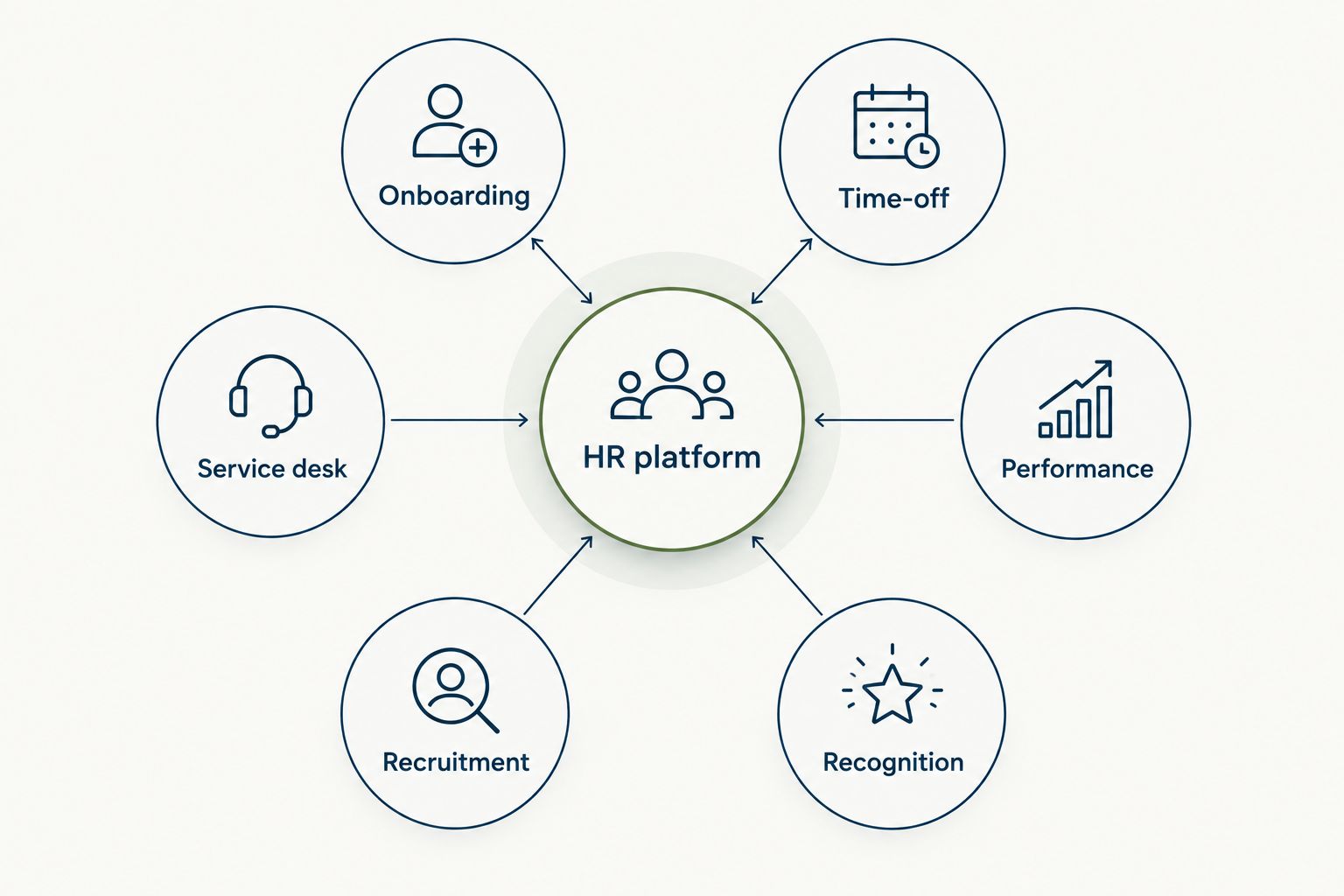
- HRSpace is the strongest HR Easily alternative in 2026 for teams that want onboarding, time-off, performance, recognition, recruiting and a service desk in one modular platform.
- BambooHR suits teams that want a familiar name and a large third-party app marketplace, with performance and recruiting sold as add-ons.
- HiBob fits culture-first companies that want a social, feed-based employee experience alongside core HR records.
- HR Easily still works for very small teams that only need records and leave tracking and nothing more.
Why this matters
HR Easily solves the problem most small teams have on day one: get employee data out of spreadsheets and leave requests out of Slack. That's a real job, done adequately. HRSpace exists for the next problem — the one that shows up once you're running performance cycles, hiring on a schedule, and fielding IT and HR requests that used to live in a group chat.
The gap isn't a quality gap. It's a scope gap. Records-and-leave tools weren't designed to run calibration meetings or route a laptop request with an SLA, and stretching them to do it usually means bolting on three more tools anyway. By 2026, most growing companies end up choosing between adding modules to one platform or adding more standalone apps to their stack.
HR Easily alternatives at a glance
| Tool | Best for | Standout feature | How it differs from HR Easily |
|---|---|---|---|
| HR Easily | Very small teams needing records and leave tracking | Simple onboarding checklists | Baseline for this comparison |
| HRSpace | Growing teams wanting one platform across the lifecycle | Modular per-employee pricing plus a built-in service desk | Adds performance reviews, AI recruitment, recognition and IT/HR request routing |
| BambooHR | Teams wanting a recognized name and app ecosystem | Large third-party app marketplace | Broader integrations, but performance and recruiting are separate add-ons |
| HiBob | Culture-first companies | Social, feed-based employee home page | Engagement and culture tools built around a news feed, less focused on ticketed requests |
1. HRSpace: best for growing teams that want one platform instead of five tools
HRSpace runs onboarding, time-off, performance reviews, goals, recognition, AI recruitment and an internal service desk under one login, priced per employee across modular per-employee pricing so you turn on the modules you actually need. That structure is the direct answer to HR Easily's ceiling — once leave tracking and records aren't the whole job anymore, you don't need a second vendor.
Where HRSpace shines
- One system for the full employee lifecycle, so onboarding data flows into performance and recognition instead of living in separate tools
- AI-drafted job posts and candidate routing for recruiting, instead of a spreadsheet pipeline
- An internal service desk with routing rules and SLA targets, so HR and IT requests stop dying in chat threads
- Modular pricing means a 20-person team isn't paying for enterprise-scale modules it doesn't use
Where HRSpace falls short
- Because it's modular, you'll spend time upfront deciding which modules to turn on rather than defaulting to one bundled plan
- Teams that only ever need records and leave tracking are paying for capability they won't touch
Best for: companies around 20-100 employees consolidating HR, recruiting and internal requests into one system in 2026.
| Dimension | HR Easily | HRSpace |
|---|---|---|
| Setup | Minutes for records and leave | Modular setup, core modules live fast |
| Performance reviews | Not a core feature | Built-in, with calibration and goal roll-ups |
| AI recruitment | Not included | AI-drafted postings and candidate routing |
| Internal requests | Handled outside the platform | Built-in service desk with SLA routing |
2. BambooHR: best for teams that want a familiar name and app marketplace
BambooHR is one of the most recognized names in small-business HR, and that recognition buys something real: a large marketplace of third-party integrations and a support ecosystem most vendors can't match. It goes past HR Easily on breadth of add-ons, but the core plan still centers on records and onboarding, with performance management and applicant tracking sold as separate modules.
Where BambooHR shines
- Wide brand recognition and a mature partner/integration marketplace
- Well-documented onboarding workflows and employee self-service
Where BambooHR falls short
- Performance and recruiting tools are separate add-ons rather than native to the core plan
- No built-in internal service desk for routing HR or IT requests
Best for: teams that prioritize brand familiarity and third-party integrations over having recruiting and a service desk in the same system.
| Dimension | HR Easily | BambooHR |
|---|---|---|
| Records and onboarding | Core strength | Core strength |
| Performance reviews | Not included | Add-on module |
| Recruiting | Not included | Add-on module (applicant tracking) |
| Internal service desk | Not included | Not included |
3. HiBob: best for culture-first companies
HiBob is built around a social, feed-based home screen where announcements, shoutouts and org updates sit alongside core HR records. For companies where culture and engagement visibility matter as much as compliance and leave tracking, that's a meaningfully different experience than HR Easily's straightforward records approach.
Where HiBob shines
- Feed-based interface that surfaces recognition and company news in one place
- Time-off and performance tools included alongside core records
Where HiBob falls short
- The social/feed layer adds complexity for teams that just want fast records and leave tracking
- No native internal service desk for IT or HR ticket routing
Best for: companies where employee engagement and internal communication are a priority alongside HR administration.
Why people switch from HR Easily
- Performance reviews outgrow a spreadsheet once cycles involve calibration across managers and teams
- Recruiting needs job postings, a pipeline and screening that a records tool was never built to run
- IT and HR requests pile up in chat and email with no SLA, no routing rule, and no record of what got resolved
- Recognition and engagement start mattering once headcount passes the point where everyone already knows everyone
See HRSpace on your team size
Check modular pricing and setup for onboarding, reviews and recruiting.
When staying with HR Easily is the right call
If your team is small and all you need is employee records and leave tracking, switching tools in 2026 for capability you won't use isn't a smart move. HR Easily stays the right call for teams whose entire HR need is records and time off — the moment performance reviews, structured recruiting, or internal request routing enter the picture, that calculation changes.
FAQ
What's the best HR Easily alternative in 2026?
HRSpace is the strongest HR Easily alternative in 2026 for teams that need performance reviews, AI recruitment and a service desk alongside records and time-off. BambooHR and HiBob are better fits if brand recognition or a culture-first feed matters more than an all-in-one lifecycle platform.
Is HRSpace cheaper than HR Easily?
Cost depends on which modules you turn on, since HRSpace uses modular per-employee pricing rather than one flat tier. Check current pricing on each site for your headcount before comparing totals.
Can I move employee records from HR Easily to HRSpace?
Moving employee records between HR platforms is typically a data export and import exercise rather than a technical migration. Confirm export formats and field mapping before switching.
Does HRSpace include AI recruitment?
Yes, HRSpace includes AI-assisted recruiting features such as AI-drafted job postings and candidate routing as one of its modules. HR Easily does not include a recruiting module.
Is BambooHR better than HR Easily?
BambooHR offers broader third-party integrations and stronger brand recognition than HR Easily, but its performance and recruiting tools are sold as separate add-ons rather than built into the core plan.
Does HiBob include an internal service desk?
No, HiBob focuses on a social, feed-based HR experience with time-off and performance tools included, but it does not have a native ticketed service desk for IT or HR requests.
How long does HRSpace take to set up?
HRSpace is built for fast setup on core modules like onboarding and time-off, so teams can get running in days rather than weeks. Setup time increases with the number of modules you activate.
What's the difference between HRSpace and Rippling for HR Easily switchers?
HRSpace is a modular, per-employee-priced HR platform focused on the employee lifecycle and an internal service desk, while Rippling pairs HR with payroll and device/IT management. Teams switching from HR Easily for HR-specific workflows typically find HRSpace the closer fit.
One last thing
The internal service desk is the piece most HR Easily alternatives skip entirely — BambooHR and HiBob both leave IT and HR requests to email or chat, same as HR Easily does. If routing rules and SLA targets for internal requests matter to you in 2026, that narrows the field to platforms built with a service desk from the start, not bolted on later.